194
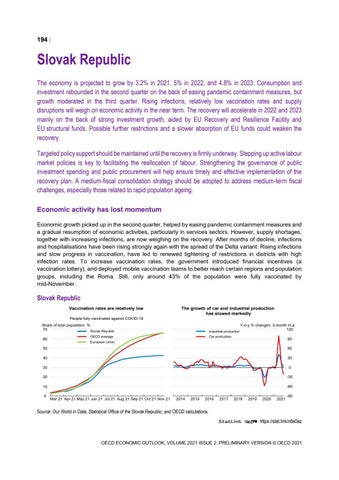
Slovak Republic The economy is projected to grow by 3.2% in 2021, 5% in 2022, and 4.8% in 2023. Consumption and investment rebounded in the second quarter on the back of easing pandemic containment measures, but growth moderated in the third quarter. Rising infections, relatively low vaccination rates and supply disruptions will weigh on economic activity in the near term. The recovery will accelerate in 2022 and 2023 mainly on the back of strong investment growth, aided by EU Recovery and Resilience Facility and EU structural funds. Possible further restrictions and a slower absorption of EU funds could weaken the recovery. Targeted policy support should be maintained until the recovery is firmly underway. Stepping up active labour market policies is key to facilitating the reallocation of labour. Strengthening the governance of public investment spending and public procurement will help ensure timely and effective implementation of the recovery plan. A medium-fiscal consolidation strategy should be adopted to address medium-term fiscal challenges, especially those related to rapid population ageing. Economic activity has lost momentum Economic growth picked up in the second quarter, helped by easing pandemic containment measures and a gradual resumption of economic activities, particularly in services sectors. However, supply shortages, together with increasing infections, are now weighing on the recovery. After months of decline, infections and hospitalisations have been rising strongly again with the spread of the Delta variant. Rising infections and slow progress in vaccination, have led to renewed tightening of restrictions in districts with high infection rates. To increase vaccination rates, the government introduced financial incentives (a vaccination lottery), and deployed mobile vaccination teams to better reach certain regions and population groups, including the Roma. Still, only around 43% of the population were fully vaccinated by mid-November.
Slovak Republic Vaccination rates are relatively low
The growth of car and industrial production has slowed markedly
People fully vaccinated against COVID-19 Share of total population, % 70 Slovak Republic 60
Industrial production
OECD average
Y-o-y % changes, 3-month m.a. 120
Car production
90
European Union
50
60
40
30
30
0
20
-30
10
-60
0
Mar 21 Apr 21 May 21 Jun 21 Jul 21 Aug 21 Sep 21 Oct 21 Nov 21
2014
2015
2016
2017
2018
2019
2020
2021
-90
Source: Our World in Data; Statistical Office of the Slovak Republic; and OECD calculations. StatLink 2 https://stat.link/n8e0az
OECD ECONOMIC OUTLOOK, VOLUME 2021 ISSUE 2: PRELIMINARY VERSION © OECD 2021
195
Slovak Republic: Demand, output and prices 2018
Slovak Republic GDP at market prices Private consumption Government consumption Gross fixed capital formation Final domestic demand Stockbuilding¹ Total domestic demand Exports of goods and services Imports of goods and services Net exports¹ Memorandum items GDP deflator Harmonised index of consumer prices Harmonised index of core inflation² Unemployment rate (% of labour force) Household saving ratio, net (% of disposable income) General government financial balance (% of GDP) General government gross debt (% of GDP) General government debt, Maastricht definition³ (% of GDP) Current account balance (% of GDP)
2019
2020
2021
2022
2023
Percentage changes, volume (2015 prices)
Current prices EUR billion
89.4 50.4 16.7 18.8
2.6 2.7 4.6 6.7
-4.4 -1.5 0.9 -11.6
3.2 1.1 3.3 -0.7
5.0 3.6 2.8 15.0
4.8 2.9 0.7 14.5
85.9 2.0
3.9 0.0
-3.2 -2.2
1.2 2.6
5.6 0.1
4.8 0.0
87.8 86.0 84.5 1.6
3.9 0.8 2.1 -1.2
-5.1 -7.4 -8.4 0.9
3.9 10.7 11.5 -0.5
5.5 2.6 3.2 -0.5
4.7 5.6 5.4 0.1
_ _ _ _ _ _ _ _ _
2.5 2.8 2.0 5.8
2.4 2.0 2.4 6.7
2.2 2.6 2.9 7.0
3.5 4.1 3.0 6.4
2.3 2.5 2.4 5.8
4.1 -1.3 63.4 48.1 -2.7
5.1 -5.5 79.3 59.7 -0.4
5.2 -6.7 80.0 60.5 -1.1
3.2 -4.4 77.7 58.2 -2.2
3.2 -2.5 76.2 56.7 -1.9
1. Contributions to changes in real GDP, actual amount in the first column. 2. Harmonised index of consumer prices excluding food, energy, alcohol and tobacco. 3. The Maastricht definition of general government debt includes only loans, debt securities, and currency and deposits, with debt at face value rather than market value. Source: OECD Economic Outlook 110 database.
StatLink 2 https://stat.link/46zexo
Quarterly GDP growth slowed to around 0.4% in the third quarter of 2021. Car manufacturers have had to suspend production temporarily owing to supply shortages of semiconductors, leading to a marked slowdown in industrial production and exports. Car sales have fallen sharply recently. High-frequency activity indicators, such as the Google location-based measures of retail and recreation mobility, have also fallen. At the same time, harmonised consumer price inflation surged, to 4.4% in October, on the back of rising energy and food prices, a tax increase on tobacco, and higher prices of construction input materials.
Several COVID-19 fiscal support measures have been extended Short-term work schemes, grants for firms and self-employed workers as well as sickness and care benefits have been extended until the end of December 2021. The budget foresees a gradual phasing-out of emergency pandemic measures in 2022 and the medium-term plan foresees additional structural consolidation in 2023. This will be partially offset by the use of grants from the EU Recovery and Resilience Facility, which could amount up to EUR 6.3 billion (6.3% of annual GDP) in total over the period 2021-2026. The Ministry of Finance expects the country to draw around 40% of the total funds from the EU Recovery and Resilience Facility by 2023, mainly for investment.
OECD ECONOMIC OUTLOOK, VOLUME 2021 ISSUE 2: PRELIMINARY VERSION © OECD 2021
196
The recovery is set to accelerate GDP growth will accelerate in 2022 and remain strong in 2023, driven by robust investment related to the EU recovery and structural funds. Private consumption will strengthen, as the health situation improves in the course of the first half of 2022, the labour market further recovers, and household savings gradually normalise. Higher administered energy prices will put upward pressure on inflation in 2022. Wage growth will also increase in the private sector though remain contained in the public sector. Inflation will however slow as supply chain bottlenecks and order backlogs gradually ease from mid-2022, as assumed. Inflation could be higher if supply constraints are prolonged and input price pressures are more strongly passed on to consumer prices. A slower absorption of EU funds would curb investment growth. Private consumption could be weaker if the development of the health situation requires stricter measures.
Policies are needed for a sustainable recovery The government should stand ready to maintain policy support in the near-term, targeted to people and sectors that may be affected by renewed restrictions. Stepping up active labour market policies, notably re-training measures, is crucial to facilitate workforce reallocation. The recovery plan foresees ambitious investment and reforms especially for the transition to a low-carbon economy, education, healthcare, and innovation. To ensure a timely and effective implementation of the recovery plan, the governance of public investment spending and public procurement should be further strengthened. The government should adopt a medium-term fiscal consolidation strategy to address fiscal challenges, especially those associated with the rapidly ageing population. The strategy should include reforming pensions, health and long-term care, and mobilising underutilised labour resources.
OECD ECONOMIC OUTLOOK, VOLUME 2021 ISSUE 2: PRELIMINARY VERSION © OECD 2021