200
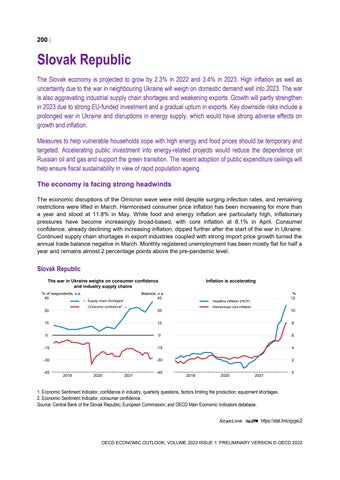
Slovak Republic The Slovak economy is projected to grow by 2.3% in 2022 and 3.4% in 2023. High inflation as well as uncertainty due to the war in neighbouring Ukraine will weigh on domestic demand well into 2023. The war is also aggravating industrial supply chain shortages and weakening exports. Growth will partly strengthen in 2023 due to strong EU-funded investment and a gradual upturn in exports. Key downside risks include a prolonged war in Ukraine and disruptions in energy supply, which would have strong adverse effects on growth and inflation. Measures to help vulnerable households cope with high energy and food prices should be temporary and targeted. Accelerating public investment into energy-related projects would reduce the dependence on Russian oil and gas and support the green transition. The recent adoption of public expenditure ceilings will help ensure fiscal sustainability in view of rapid population ageing. The economy is facing strong headwinds The economic disruptions of the Omicron wave were mild despite surging infection rates, and remaining restrictions were lifted in March. Harmonised consumer price inflation has been increasing for more than a year and stood at 11.8% in May. While food and energy inflation are particularly high, inflationary pressures have become increasingly broad-based, with core inflation at 8.1% in April. Consumer confidence, already declining with increasing inflation, dipped further after the start of the war in Ukraine. Continued supply chain shortages in export industries coupled with strong import price growth turned the annual trade balance negative in March. Monthly registered unemployment has been mostly flat for half a year and remains almost 2 percentage points above the pre-pandemic level.
Slovak Republic The war in Ukraine weighs on consumer confidence and industry supply chains % of respondents, s.a. 45
Balance, s.a. 45
← Supply chain shortages¹ Consumer confidence² →
30
Inflation is accelerating % 12
Headline inflation (HICP) Harmonised core inflation
30
10
15
15
8
0
0
6
-15
-15
4
-30
-30
2
-45
2019
2020
2021
-45
2019
2020
2021
0
1. Economic Sentiment Indicator, confidence in industry, quarterly questions, factors limiting the production: equipment shortages. 2. Economic Sentiment Indicator, consumer confidence. Source: Central Bank of the Slovak Republic; European Commission; and OECD Main Economic Indicators database. StatLink 2 https://stat.link/qygsc2
OECD ECONOMIC OUTLOOK, VOLUME 2022 ISSUE 1: PRELIMINARY VERSION © OECD 2022
201
Slovak Republic: Demand, output and prices 2018
Slovak Republic GDP at market prices Private consumption Government consumption Gross fixed capital formation
2019
2020
2021
2022
2023
Percentage changes, volume (2015 prices)
Current prices EUR billion
89.4 50.4 16.7 18.8
2.6 2.7 4.6 6.7
-4.4 -1.5 0.9 -11.6
3.0 1.4 1.9 0.6
2.3 1.7 -0.2 13.9
3.4 0.5 0.1 15.0
Final domestic demand Stockbuilding¹
85.9 2.0
3.9 0.0
-3.2 -2.2
1.3 2.4
3.6 -0.6
3.5 0.0
Total domestic demand Exports of goods and services Imports of goods and services Net exports¹
87.8 86.0 84.5 1.6
3.9 0.8 2.1 -1.2
-5.1 -7.4 -8.4 0.9
3.8 10.2 11.1 -0.6
2.9 1.0 1.7 -0.6
3.4 4.3 4.3 -0.2
_ _ _ _ _ _ _ _ _
2.5 2.8 2.0 5.8
2.4 2.0 2.4 6.7
2.4 2.8 3.3 6.8
7.9 10.8 7.1 6.7
8.4 10.1 7.3 6.4
4.1 -1.3 63.4 48.1 -3.4
5.1 -5.5 79.3 59.7 0.1
5.4 -6.2 81.7 63.1 -2.0
3.4 -4.5 81.3 62.7 -4.7
2.4 -2.4 78.2 59.6 -4.3
Memorandum items GDP deflator Harmonised index of consumer prices Harmonised index of core inflation² Unemployment rate (% of labour force) Household saving ratio, net (% of disposable income) General government financial balance (% of GDP) General government gross debt (% of GDP) General government debt, Maastricht definition³ (% of GDP) Current account balance (% of GDP)
1. Contributions to changes in real GDP, actual amount in the first column. 2. Harmonised index of consumer prices excluding food, energy, alcohol and tobacco. 3. The Maastricht definition of general government debt includes only loans, debt securities, and currency and deposits, with debt at face value rather than market value. Source: OECD Economic Outlook 111 database.
StatLink 2 https://stat.link/sporbg
The war has reinforced pre-existing headwinds. Industrial production contracted already in February. At least two car plants had to temporarily suspend production in March and April due to shortages in components from Ukraine in addition to continued disruptions in global semi-conductor supply chains. The Slovak Republic is highly dependent on Russian supply for oil and gas, with the main pipelines for both commodities coming from Russia via Ukraine. Around 78 000 refugees from Ukraine (equivalent to 1.5% of the Slovak population) have applied for temporary protection status in the Slovak Republic, and about 10% have become employed, as of late May 2022. The influx of refugees temporarily increased accommodation revenues especially in eastern regions. A majority of refugees are children and women.
Fiscal measures are being taken in response to the war and the increase in the cost of living A nominal freeze of household electricity prices until 2024 was negotiated with the main utility provider. Parliament approved a package to mitigate the increase in costs of living with estimated fiscal costs of around 0.3% of GDP in 2022 and 1% of GDP in 2023. While some (0.1% of GDP) are targeted one-off payments, the bulk of the package consists of permanent increases in family benefits, such as child benefits and child tax credits. Pandemic measures are being phased out further in 2022. The projections assume a mildly restrictive fiscal stance in 2022 and, in line with the latest stability programme, that structural consolidation gathers pace in 2023. Costs associated with hosting refugees (0.4% of GDP) are OECD ECONOMIC OUTLOOK, VOLUME 2022 ISSUE 1: PRELIMINARY VERSION © OECD 2022
202 largely covered by the European Commission. Funds from the EU Recovery and Resilience Facility of about 1.4% of GDP per year over 2022-25 will boost public investment. In addition, Slovakia has until end2023 to draw on its remaining 2014-2020 EU cohesion policy funds, of which around half (worth about 7% of GDP) are still unused.
The war weighs on the recovery Growth is projected to slow in 2022, as the war in Ukraine adds to already high inflation through higher energy and food prices, weighing on household disposable income and private consumption. Export growth will slow, due to weaker external demand and intensified supply-chain disruptions in exportintensive manufacturing industries, especially the automotive sector. Growth will strengthen in 2023 mainly due to strong investment, driven by the absorption of EU funds. Inflation will stay in double-digits throughout 2022 and will recede only slightly in 2023, as external price pressures wane but delayed pass-through of the current high energy prices to regulated heating and gas prices keeps inflation high. The main downside risk is a prolonged war in Ukraine, which would jeopardise the gradual recovery of consumption and exports in 2023. While oil imports from Russia are currently exempt from the EU embargo, disruptions in Russian oil and gas supply would lead to energy shortages. Moreover, the Slovak Republic is vulnerable to future waves of COVID-19 given the low vaccination rate of its population. A prolonged shutdown in China could also intensify supply disruptions. On the upside, a stronger integration of Ukrainian refugees into the labour market would lead to higher growth.
Fiscal support should be targeted on vulnerable households and investments to support the green transition Fiscal support for households should be better targeted to the most vulnerable households, to avoid adding to existing price pressures. Most of the recently approved measures are permanent and need to be sustainably financed to avoid jeopardising long-term fiscal sustainability. Labour market integration of Ukrainian refugees who are willing and able to work should be facilitated, for example by offering language training and childcare. The recovery plan allocates substantial investments for the energy transition, enhancing energy security and reducing carbon intensity. Investment in these areas should be accelerated. Strengthening the governance of public investment and procurement would help accelerate Slovakia’s chronically slow absorption of EU funds and support the timely implementation of investment projects. Structural reforms to training and other active labour market policies would support labour reallocation during the green transition.
OECD ECONOMIC OUTLOOK, VOLUME 2022 ISSUE 1: PRELIMINARY VERSION © OECD 2022