233
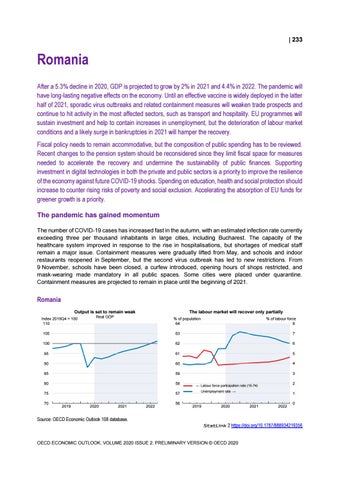
Romania After a 5.3% decline in 2020, GDP is projected to grow by 2% in 2021 and 4.4% in 2022. The pandemic will have long-lasting negative effects on the economy. Until an effective vaccine is widely deployed in the latter half of 2021, sporadic virus outbreaks and related containment measures will weaken trade prospects and continue to hit activity in the most affected sectors, such as transport and hospitality. EU programmes will sustain investment and help to contain increases in unemployment, but the deterioration of labour market conditions and a likely surge in bankruptcies in 2021 will hamper the recovery. Fiscal policy needs to remain accommodative, but the composition of public spending has to be reviewed. Recent changes to the pension system should be reconsidered since they limit fiscal space for measures needed to accelerate the recovery and undermine the sustainability of public finances. Supporting investment in digital technologies in both the private and public sectors is a priority to improve the resilience of the economy against future COVID-19 shocks. Spending on education, health and social protection should increase to counter rising risks of poverty and social exclusion. Accelerating the absorption of EU funds for greener growth is a priority. The pandemic has gained momentum The number of COVID-19 cases has increased fast in the autumn, with an estimated infection rate currently exceeding three per thousand inhabitants in large cities, including Bucharest. The capacity of the healthcare system improved in response to the rise in hospitalisations, but shortages of medical staff remain a major issue. Containment measures were gradually lifted from May, and schools and indoor restaurants reopened in September, but the second virus outbreak has led to new restrictions. From 9 November, schools have been closed, a curfew introduced, opening hours of shops restricted, and mask-wearing made mandatory in all public spaces. Some cities were placed under quarantine. Containment measures are projected to remain in place until the beginning of 2021.
Romania Output is set to remain weak Index 2019Q4 = 100 110
The labour market will recover only partially
Real GDP
% of population 64
% of labour force 8
105
63
7
100
62
6
95
61
5
90
60
4
85
59
3
80
58
75
57
70
2019
2020
2021
2022
0
56
2
← Labour force participation rate (15-74) Unemployment rate →
2019
2020
1 2021
2022
0
Source: OECD Economic Outlook 108 database. StatLink 2 https://doi.org/10.1787/888934219356 OECD ECONOMIC OUTLOOK, VOLUME 2020 ISSUE 2: PRELIMINARY VERSION © OECD 2020
234 ď ź
Romania: Demand, output and prices 2017
2018
GDP at market prices Private consumption Government consumption Gross fixed capital formation Final domestic demand Stockbuilding1 Total domestic demand Exports of goods and services Imports of goods and services Net exports1
2020
2021
2022
Percentage changes, volume (2010 prices)
Current prices RON billion
Romania
2019
857.9 543.3 134.8 192.2 870.3 8.7 879.1 360.5 381.7 - 21.2
4.5 7.7 3.3 -1.1 5.1 0.8 5.9 5.3 8.6 -1.6
4.2 5.5 6.0 17.8 8.3 -2.9 5.2 4.0 6.5 -1.3
-5.3 -7.3 3.4 -0.9 -3.5 0.0 -3.4 -15.6 -9.9 -1.9
2.0 2.6 3.5 2.0 2.7 -0.4 2.4 3.3 4.3 -0.6
4.4 5.1 1.0 6.3 4.6 0.0 4.8 5.4 6.2 -0.6
_ _ _ _ _ _ _ _ _
6.2 4.6 2.8 4.2 -6.4 -2.9 43.6 34.7 -4.4
6.9 3.8 3.2 3.9 -5.5 -4.4 44.3 35.3 -4.7
2.9 2.8 3.7 5.5 0.8 -9.0 53.9 44.9 -4.6
2.6 2.2 2.3 7.0 -2.8 -9.4 62.0 52.9 -4.9
2.6 2.1 2.1 6.3 -4.1 -7.1 66.4 57.4 -4.8
Memorandum items GDP deflator Consumer price index Core consumer price index2 Unemployment rate (% of labour force) Household saving ratio, net (% of disposable income) General government financial balance (% of GDP) General government gross debt (% of GDP) General government debt, Maastricht definition (% of GDP) Current account balance (% of GDP) 1. Contributions to changes in real GDP, actual amount in the first column. 2. Consumer price index excluding food and energy. Source: OECD Economic Outlook 108 database.
StatLink 2 https://doi.org/10.1787/888934219375
The virus surge is undermining the recovery After a rather quick resumption of activity following the easing of containment measures from May, the recovery has lost momentum. Droughts have negatively affected agriculture. High spare capacity in manufacturing reflects weak external demand. Retail sales almost reached pre-crisis levels, but lost momentum. The increasing number of cases and political turbulences have weighed on confidence and the economic sentiment remains well below historical levels. Labour market conditions have deteriorated with a decline in job vacancies and a rise of the unemployment rate by around 2 percentage points since January 2020.
Public finance support is limited The future fiscal stance is uncertain due to upcoming legislative elections. It is expected to remain mildly supportive over the projection period. The 40% increase in the pension point value, voted in September, but not promulgated yet, is projected to be partly reversed due to its strong negative impact on the sustainability of the public finances. EU funds will promote public investment in transport infrastructure and finance labour market programmes, but absorption rates will likely remain relatively weak due to limited administrative capacity. Monetary policy has been supportive, with three policy rate cuts in March, June and August and government bond purchases. The central bank should continue to play its stabilising role in financial markets.
OECD ECONOMIC OUTLOOK, VOLUME 2020 ISSUE 2: PRELIMINARY VERSION Š OECD 2020
235
The pandemic will have long-lasting effects on the economy GDP is set to contract by 5.3% in 2020, before expanding by 2% in 2021 and 4.4% in 2022. A weak external environment, especially in the European Union, will limit export prospects and business investment. After a 70% decline in the first eight months of the year, foreign direct investment will continue to be low. Possible sporadic virus outbreaks will continue to require targeted local containment measures and limit demand for services requiring physical proximity until immunisation is widespread. High job losses, slower wage growth, lower remittances and reduced fiscal stimulus will weigh on households’ purchasing power. Public debt (Maastricht definition) is set to increase fast, to 57% of GDP in 2022, due to high budget deficits. The main downside risks to the projections relate to fiscal policy. Full implementation of the 40% increase in pensions could push the budget deficit up to 11% of GDP. This could result in a downgrade of Romania’s sovereign debt rating, undermining access to financial markets. By contrast, a faster absorption of EU funds and increased political stability could stimulate investment and job creation.
Improving spending efficiency can enhance economic potential and well-being A reallocation of spending to areas supporting economic potential, especially education, health and infrastructure, could pave the way to a sustainable recovery. The priority is to contain the pandemic by implementing fast testing, strict tracing, tracking and isolation, and by providing sufficient resources to the healthcare sector. Public support for those in need should be strengthened. The long awaited reform of social assistance that streamlines and improves the targeting of social benefits should be pursued. Fostering the digital transformation is crucial, especially in schools to ensure all have access to online education during lockdowns and in firms to foster teleworking. Amid concerns about air quality, speeding up the transition from fossil fuels to cleaner and more affordable energy sources is urgent, as it would improve health and environment outcomes while reducing vulnerability to pandemics. Finally, streamlining the permits and licensing system can remove unnecessary barriers to business dynamism.
OECD ECONOMIC OUTLOOK, VOLUME 2020 ISSUE 2: PRELIMINARY VERSION © OECD 2020