191
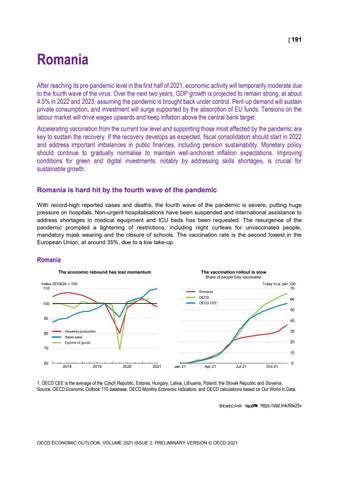
Romania After reaching its pre-pandemic level in the first half of 2021, economic activity will temporarily moderate due to the fourth wave of the virus. Over the next two years, GDP growth is projected to remain strong, at about 4.5% in 2022 and 2023, assuming the pandemic is brought back under control. Pent-up demand will sustain private consumption, and investment will surge supported by the absorption of EU funds. Tensions on the labour market will drive wages upwards and keep inflation above the central bank target. Accelerating vaccination from the current low level and supporting those most affected by the pandemic are key to sustain the recovery. If the recovery develops as expected, fiscal consolidation should start in 2022 and address important imbalances in public finances, including pension sustainability. Monetary policy should continue to gradually normalise to maintain well-anchored inflation expectations. Improving conditions for green and digital investments, notably by addressing skills shortages, is crucial for sustainable growth. Romania is hard hit by the fourth wave of the pandemic With record-high reported cases and deaths, the fourth wave of the pandemic is severe, putting huge pressure on hospitals. Non-urgent hospitalisations have been suspended and international assistance to address shortages in medical equipment and ICU beds has been requested. The resurgence of the pandemic prompted a tightening of restrictions, including night curfews for unvaccinated people, mandatory mask wearing and the closure of schools. The vaccination rate is the second lowest in the European Union, at around 35%, due to a low take-up.
Romania The economic rebound has lost momentum
The vaccination rollout is slow Share of people fully vaccinated
Index 2019Q4 = 100 110
7-day m.a. per 100 70
Romania OECD
60
OECD CEE¹
100
50 90
80
40 30
Industrial production Retail sales
20
Exports of goods
70
60
10 2018
2019
2020
0 2021
0 Jan 21
Apr 21
Jul 21
Oct 21
0
1. OECD CEE is the average of the Czech Republic, Estonia, Hungary, Latvia, Lithuania, Poland, the Slovak Republic and Slovenia. Source: OECD Economic Outlook 110 database; OECD Monthly Economic Indicators; and OECD calculations based on Our World in Data. StatLink 2 https://stat.link/6tw25v
OECD ECONOMIC OUTLOOK, VOLUME 2021 ISSUE 2: PRELIMINARY VERSION © OECD 2021
192
Romania: Demand, output and prices 2018
2019
GDP at market prices Private consumption Government consumption Gross fixed capital formation Final domestic demand Stockbuilding¹ Total domestic demand Exports of goods and services Imports of goods and services Net exports¹ Memorandum items GDP deflator Consumer price index Core consumer price index² Unemployment rate (% of labour force) General government financial balance (% of GDP) General government gross debt (% of GDP) General government debt, Maastricht definition³ (% of GDP) Current account balance (% of GDP)
2021
2022
2023
Percentage changes, volume (2010 prices)
Current prices RON billion
Romania
2020
951.7 607.3 160.1 200.4
4.1 4.1 6.9 13.0
-3.9 -5.2 2.0 6.8
6.3 4.1 1.6 7.5
4.5 4.5 2.6 8.3
4.5 4.1 2.1 9.8
967.8 16.4
6.4 -1.2
-1.1 -1.4
4.6 3.0
5.1 -0.5
5.2 0.0
984.2 398.4 430.9 - 32.5
5.1 4.6 6.8 -1.2
-2.4 -9.7 -5.1 -1.6
7.6 11.3 14.6 -1.9
4.4 6.1 5.6 -0.1
5.0 4.9 5.9 -0.7
6.8 3.8 3.2 3.9 -4.4 44.5 35.3 -4.9
3.8 2.6 3.7 5.0 -9.4 59.4 47.4 -5.0
5.3 4.9 4.5 5.1 -8.0 62.4 50.3 -6.5
5.3 5.6 4.3 4.8 -6.6 66.1 54.1 -6.1
3.9 3.6 3.6 4.4 -5.3 69.1 57.1 -6.1
_ _ _ _ _ _ _ _
1. Contributions to changes in real GDP, actual amount in the first column. 2. Consumer price index excluding food and energy. 3. The Maastricht definition of general government debt includes only loans, debt securities, and currency and deposits, with debt at face value rather than market value. Source: OECD Economic Outlook 110 database.
StatLink 2 https://stat.link/3byroj
The economic recovery has slowed After a strong recovery in the first half of 2021, economic activity has been cooling. Supply-chain disruptions have damped manufacturing activity, which was already on a declining path before the pandemic. The rapid growth in coronavirus infections has hurt confidence. Consumer spending has remained robust, but lost momentum on the back of lower pent-up demand and price increases. Inflation has surged, far above the central bank target band, mainly driven by sharp increases in food and energy prices. Underlying inflationary pressures have built up due to the relatively fast pass-through of higher production costs into consumer prices. Average wage growth has remained solid, reaching 7% over the first eight months of 2021. Labour market conditions have improved, with the number of registered unemployed close to its pre-crisis level.
Macroeconomic policies will remain supportive Monetary policy should continue to normalise gradually over the next two years, as the economic recovery progresses. Policy interest rates are projected to converge to their pre-crisis level by the end of 2023. The government committed to reduce the budget deficit from 9.4% in 2020 to below 3% by 2024. Despite the progressive withdrawal of emergency measures and higher-than-expected tax revenues due to the strong economic performance, the fiscal stance will tighten only slightly in 2021. Fiscal consolidation is set to OECD ECONOMIC OUTLOOK, VOLUME 2021 ISSUE 2: PRELIMINARY VERSION © OECD 2021
193 continue in 2022, sustained by improved tax collection. Public investment will surge, exceeding 5% of GDP by the second half of 2023, with increased absorption of European funds granted under the Cohesion policy and the Next Generation EU plan.
Risks to the outlook are high At around 4.5% in 2022 and 2023, GDP growth is expected to remain robust, under the assumption that the health situation will progressively improve and containment measures will be phased out. Business investment will firm, helped by the disbursement of EU funds and external demand. Private consumption will continue to support activity, helped by a fall in the household saving ratio. A tighter labour market will push wages up, maintaining inflationary pressures. As the impact of past increases in commodity prices fades, inflation will edge down to around 3.5% by the end of 2023. The recovery of supply chains will sustain exports of goods, including cars, but rising production costs will limit gains in export market shares in the medium term. The current account will remain in deficit, due to strong demand for imports. The main risks to the outlook stem from the evolution of the pandemic. Deeper labour shortages, persistent supplychain bottlenecks, and rising energy prices could also accentuate inflation pressures and dampen external and domestic demand. In contrast, productivity-enhancing reforms and investments envisaged under the recovery and resilience plan could materialise faster than expected, with a positive impact on competitiveness and growth.
Policy measures can improve economic potential and resilience Encouraging a high take-up of vaccines is critical to limit the human and economic costs of the health crisis. Maintaining support to those affected by the pandemic and providing adequate resources to the healthcare sector to tackle the consequences of the fourth wave is a key priority. Over the medium run, improving the business environment by reducing the administrative burden on firms, providing adequate transport infrastructure and easing access to training is crucial to foster private investment and address labour shortages. The transition to greener energy sources should also accelerate to reduce reliance on fossil fuels and reduce air pollution from current high levels. The effective implementation of the Recovery and Resilience Plan, especially of the planned structural reforms, will be key to put growth on a sustainable path. In particular, reforms of the pension and the tax systems are needed to restore the sustainability of public finances.
OECD ECONOMIC OUTLOOK, VOLUME 2021 ISSUE 2: PRELIMINARY VERSION © OECD 2021