197
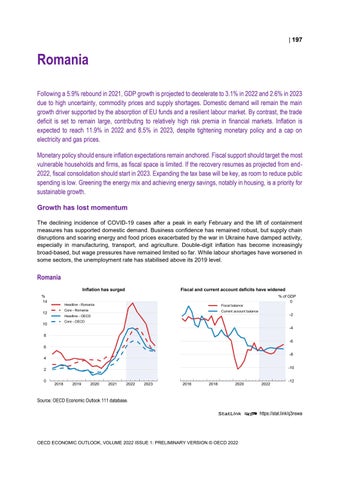
Romania Following a 5.9% rebound in 2021, GDP growth is projected to decelerate to 3.1% in 2022 and 2.6% in 2023 due to high uncertainty, commodity prices and supply shortages. Domestic demand will remain the main growth driver supported by the absorption of EU funds and a resilient labour market. By contrast, the trade deficit is set to remain large, contributing to relatively high risk premia in financial markets. Inflation is expected to reach 11.9% in 2022 and 8.5% in 2023, despite tightening monetary policy and a cap on electricity and gas prices. Monetary policy should ensure inflation expectations remain anchored. Fiscal support should target the most vulnerable households and firms, as fiscal space is limited. If the recovery resumes as projected from end2022, fiscal consolidation should start in 2023. Expanding the tax base will be key, as room to reduce public spending is low. Greening the energy mix and achieving energy savings, notably in housing, is a priority for sustainable growth. Growth has lost momentum The declining incidence of COVID-19 cases after a peak in early February and the lift of containment measures has supported domestic demand. Business confidence has remained robust, but supply chain disruptions and soaring energy and food prices exacerbated by the war in Ukraine have damped activity, especially in manufacturing, transport, and agriculture. Double-digit inflation has become increasingly broad-based, but wage pressures have remained limited so far. While labour shortages have worsened in some sectors, the unemployment rate has stabilised above its 2019 level.
Romania Inflation has surged % 14 12
Fiscal and current account deficits have widened % of GDP 0
Headline - Romania
Fiscal balance
Core - Romania
Current account balance
-2
Headline - OECD Core - OECD
10
-4
8 -6 6 -8
4
-10
2 0
2018
2019
2020
2021
2022
2023
0
0
2016
2018
2020
2022
-12
Source: OECD Economic Outlook 111 database. StatLink 2 https://stat.link/q3nswa
OECD ECONOMIC OUTLOOK, VOLUME 2022 ISSUE 1: PRELIMINARY VERSION © OECD 2022
198
Romania: Demand, output and prices 2018
2019
GDP at market prices Private consumption Government consumption Gross fixed capital formation
2021
2022
2023
Percentage changes, volume (2010 prices)
Current prices RON billion
Romania
2020
951.7 607.3 160.1 200.4
4.2 3.9 7.3 12.9
-3.7 -5.1 1.8 4.1
5.9 7.9 0.4 2.3
3.1 2.2 1.2 2.4
2.6 2.1 1.7 7.1
Final domestic demand Stockbuilding¹
967.8 16.4
6.4 -0.6
-1.7 -0.7
5.3 1.3
2.3 -0.3
3.2 -0.2
Total domestic demand Exports of goods and services Imports of goods and services Net exports¹
984.2 398.4 430.9 - 32.5
5.6 5.4 8.6 -1.6
-2.4 -9.4 -5.2 -1.5
6.8 12.5 14.6 -1.4
3.0 4.9 4.6 -0.1
2.9 3.9 4.3 -0.4
6.8 3.8 3.2 4.9 -4.3 44.5 35.3 -4.9
3.9 2.6 3.7 6.1 -9.3 59.2 47.2 -5.0
5.4 5.0 4.5 5.6 -7.1 57.3 48.8 -7.0
7.9 11.9 7.9 5.8 -7.5 61.7 53.2 -7.2
8.1 8.5 6.7 5.7 -7.0 65.1 56.6 -7.1
Memorandum items GDP deflator Consumer price index Core consumer price index² Unemployment rate (% of labour force) General government financial balance (% of GDP) General government gross debt (% of GDP) General government debt, Maastricht definition³ (% of GDP) Current account balance (% of GDP)
_ _ _ _ _ _ _ _
1. Contributions to changes in real GDP, actual amount in the first column. 2. Consumer price index excluding food and energy. 3. The Maastricht definition of general government debt includes only loans, debt securities, and currency and deposits, with debt at face value rather than market value. Source: OECD Economic Outlook 111 database.
StatLink 2 https://stat.link/5gofbe
Direct trade and financial links to Russia and Ukraine are limited. Around 70% of energy demand is covered by domestic production. However, spillovers from the war, including through supply shortages (such as components imported from Ukraine in the automotive sector), have hit activity. In addition, reliance on Russia for energy imports, especially of crude oil, is high. Romania has received one of the largest inflows of Ukrainian refugees in Europe. The impact on the labour market should be limited as most of them are expected to leave the country. Only around 4 300 (0.5%) have asked for asylum in the country as of early May. Sovereign bond spreads have widened, reaching their highest level since the global financial crisis, signalling significant rises in risk premia.
Policies will remain accommodative In response to inflationary pressures and tightening monetary policies in the region, the central bank is set to continue raising its policy rate from 3.75% to 6% by the end of 2022. The fiscal deficit is projected to widen in 2022, due to slowing activity, additional spending on defence and temporary measures to cushion the adverse effects of the war in Ukraine. A cap on electricity and gas prices is in place until March 2023 to shield consumers’ purchasing power. Support measures, amounting to around 1.5% of GDP, also include vouchers for low-income households and grants for most affected sectors. Public investment financed with EU funds will pick up at the end of 2022. The implementation of the Next Generation EU Plan is expected to be delayed, with only around 20% of the total allocation absorbed by 2023. Fiscal consolidation will start slowly in 2023, as support measures are phased out.
OECD ECONOMIC OUTLOOK, VOLUME 2022 ISSUE 1: PRELIMINARY VERSION © OECD 2022
199
Inflationary pressures will continue to weigh on growth After a strong rebound in the first quarter, GDP growth is expected to decelerate to 3.1% in 2022, and 2.6% in 2023. Slowing activity in Europe and high uncertainty will weigh on exports, business investment and job creation. The absence of major tensions on the labour market will keep wage growth moderate. Households’ purchasing power will decline, holding back consumption. Inflation is projected to remain well above the upper bound of the central bank target, due to the end of the capping scheme on electricity and gas and the EU embargo on Russian oil imports in 2023. The main risks to the recovery relate to stronger and persistent increases in commodity prices and to possible disruptions in energy supply that would undermine firms’ capacity to operate and invest. Capital outflows and tightening financing conditions could jeopardise access to credit and reduce fiscal space. Other risks include the emergence of new virus variants that would require restrictions, as Romania is among the EU countries with the lowest vaccination rates. Conversely, the faster use of EU funds would support activity, especially if directed to infrastructure projects.
Targeted policies can support sustainable growth A prudent policy mix will be key to avoiding an inflationary spiral and unsustainable increases in borrowing costs. Fiscal consolidation would help to reduce demand pressures and maintain external credibility. Expanding the tax base, notably by removing special tax regimes and exemptions would improve public finance sustainability and make the tax system more equitable. At the same time, improving the coverage and adequacy of the social assistance system would reinforce support to vulnerable households. The high reliance on fossil fuels calls for accelerating investment in renewable energy sources by extending support to new installations and developing adequate grid infrastructure. Accelerating building refurbishment in deprived areas can achieve large efficiency gains and help to reduce energy poverty. Such measures, which can both improve energy security and help to meet decarbonisation targets, require increasing administrative capacity to absorb EU funds.
OECD ECONOMIC OUTLOOK, VOLUME 2022 ISSUE 1: PRELIMINARY VERSION © OECD 2022