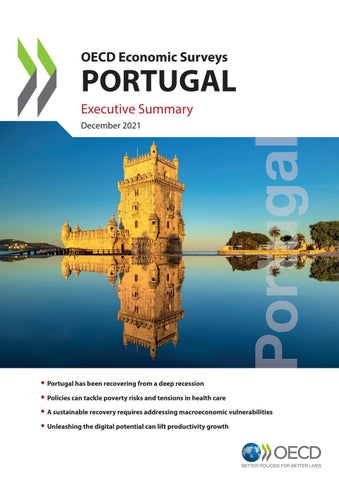
OECD Economic Surveys OECD Economic Surveys PORTUGAL
PORTUGAL Executive Summary
NCH N
U
IO
• Portugal has been recovering from a deep recession • Policies can tackle poverty risks and tensions in health care • A sustainable recovery requires addressing macroeconomic vulnerabilities • Unleashing the digital potential can lift productivity growth
LA
DECEMBER 2021 December 2021
VE S R
2 . OECD ECONOMIC SURVEY OF PORTUGAL – EXECUTIVE SUMMARY
Main findings Policies for a stronger and resilient recovery • The economic recovery can be slow due to containment measures needed to limit the spread of the virus. • Public debt exceeds 130% of GDP and increased contingent liabilities can complicate fiscal consolidation. Details on the strategy to contain public spending in the coming years are missing. • Available EU funds, including under Next Generation EU plan, will reach record levels. Absorption might be slow due to hurdles in designing, approving and implementing programmes. • Population ageing puts pressure on the financial sustainability of the pension system.
• Corporate sector vulnerabilities have increased. Insolvencies are likely to surge after the end of the moratorium on credit instalments, in spite of a new relief measure. The government has started to reinforce support to the capitalisation of firms. • A surge in insolvencies could translate into a marked increase in credit defaults. • Courts have a large backlog in insolvency cases that risks increasing significantly. • Rules on conflict of interest for statespersons are not strict. There are no specific rules for Members of Parliament on how to engage with the private sector and lobbyists. Addressing social and environmental challenges in crisis time • Like in several other OECD countries, the pandemic hit Portugal hard, putting huge pressure on the healthcare sector, which was compounded by shortages of healthcare professionals. The number of nurses and long-term care workers per inhabitant has been low compared to the OECD average. • The COVID-19 crisis has triggered major changes in the labour market. Employment prospects have deteriorated for the youth and the low skilled. • Meeting the new ambitious climate objectives and reducing air pollution in large cities will require reducing greenhouse gas emissions in the transport sector. • While there are plans to increase resources for upgrading water infrastructure, they will be too low to ensure high quality services and avoid leakages. Municipalities lack expertise to design and implement water infrastructure projects. Reaping the benefits of the digital transition • The prices of broadband are relatively high. High market concentration in the telecommunication sector and low consumer mobility suggest competition pressures to reduce them are low. • Schools and teachers are not well equipped to use and teach ICT. The government has initiated a range of measures to address this issue under the Recovery and Resilience Plan. • The number of STEM and ICT professionals has to increase to address skill shortages. More women could engage in STEM and ICT studies. Improving gender equality one of the targets of the Recovery and Resilience Plan. • Participation in adult learning is low, especially among low skilled workers, more at risk of being affected by the digital transition. Ambitious programmes are in place to address that issue, but those not covered by these programmes have few incentives to train. • Lack of awareness and expertise in digital technologies undermines the adoption of digital tools in small firms. Implementation of cybersecurity measures and data protection legislation is difficult for SMEs. The Recovery and Resilience Plan includes a range of programmes to support the digital transition in SMEs.
OECD ECONOMIC SURVEY OF PORTUGAL – EXECUTIVE SUMMARY . 3
Key recommendations Policies for a stronger and resilient recovery • Maintain fiscal policy support until the recovery is firmly underway, while making it more targeted. • Once the recovery is firmly established, gradually phase out support measures and announce a clear and credible medium-term fiscal consolidation strategy. • Ensure the transparent and effective implementation of programmes financed with EU funds • Prioritise projects that have the strongest economic and social impact by relying on cost-benefit analysis. • Duly implement the link between increases in the retirement age and life expectancy gains to continue to ensure the longterm financial sustainability of the pension system. • Extend that link to the minimum age of early retirement. • Strengthen direct aid to companies in a timely, targeted, and temporary way, by using quasi-equity injections, statecontingent loans or non-refundable grants. • Strengthen incentives for banks to reduce their non-performing loans should they prove insufficient. • Consider establishing a national asset management company. • Encourage the use of out-of-court insolvency procedures. • Introduce codes of conduct on how to engage with lobbyists including a lobbying register.
Addressing social and environmental challenges in crisis time • Improve the working conditions of healthcare professionals, notably to facilitate recruitment.
• Increase resources allocated to public employment services to provide individualised support and to reach out jobseekers, especially the younger ones. • Accelerate investment in electric mobility and public transportation as envisaged in the Recovery and Resilience Plan. • Once the recovery is firmly established, progressively increase the coverage of the carbon tax, while financially supporting the population in adjusting to greener usages. • Increase investment in water infrastructure further, and strengthen technical support to municipalities on how to design and implement infrastructure projects, using EU funds. Reaping the benefits of the digital transition • Remove constraints to consumer mobility across telecommunication providers, for example by restricting the use of loyalty clauses in contracts and providing clearer information on the quality of services. • Accelerate and expand the provision of adequate digital resources to schools and teachers, including regular in-service training on ICT use. • Further promote the enrolment of women in STEM fields, by reinforcing communication campaigns and early exposure to ICT projects, as planned. • Consider introducing a personal training account for adults, with more generous vouchers for low skilled workers.
• Expand the coverage of programmes for small companies to acquire digital training, advisory services and information on security and privacy after a thorough evaluation of their impact.
4 . OECD ECONOMIC SURVEY OF PORTUGAL – EXECUTIVE SUMMARY
Portugal has been recovering from a deep recession As in other OECD countries, the pandemic caused severe human suffering and triggered a deep recession. The economy has been recovering fast, supported by policies, but uncertainty on the outlook remains large. Economic activity has rebounded sharply, fafter a major contraction in 2020 (Figure 1). Nevertheless, severely affected sectors, including tourism and hospitality, are still running well below pre-crisis levels. The direct and indirect policy support helped weather the economic shock. Job retention measures limited job losses. At 6.3% in the third quarter of 2021, the unemployment rate stands below its pre-crisis level (6.5% in 2019). Supportive monetary policy in the euro area, and a broad range of measures, including state loans guarantees, grants, tax deferrals, and the moratorium on credit repayments of firms and households affected by the pandemic prevented a sudden rise in insolvencies and credit defaults. The economic outlook critically hinges on the evolution of the pandemic, especially the effectiveness of vaccines against virus variants. While the vaccination rate is the highest in the OECD, the recovery is fraught with high uncertainties (Table 1). Persistently weak economic activity due to supply disruptions and restrictions to contain the pandemic may trigger further job losses and bankruptcies of financially vulnerable firms. Fiscal and monetary policies need to remain supportive until the recovery is firmly underway. Agile policy responses to fast changing economic developments will be key to limit losses in productive capacity and negative hysteresis effects on the labour market. Further grants and equity injections into distressed but viable firms can support the recovery. An effective and rapid implementation of the Next Generation EU Plan can sustain economic activity while addressing long-lasting vulnerabilities of the economy. Projects that have the strongest positive economic and social impact should be prioritised.
Figure 1. The pandemic severely hit the economy Gross Domestic Product, Index 2015Q1 = 100
115 110 105 100 95 90
Portugal
85 80
2015
2016
Peers 2017
2018
OECD 2019
2020
2021
Note: Peers refer to the weighted average of Greece, Italy and Spain. Source: OECD Economic Outlook: Statistics and Projections (database) and updates.
Table 1. The recovery is robust 2019
2020
2021
2022
Gross domestic product Unemployment rate (%)
2.7
-8.4
4.8
5.8
6.6
7.0
6.9
6.7
Fiscal balance (% of GDP)
0.1
-5.8
-4.3
-2.4
116.6
135.2
133.4
128.3
Public debt (Maastricht, % of GDP)
Source: OECD Economic Outlook No 110
OECD ECONOMIC SURVEY OF PORTUGAL – EXECUTIVE INTRODUCTION SUMMARY . 5
Policies can tackle poverty risks and tensions in health care The crisis risks increasing poverty and inequality and puts huge pressure on the healthcare system. Ensuring an inclusive recovery will require strengthening health and labour market policies. The pandemic has disproportionately hit contactintensive sectors employing a high share of workers with precarious work contracts, and limited access to social protection (Figure 2). Public employment services need to adapt to new circumstances surrounding the labour market, including higher unemployment among youth. Capacity to reach out those detached from the labour market, especially the youth, needs to strengthen, as the share of jobseekers using employment services is among the lowest in the OECD. Improving the coverage of unemployment benefits by further easing strict eligibility conditions can help. Further efforts to expand training programmes and adapt them to labour market needs will also be key to facilitate labour mobility and improve employability of displaced workers. The inclusion of measures to address youth unemployment and precarious employment conditions in Portugal’s Recovery and Resilience Plan is thus welcome. The pandemic has exposed important vulnerabilities in the healthcare sector. During the third wave of the outbreak around the end of 2020, public hospitals almost reached full capacity, delaying access to healthcare. Staff shortages of nurses and long-term care workers are large and workload on healthcare professionals has increased substantially. The pandemic has accentuated mental health problems, calling for a rapid strengthening of policies in this area.
Figure 2. Job losses were concentrated on young and temporary workers Index, 2019Q4 = 100 120 110 100 90 Total employment
80
Employment under temporary contract
70 60
Employment of workers under 25 18Q1
18Q3
19Q1
Source: Statistics Portugal
19Q3
20Q1
20Q3
21Q1
21Q3
6. OECD ECONOMIC SURVEY OF PORTUGAL – EXECUTIVE SUMMARY
A sustainable recovery requires addressing macroeconomic vulnerabilities Policy action needs to tackle new financial and fiscal risks. Efforts to establish the foundations for a greener economy should be strengthened. Insolvencies risk surging after the phase out of public support. A large share of Portuguese firms are small, undercapitalised, and vulnerable to economic shocks. The moratorium on credit repayments covered around a third of bank loans to non-financial corporations before being phased out in September 2021. Quasi-equity instruments or provision of non-refundable grants can reduce the risk of a surge in defaults and debt overhang. Past reform of the insolvency regime improved its effectiveness and should facilitate firms’ restructuring. The use of out-of-court procedures has remained limited though, and a large backlog of cases poses the risk of court congestion in the future. Increases in credit defaults can weigh on banks’ profitability and curtail credit supply needed to finance investment. The regulator and the supervisor have strengthened incentives for banks to limit the accumulation of non-performing loans in their balance sheets. Measures supporting the development of secondary markets for non-performing loans would also help with the disposal of impaired assets. Policy options include establishing a national asset management company. Once the recovery is well established, Portugal needs to announce a credible and transparent medium-term fiscal consolidation strategy. Public debt exceeds 130% of GDP and is one of the highest in the OECD. Fast population ageing weighs on public finance and risks to sustainability have accentuated with the rise of contingent liabilities. The pension system needs to adapt to contain future increases in age-related costs.
The modernisation of the budget framework, including the implementation of performance budgeting, is crucial to ensure an efficient use of public funds, including those provided by the EU. Enforcement of the 2015 Budget Framework Law, one of the objectives of the Recovery and Resilience Plan, needs to accelerate and the capacity to monitor and evaluate policies needs to improve to shift spending to productive uses. The Next Generation EU is a unique opportunity to put growth on an environmentally sustainable path. Reducing water abstraction remains a key priority, calling for further investments in upgrading existing water infrastructure. Reaching the ambitious target of becoming a carbon neutral economy by 2050 requires, as envisaged in the National Energy and Climate Plan 2030, a significant acceleration in emission abatement, including by further increasing electricity supply from renewables and greening the transport sector. Policy action must combine incentives to reduce environmental damages, investment support in less polluting activities and compensation measures for low-income households affected by the measures. Intensifying the fight against corruption can foster inclusive growth. Preventing economic crimes has been high in the government agenda and the on-going implementation of the new national anti-corruption strategy is welcome. Strengthening the prosecution mechanisms and raising the accountability and integrity of senior public officials are priority.
OECD ECONOMIC SURVEY OF PORTUGAL – EXECUTIVE INTRODUCTION SUMMARY . 7
Unleashing the digital potential can lift productivity growth A higher uptake of digital technologies – through better infrastructure and skills development – can boost potential growth. EU support could help speed up this change. Digital technologies can contribute to speeding up the recovery, by boosting productivity and offering innovative solutions to adapt to behavioural changes triggered by the pandemic. Portugal has achieved impressive progress in the digital transition, but disparities in ICT adoption across firms and people remain large. The 2020 Digital Transition Action Plan that aims at tackling the digital divide is welcome as delays in technology diffusion, especially in small firms, hurt productivity growth and inclusiveness.
ambitious measures to develop adult education, participation has remained relatively low, suggesting the need for increased incentives to uptake training, especially for workers in jobs more affected by the digital transformation. Policy avenues to promote adult education include providing personal training accounts with more generous vouchers for low-skilled workers, together with expanding the training offer by developing online courses and flexible pathways between qualification programmes further.
Communication infrastructure is of good quality but fibre deployment and coverage in rural areas should be improved. While fast-broadband subscriptions are among the highest in the OECD, there is room to expand the use of mobile broadband. Broadband prices are high by international standards, including for basic services, reflecting low competition pressures among service providers. Reducing barriers to consumer mobility between suppliers can improve market contestability.
There is large room to increase investment in digital technologies and in complementary intangible assets in small firms. A range of measures is in place to foster the adoption of ICTs and to promote partnerships between firms and research institutes to stimulate innovation. Their scope should expand with the implementation of the Recovery and Resilience Plan. The multiplication of initiatives poses some risk of dispersion and efficiency losses, calling for a thorough evaluation.
Equipping the population with digital and foundational skills is crucial to embrace the digital transformation. A relatively large share of the population has low education levels and only one third of Portuguese have above basic digital skills (Figure 3). The lack of digital skills is particularly pronounced among older workers and low educated people. Despite some progress in the past, more women could graduate in ICT fields. The scope of the comprehensive and ambitious initiative to develop digital competences “Incode2030” will expand with the implementation of the 2020 Digital Transition Action Plan.
Figure 3. Adult digital skills are below average Share of individuals with above-basic overall digital skills, 2019 % 70 60 50 40 30 20 10
Reform of the education and training systems needs to accelerate. A large share of schools and teachers are not well equipped to use and teach ICT. Inequality issues in education have accentuated with the pandemic. Efforts to develop teachers training and equip schools should continue. Despite
0
ITA
Source: Eurostat
PRT
ESP
OECD
ISL
PORTUGAL As in most OECD countries, the pandemic triggered a deep recession in Portugal and put huge pressure on the healthcare system. The policy response helped to weather the shock and the recovery has gained speed, sustained by progress in vaccination. However, the crisis is likely to leave scars, with increased poverty and inequality. Ensuring an inclusive recovery will require strengthening health and labor market policies. Policy OECD Economic Surveys action also needs to tackle new financial and fiscal risks. A swift and effective implementation of the Recovery and Resilience Plan will help to address these challenges and ensure a durable recovery. A higher uptake of digital technologies – through better infrastructure and skills development – can boost long-term growth. Equipping the population with digital and foundational skills while promoting investment and innovation in small firms will bemost crucial to reap the benefi ts of the triggered digital transformation, while leaving no one As in OECD countries, the pandemic a deep recession in Portugal and putbehind. huge pressure on the
PORTUGAL
OECD Economic Surveys
OECD Economic Surveys
SPECIAL FEATURE: GETTING THE MOSThelped OF THE DIGITALthe TRANSFORMATION healthcare system. The policy response to weather shock and the recovery has gained speed, sustained by progress in vaccination. However, the crisis is likely to leave scars, with increased poverty and inequality. Ensuring new financial and fiscal risks. A swift and effective implementation of the Recovery and Resilience Plan will help to address these challenges and ensure a durable recovery. A higher uptake of digital technologies – through better infrastructure and skills development – can boost long-term growth. Equipping the population with digital and foundational skills while promoting investment and innovation in small firms will be crucial to reap the benefits of
Volume 2021/11
an inclusive recovery will require strengthening health and labour market policies. Policy action also needs to tackle
the digital transformation, while leaving no one behind. SPECIAL FEATURE: GETTING THE MOST OF THE DIGITAL TRANSFORMATION
oe.cd/portugal
PORTUGAL
PRINT ISBN 978-92-64-85016-3 PDF ISBN 978-92-64-64195-2
© Shutterstock.com/ Policas (p5) © Shutterstock.com/ TMP - an instant of Time (p5) © Shutterstock.com/ Nikiforov Alexander (p6)
ISSN 0376-6438 2021 SUBSCRIPTION (18 ISSUES)
9HSTCQE*ifabgd+
July 2021
Volume 2021/11Julius Silver (Cover page) © Pixabay.com/ July 2021 © Pixabay.com/ Travel photographer (p4)