230
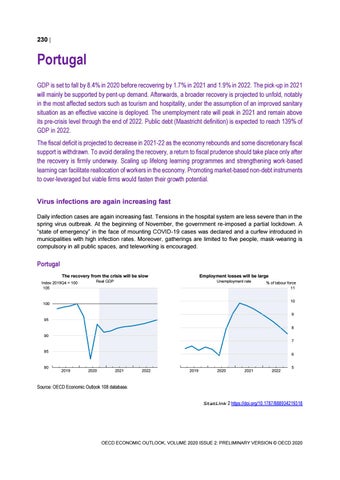
Portugal GDP is set to fall by 8.4% in 2020 before recovering by 1.7% in 2021 and 1.9% in 2022. The pick-up in 2021 will mainly be supported by pent-up demand. Afterwards, a broader recovery is projected to unfold, notably in the most affected sectors such as tourism and hospitality, under the assumption of an improved sanitary situation as an effective vaccine is deployed. The unemployment rate will peak in 2021 and remain above its pre-crisis level through the end of 2022. Public debt (Maastricht definition) is expected to reach 139% of GDP in 2022. The fiscal deficit is projected to decrease in 2021-22 as the economy rebounds and some discretionary fiscal support is withdrawn. To avoid derailing the recovery, a return to fiscal prudence should take place only after the recovery is firmly underway. Scaling up lifelong learning programmes and strengthening work-based learning can facilitate reallocation of workers in the economy. Promoting market-based non-debt instruments to over-leveraged but viable firms would fasten their growth potential. Virus infections are again increasing fast Daily infection cases are again increasing fast. Tensions in the hospital system are less severe than in the spring virus outbreak. At the beginning of November, the government re-imposed a partial lockdown. A “state of emergency” in the face of mounting COVID-19 cases was declared and a curfew introduced in municipalities with high infection rates. Moreover, gatherings are limited to five people, mask-wearing is compulsory in all public spaces, and teleworking is encouraged.
Portugal The recovery from the crisis will be slow
Employment losses will be large
Real GDP
Unemployment rate
Index 2019Q4 = 100 105
% of labour force 11 10
100
9 95 8 90 7 85
80
6
2019
2020
2021
2022
0
0
2019
2020
2021
2022
5
Source: OECD Economic Outlook 108 database. StatLink 2 https://doi.org/10.1787/888934219318
OECD ECONOMIC OUTLOOK, VOLUME 2020 ISSUE 2: PRELIMINARY VERSION © OECD 2020
231
Portugal: Demand, output and prices 2017
Portugal GDP at market prices Private consumption Government consumption Gross fixed capital formation Final domestic demand Stockbuilding1 Total domestic demand Exports of goods and services Imports of goods and services Net exports1 Memorandum items GDP deflator Harmonised index of consumer prices Harmonised index of core inflation2 Unemployment rate (% of labour force) Household saving ratio, net (% of disposable income) General government financial balance3 (% of GDP) General government gross debt (% of GDP) General government debt, Maastricht definition (% of GDP) Current account balance (% of GDP)
2018
2020
2021
2022
Percentage changes, volume (2016 prices)
Current prices EUR billion
195.9 126.5 33.7 32.9 193.1 0.9 194.0 83.7 81.7 2.0 _ _ _ _ _ _ _ _ _
2019
2.8 2.6 0.6 6.2 2.9 0.3 3.2 4.1 5.0 -0.3
2.2 2.4 0.7 5.4 2.7 0.1 2.7 3.5 4.7 -0.5
-8.4 -7.3 -0.3 -4.2 -5.5 -0.4 -5.9 -21.3 -16.1 -2.3
1.7 1.1 3.5 0.1 1.3 0.0 1.4 3.6 2.5 0.4
1.9 2.8 0.7 2.5 2.3 0.0 2.3 5.8 6.9 -0.5
1.8 1.7 3.0 0.3 0.5 1.2 0.3 -0.2 -0.2 0.3 0.8 0.4 -0.2 -0.3 0.3 7.0 6.5 7.3 9.5 8.2 -2.5 -2.2 8.2 6.3 3.0 -0.3 0.1 -7.3 -6.3 -4.9 137.8 136.8 155.7 159.3 158.3 121.5 117.2 136.1 139.7 138.8 0.4 -0.1 -0.4 -0.6 -0.7
1. Contributions to changes in real GDP, actual amount in the first column. 2. Harmonised index of consumer prices excluding food, energy, alcohol and tobacco. 3. Based on national accounts definition. Source: OECD Economic Outlook 108 database.
StatLink 2 https://doi.org/10.1787/888934219337
The recovery has been uneven across sectors Economic activity and confidence indicators bounced back in the summer but the strength of the recovery differed across sectors. Construction activity had hardly been affected by the past containment measures. Retail sales picked up quickly and credit card payments reached pre-crisis levels in July. The recovery in the tourism sector remains incomplete. The number of tourists in August was 68% smaller than one year ago. The number of employees on the short-time work scheme remains high. Survey indicators show that bankruptcy levels are low but insolvencies have increased by 64% in August compared with the last year. The recent resurgence of the pandemic reversed the tepid recovery trend in the travel and tourism sector in the third quarter of 2020. Finally, high-frequency data from credit card purchases show that domestic demand started falling again with the renewed restrictions. In the last quarter of the year, the resurgence of infections and the weakening of external demand are weighing on the economy.
Policy support is significant Fiscal policy is supporting the economy through two plans, the medium-term budget plan and the national recovery plan. The budget plan has a strong focus on protecting workers’ income and revamping the health sector. Key labour market policies include wage increases for healthcare workers and employees with incomes below the poverty line and increases in unemployment benefits. In addition, the government is planning to extend the job retention scheme beyond the end of 2020. The national recovery plan is dedicated to support businesses, deepen digitalisation and increase investment efforts, especially those related to climate change. An effective implementation of the national recovery plan will help with structural OECD ECONOMIC OUTLOOK, VOLUME 2020 ISSUE 2: PRELIMINARY VERSION © OECD 2020
232 reforms to boost productivity, create jobs and improve environmental outcomes. In addition, the European Central Bank’s accommodative monetary policy and expanded asset purchases will continue to support aggregate demand. The Next Generation EU plan will help finance 2021-22 fiscal measures as Portugal is expected to receive EUR 13.2 billion (3.8% of GDP).
Activity will recover gradually GDP growth is projected to reach 1.7% in 2021 and 1.9% in 2022, but GDP will remain below its pre-crisis level at the end of 2022 due to long-lasting effects of the pandemic on the productive potential of the economy. High uncertainty about the evolution of the pandemic and the high share of tourism in GDP will mute the speed of recovery until an effective vaccine is in place. Business investment will pick up, supported by low interest rates and EU funds. The budget deficit and public debt are projected to remain high, with the latter reaching 139% of GDP in 2022 (Maastricht definition). A slower-than-expected recovery in tourism and trading partners’ growth would limit exports further. Weak growth could also magnify the spillover effects in the financial sector, via a significant rise in non-performing loans in most affected sectors, such as tourism. Contingent liabilities arising from loan guarantees might also pose an additional burden for public finances. On the upside, an early and effective containment of the pandemic, boosting confidence, and a faster absorption of EU funds could help to foster a stronger-than-projected economic performance.
Further well-targeted policies could facilitate the reallocation of resources The government should ensure a progressive withdrawal of support measures only once the recovery is well underway. At the same time, it should avoid supporting non-viable firms and ensure that resources go to the most productive firms to allow a progressive restructuring of the economy. Promoting access to market-based financing, such as equity, could help recapitalise firms while at the same time mitigate debt overhang. This crisis has weakened the tourism sector’s medium-term prospects, and measures should help affected businesses and their workers to shift to sectors that promise better opportunities. Key to improved reallocation will also be a faster dispute resolution system, higher efficiency of the justice system, scaling up lifelong learning programmes, and more work-based learning in vocational education and training. Finally, public employment services should be strengthened. Faced with a likely surge in the number of job seekers, they need to be supported in finding jobs in new occupations, sectors and regions.
OECD ECONOMIC OUTLOOK, VOLUME 2020 ISSUE 2: PRELIMINARY VERSION © OECD 2020