188
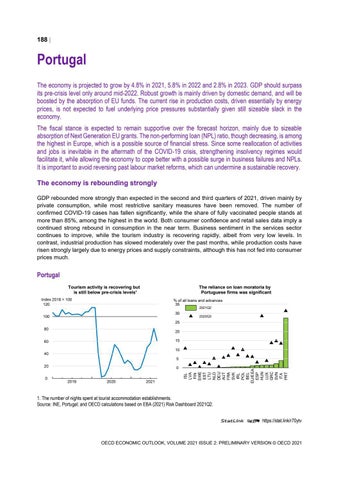
Portugal The economy is projected to grow by 4.8% in 2021, 5.8% in 2022 and 2.8% in 2023. GDP should surpass its pre-crisis level only around mid-2022. Robust growth is mainly driven by domestic demand, and will be boosted by the absorption of EU funds. The current rise in production costs, driven essentially by energy prices, is not expected to fuel underlying price pressures substantially given still sizeable slack in the economy. The fiscal stance is expected to remain supportive over the forecast horizon, mainly due to sizeable absorption of Next Generation EU grants. The non-performing loan (NPL) ratio, though decreasing, is among the highest in Europe, which is a possible source of financial stress. Since some reallocation of activities and jobs is inevitable in the aftermath of the COVID-19 crisis, strengthening insolvency regimes would facilitate it, while allowing the economy to cope better with a possible surge in business failures and NPLs. It is important to avoid reversing past labour market reforms, which can undermine a sustainable recovery. The economy is rebounding strongly GDP rebounded more strongly than expected in the second and third quarters of 2021, driven mainly by private consumption, while most restrictive sanitary measures have been removed. The number of confirmed COVID-19 cases has fallen significantly, while the share of fully vaccinated people stands at more than 85%, among the highest in the world. Both consumer confidence and retail sales data imply a continued strong rebound in consumption in the near term. Business sentiment in the services sector continues to improve, while the tourism industry is recovering rapidly, albeit from very low levels. In contrast, industrial production has slowed moderately over the past months, while production costs have risen strongly largely due to energy prices and supply constraints, although this has not fed into consumer prices much.
Portugal Tourism activity is recovering but is still below pre-crisis levels¹
The reliance on loan moratoria by Portuguese firms was significant
Index 2018 = 100 120
% of all loans and advances 35 2021Q2
30
100
2020Q3
25 80
20 15
60
10
40
0
0 2019
2020
2021
0
ISL LVA FIN SWE EST LTU NLD DEU AUT FRA SVK IRL POL BEL EU/EEA ESP HUN LUX GRC SVN ITA PRT
5 20
0
1. The number of nights spent at tourist accommodation establishments. Source: INE, Portugal; and OECD calculations based on EBA (2021) Risk Dashboard 2021Q2. StatLink 2 https://stat.link/r70ytv
OECD ECONOMIC OUTLOOK, VOLUME 2021 ISSUE 2: PRELIMINARY VERSION © OECD 2021
189
Portugal: Demand, output and prices 2018
Portugal GDP at market prices Private consumption Government consumption Gross fixed capital formation Final domestic demand Stockbuilding¹ Total domestic demand Exports of goods and services Imports of goods and services Net exports¹ Memorandum items GDP deflator Harmonised index of consumer prices Harmonised index of core inflation² Unemployment rate (% of labour force) Household saving ratio, net (% of disposable income) General government financial balance³ (% of GDP) General government gross debt (% of GDP) General government debt, Maastricht definition⁴ (% of GDP) Current account balance (% of GDP)
2019
2020
2021
2022
2023
Percentage changes, volume (2016 prices)
Current prices EUR billion
205.2 131.9 34.8 36.0
2.7 3.3 2.1 5.4
-8.4 -7.1 0.4 -2.7
4.8 4.5 4.3 5.7
5.8 4.6 2.9 8.1
2.8 1.9 1.3 8.5
202.7 1.6
3.4 -0.3
-5.0 -0.6
4.7 0.2
5.0 0.0
3.1 0.0
204.2 89.1 88.2 0.9
3.1 4.1 4.9 -0.4
-5.5 -18.6 -12.1 -2.9
4.9 9.2 9.2 -0.2
4.9 10.5 8.0 0.8
3.1 4.6 5.3 -0.4
1.7 0.3 0.4 6.6
1.9 -0.1 -0.2 7.0
0.9 0.8 0.1 6.9
1.4 1.7 1.6 6.7
1.2 1.1 1.1 6.5
_ _ _ _ _ _ _ _ _
-2.2 3.5 2.4 -1.1 -2.0 0.1 -5.8 -4.3 -2.4 -1.6 136.1 157.5 155.7 150.6 148.2 116.6 135.2 133.4 128.3 125.8 0.4 -1.1 -1.0 -0.6 -0.9
1. Contributions to changes in real GDP, actual amount in the first column. 2. Harmonised index of consumer prices excluding food, energy, alcohol and tobacco. 3. Based on national accounts definition. 4. The Maastricht definition of general government debt includes only loans, debt securities, and currency and deposits, with debt at face value rather than market value. Source: OECD Economic Outlook 110 database.
StatLink 2 https://stat.link/o5e8rj
Policy will remain supportive Fiscal policy is expected to be supportive in 2022 and 2023, although most of emergency measures against the COVID-19 crisis are wound down. This mainly reflects the absorption of grants from the EU Recovery and Resilience Facility, which is assumed to amount to 0.6% of GDP in 2021, 1.3% of GDP in 2022, and 1.5% of GDP in 2023. Recently, the government has also introduced a number of measures to cushion the negative effects from rising energy prices, such as fuel subsidies for households and for public transport operators as well as a control of fuel marketing margins. The draft Budget 2022 was not approved by Parliament and an early election will take place on 30 January 2022. As a consequence, some new stimulus measures planned in the draft Budget, such as a reduction in personal income tax and a rise in the payroll in public administration, are not incorporated in the projections. In contrast, public infrastructure investment, largely relying on EU funds, is assumed to be implemented as planned. Financing conditions will remain favourable, as monetary policy by the European Central Bank will remain accommodative. While most of emergency measures against the COVID-19 have been phased out, the moratorium on bank loans ended as scheduled in September 2021.
OECD ECONOMIC OUTLOOK, VOLUME 2021 ISSUE 2: PRELIMINARY VERSION © OECD 2021
190
The strong recovery will continue, boosted by investment The recovery is projected to remain robust, and increasingly driven by investment. In Portugal, the absorption of Next Generation EU grants is expected to be swift, as close to 60% of the total amount has already been contracted. Consumption will remain strong, while the saving ratio should decline as uncertainty related to the epidemic wanes. Exports, currently still subdued, will be slow to recover fully, reaching the pre-crisis level only at the beginning of 2023, as tourism is expected to continue to be affected by mobility restrictions across borders. If restrictions are removed earlier than expected, this would be an upside risk for tourism and activity. High production costs, due to energy prices and supply constraints, are not expected to derail inflation expectations, which remain moderate given sizeable slack in the economy. Employment will increase only slowly, as many jobs had been protected by the job retention scheme, and firms have reacted by increasing working hours instead, at least initially. A major risk is related to business failures that can be more prevalent than expected, harming financial stability and raising unemployment. This could follow the removal of the moratorium on bank loans, as the share of businesses having relied on the moratorium in Portugal was by far the highest across European countries.
Policy can support sustainable growth As some reallocation of activities and jobs is likely inevitable, due to changes in people’s preferences and behaviour, policy support should be strictly targeted to viable jobs and firms. Strengthening insolvency regimes can reduce the obstacles hampering the successful restructuring of viable firms and the smooth exit of non-viable ones. This includes facilitating the use of out-of-court procedures, which can also alleviate court congestion in face of a potential surge in business failures. While significant job losses are expected in certain sectors, other sectors are increasing vacancies, which may not be easily filled due to job-skill mismatches. Such job reallocation can be facilitated by strengthening public employment services and upskilling and reskilling programmes. The government should also avoid increasing firing costs abruptly, which would discourage job creation, and increasing the legal minimum wage rapidly, which would reduce job opportunities for low-skilled workers in particular and feed into inefficiently high labour costs in the longer run.
OECD ECONOMIC OUTLOOK, VOLUME 2021 ISSUE 2: PRELIMINARY VERSION © OECD 2021