194
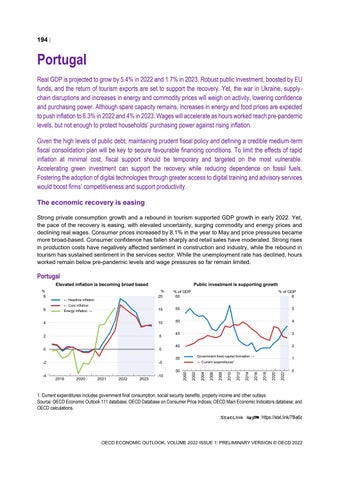
Portugal Real GDP is projected to grow by 5.4% in 2022 and 1.7% in 2023. Robust public investment, boosted by EU funds, and the return of tourism exports are set to support the recovery. Yet, the war in Ukraine, supplychain disruptions and increases in energy and commodity prices will weigh on activity, lowering confidence and purchasing power. Although spare capacity remains, increases in energy and food prices are expected to push inflation to 6.3% in 2022 and 4% in 2023. Wages will accelerate as hours worked reach pre-pandemic levels, but not enough to protect households’ purchasing power against rising inflation. Given the high levels of public debt, maintaining prudent fiscal policy and defining a credible medium-term fiscal consolidation plan will be key to secure favourable financing conditions. To limit the effects of rapid inflation at minimal cost, fiscal support should be temporary and targeted on the most vulnerable. Accelerating green investment can support the recovery while reducing dependence on fossil fuels. Fostering the adoption of digital technologies through greater access to digital training and advisory services would boost firms’ competitiveness and support productivity. The economic recovery is easing Strong private consumption growth and a rebound in tourism supported GDP growth in early 2022. Yet, the pace of the recovery is easing, with elevated uncertainty, surging commodity and energy prices and declining real wages. Consumer prices increased by 8.1% in the year to May and price pressures became more broad-based. Consumer confidence has fallen sharply and retail sales have moderated. Strong rises in production costs have negatively affected sentiment in construction and industry, while the rebound in tourism has sustained sentiment in the services sector. While the unemployment rate has declined, hours worked remain below pre-pandemic levels and wage pressures so far remain limited.
Portugal Elevated inflation is becoming broad based % 8
Public investment is supporting growth % 20
← Headline inflation ← Core inflation
% of GDP 60
% of GDP 6
15
55
5
4
10
50
4
2
5
45
3
0
0
40
2
-2
-5
2022
2020
2018
2016
-10
2014
2023
2012
2022
2010
2021
2008
2020
2006
2019
1
← Current expenditures¹
2004
30 -4
Government fixed capital formation →
35
2002
Energy inflation →
2000
6
0
1. Current expenditures includes government final consumption, social security benefits, property income and other outlays. Source: OECD Economic Outlook 111 database; OECD Database on Consumer Price Indices; OECD Main Economic Indicators database; and OECD calculations. StatLink 2 https://stat.link/78ia6z
OECD ECONOMIC OUTLOOK, VOLUME 2022 ISSUE 1: PRELIMINARY VERSION © OECD 2022
195
Portugal: Demand, output and prices 2018
Portugal GDP at market prices Private consumption Government consumption Gross fixed capital formation Final domestic demand Stockbuilding¹ Total domestic demand Exports of goods and services Imports of goods and services Net exports¹ Memorandum items GDP deflator Harmonised index of consumer prices Harmonised index of core inflation² Unemployment rate (% of labour force) Household saving ratio, net (% of disposable income) General government financial balance³ (% of GDP) General government gross debt (% of GDP) General government debt, Maastricht definition⁴ (% of GDP) Current account balance (% of GDP)
2019
2020
2021
2022
2023
Percentage changes, volume (2016 prices)
Current prices EUR billion
205.2 131.9 34.8 36.0
2.7 3.3 2.1 5.4
-8.4 -7.1 0.4 -2.7
4.9 4.5 4.1 6.5
5.4 3.6 1.3 7.7
1.7 0.5 0.9 5.1
202.7 1.6
3.4 -0.3
-5.0 -0.6
4.8 0.2
4.0 -0.1
1.5 0.0
204.2 89.1 88.2 0.9
3.1 4.1 4.9 -0.4
-5.5 -18.6 -12.1 -2.9
5.0 13.1 13.1 -0.3
4.0 13.2 9.3 1.3
1.5 3.2 2.6 0.2
1.7 0.3 0.4 6.6
1.9 -0.1 -0.2 7.0
0.7 0.9 0.2 6.6
3.7 6.3 5.3 5.8
2.9 4.0 3.9 5.7
_ _ _ _ _ _ _ _ _
-2.2 3.3 1.3 -0.9 0.4 0.1 -5.8 -2.8 -1.5 -1.1 136.1 157.6 145.6 138.1 134.9 116.6 135.2 127.4 120.0 116.7 0.4 -1.1 -1.1 -2.2 -2.8
1. Contributions to changes in real GDP, actual amount in the first column. 2. Harmonised index of consumer prices excluding food, energy, alcohol and tobacco. 3. Based on national accounts definition. 4. The Maastricht definition of general government debt includes only loans, debt securities, and currency and deposits, with debt at face value rather than market value. Source: OECD Economic Outlook 111 database.
StatLink 2 https://stat.link/jto1q2
While Portugal has few direct trade links with Russia and Ukraine, the war is perpetuating increases in energy and food prices, increasing uncertainty and weighing on activity. 10-year government bond yields have increased by around 150 basis points since the start of January. The measures to cushion the effects of higher energy costs are on net impacting the 2022 government budget by EUR 1.1 billion (0.5% of GDP). An estimated EUR 780 million will reduce fuel prices by temporarily decreasing the petrol and energy tax (ISP), suspending the increase in the carbon tax and increasing subsidies through the Autovoucher programme. There is EUR 450 million of grants for companies and EUR 105 million of social benefits for refugees and vulnerable families.
Policy will remain supportive in 2022, boosted by EU funds Fiscal policy is expected to be supportive in 2022. Although pandemic-related measures will ease to 0.8% of GDP in 2022, spending of Next Generation EU funds (grants and loans) is assumed to jump from zero in 2021 to 1.4% of GDP in 2022 and 1.8% in 2023, boosting government investment. The first stage of this spending is already fully contracted, although there are risks of delays given the significant amount. Fiscal policy is expected to be broadly neutral in 2023 as pandemic-related measures are eliminated.
OECD ECONOMIC OUTLOOK, VOLUME 2022 ISSUE 1: PRELIMINARY VERSION © OECD 2022
196
The recovery is slowing Real GDP is projected to grow by 5.4% in 2022 and 1.7% in 2023. Diminishing pent-up demand and elevated inflation will weigh on consumption. Investment growth will remain solid, supported by government spending, which is being boosted by EU funds. Tourism exports should rebound further. Although spare capacity remains, inflation is projected to increase to 6.3% in 2022 before moderating to 4% in 2023, as elevated energy and food prices ease somewhat through the year. As employment and hours worked increase, wage growth is expected to increase, although elevated inflation will lower real wages. Strong nominal GDP growth will lower public debt (Maastricht definition) to 117% of GDP in 2023. Risks to the recovery include the delayed spending of EU funds or their erosion in real terms due to higher inflation, and an increase in interest rates which may reduce bank lending and gradually limit the government’s ability to spend. Tourism could rebound more strongly than expected. Alternatively higher-than-expected oil prices could weigh on demand for international travel.
Policy can support sustainable growth Temporary fiscal support against high energy prices should target the most-impacted households and firms. For instance, means-tested financial support should replace reductions in fuel taxes. Increasing the share of renewables in energy supply, combined with reducing energy demand would support energy security and the achievement of carbon neutrality. Faster development of public transport, shared transport solutions and electric-vehicle infrastructure would support investment and lower fossil-fuel dependence. To reduce energy demand, technical and financial support to low-income households and vulnerable (but viable) firms, such as for building insulation, should intensify. Fostering the adoption of digital technologies, such as through expanding access to training and advisory services, can boost productivity. Maintaining the government’s commitment to fiscal prudence should help reassure financial markets and limit increases in borrowing costs as euro-area monetary policy normalises. A clear and credible medium-term fiscal consolidation strategy would further help support external credibility.
OECD ECONOMIC OUTLOOK, VOLUME 2022 ISSUE 1: PRELIMINARY VERSION © OECD 2022