118
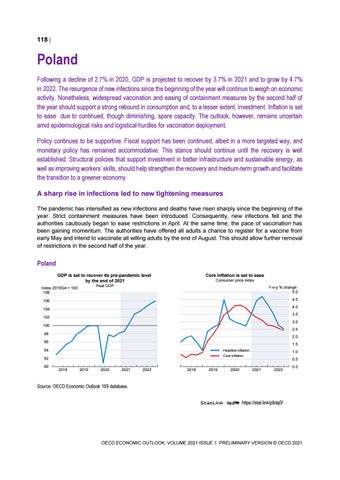
Poland Following a decline of 2.7% in 2020, GDP is projected to recover by 3.7% in 2021 and to grow by 4.7% in 2022. The resurgence of new infections since the beginning of the year will continue to weigh on economic activity. Nonetheless, widespread vaccination and easing of containment measures by the second half of the year should support a strong rebound in consumption and, to a lesser extent, investment. Inflation is set to ease due to continued, though diminishing, spare capacity. The outlook, however, remains uncertain amid epidemiological risks and logistical hurdles for vaccination deployment. Policy continues to be supportive. Fiscal support has been continued, albeit in a more targeted way, and monetary policy has remained accommodative. This stance should continue until the recovery is well established. Structural policies that support investment in better infrastructure and sustainable energy, as well as improving workers’ skills, should help strengthen the recovery and medium-term growth and facilitate the transition to a greener economy. A sharp rise in infections led to new tightening measures The pandemic has intensified as new infections and deaths have risen sharply since the beginning of the year. Strict containment measures have been introduced. Consequently, new infections fell and the authorities cautiously began to ease restrictions in April. At the same time, the pace of vaccination has been gaining momentum. The authorities have offered all adults a chance to register for a vaccine from early May and intend to vaccinate all willing adults by the end of August. This should allow further removal of restrictions in the second half of the year.
Poland GDP is set to recover its pre-pandemic level by the end of 2021
Core inflation is set to ease Consumer price index
Real GDP
Index 2019Q4 = 100 108
Y-o-y % change 5.0 4.5
106
4.0
104
3.5
102
3.0 100 2.5 98
2.0
96
1.5
94
Headline inflation
90
1.0
Core inflation
92
0.5 2018
2019
2020
2021
2022
0
0
2018
2019
2020
2021
2022
0.0
Source: OECD Economic Outlook 109 database. StatLink 2 https://stat.link/p8dq0f
OECD ECONOMIC OUTLOOK, VOLUME 2021 ISSUE 1: PRELIMINARY VERSION © OECD 2021
119
Poland: Demand, output and prices
StatLink 2 https://stat.link/94x3os
The resurgence of infections has delayed the recovery The wave of infections in the autumn of 2020 and the accompanying tightening of restrictions led to a decrease in output at the end of last year, although to a lesser extent than during the first half of 2020. While the economy was more resilient in early 2021, with GDP expanding in the first quarter, the resurgence of infections since March and continued restrictions are likely to have weighed on economic activity. Mobility indicators have been subdued since the end of 2020 although they picked up recently. Similarly, despite recent increases, consumer and business confidence remain below levels seen before the pandemic.
Policy has continued to support the economy In response to the rising infections, the authorities extended the initial support measures, with some foreseen to last until mid-2021. However, these measures are more targeted as they focus on firms and sectors most impacted by the pandemic. The continued fiscal support entails a higher debt level, but the fiscal stance remains sustainable as Poland entered the pandemic with fiscal space. Monetary policy remains accommodative as interest rates have stayed low and financial conditions are favourable.
The economy is set for a rebound in 2021 GDP is projected to grow by 3.7% in 2021, rebounding in the second half of the year and returning to its pre-pandemic level by year-end. Widespread vaccination is assumed to allow for a gradual removal of containment measures. This will facilitate the rebound in private consumption, supported by a decline in
OECD ECONOMIC OUTLOOK, VOLUME 2021 ISSUE 1: PRELIMINARY VERSION © OECD 2021
120 high household saving rates which are currently well above their pre-pandemic levels. Investment should also bounce back but to a smaller extent amid high uncertainty and spare capacity. The labour market is expected to remain robust. Continued growth in consumption and investment, with the help of the EU’s Recovery and Resilience Facility funds, should boost growth to 4.7% in 2022. Inflation was elevated in 2020, partly due to administered and temporary price rises. Past increases in commodity prices should further push up annual headline inflation this year but inflation is set to ease in 2022 as spare capacity exerts downward pressure. The outlook remains uncertain. On the downside, despite steady vaccination progress, renewed outbreaks could result in a slower lifting of containment measures. On the upside, a faster recovery in confidence could lead to a strong rebound in activity and a tighter labour market.
Policies should foster a green recovery The prospects for a sustainable recovery would be enhanced by a focus on decarbonisation, productivity-friendly investments, and labour market reforms. Public investment should concentrate on improving the country’s infrastructure, especially in transport, energy and digital technologies, in order to help smaller firms better access foreign markets. Within energy, investment should be targeted towards renewable sources, which would support the necessary move toward a greener economy. Also, many adults, notably older ones, have weak basic skills and lifelong training opportunities are limited for the unemployed and the low-skilled. Despite a still robust labour market, and in order to facilitate job transition, it will be important to strengthen the training and skills of these groups, help displaced workers with job placement measures, and facilitate the reallocation of resources toward growing industries.
OECD ECONOMIC OUTLOOK, VOLUME 2021 ISSUE 1: PRELIMINARY VERSION © OECD 2021