ď ź 227
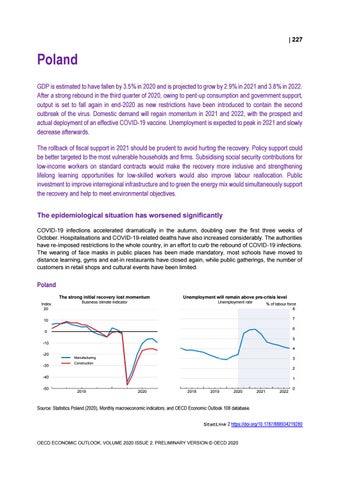
Poland GDP is estimated to have fallen by 3.5% in 2020 and is projected to grow by 2.9% in 2021 and 3.8% in 2022. After a strong rebound in the third quarter of 2020, owing to pent-up consumption and government support, output is set to fall again in end-2020 as new restrictions have been introduced to contain the second outbreak of the virus. Domestic demand will regain momentum in 2021 and 2022, with the prospect and actual deployment of an effective COVID-19 vaccine. Unemployment is expected to peak in 2021 and slowly decrease afterwards. The rollback of fiscal support in 2021 should be prudent to avoid hurting the recovery. Policy support could be better targeted to the most vulnerable households and firms. Subsidising social security contributions for low-income workers on standard contracts would make the recovery more inclusive and strengthening lifelong learning opportunities for low-skilled workers would also improve labour reallocation. Public investment to improve interregional infrastructure and to green the energy mix would simultaneously support the recovery and help to meet environmental objectives. The epidemiological situation has worsened significantly COVID-19 infections accelerated dramatically in the autumn, doubling over the first three weeks of October. Hospitalisations and COVID-19-related deaths have also increased considerably. The authorities have re-imposed restrictions to the whole country, in an effort to curb the rebound of COVID-19 infections. The wearing of face masks in public places has been made mandatory, most schools have moved to distance learning, gyms and eat-in restaurants have closed again, while public gatherings, the number of customers in retail shops and cultural events have been limited.
Poland Index 20
The strong initial recovery lost momentum
Unemployment will remain above pre-crisis level
Business climate indicator
Unemployment rate
% of labour force 8 7
10
6
0
5
-10
4 -20 -30
Manufacturing
3
Construction
2
-40 -50
1 2019
2020
0
0
2018
2019
2020
2021
2022
0
Source: Statistics Poland (2020), Monthly macroeconomic indicators; and OECD Economic Outlook 108 database. StatLink 2 https://doi.org/10.1787/888934219280
OECD ECONOMIC OUTLOOK, VOLUME 2020 ISSUE 2: PRELIMINARY VERSION Š OECD 2020
228
Poland: Demand, output and prices 2017
2018
Current prices PLN billion
Poland GDP at market prices Private consumption Government consumption Gross fixed capital formation Final domestic demand Stockbuilding1 Total domestic demand Exports of goods and services Imports of goods and services Net exports1
1 989.8 1 166.8 351.9 348.7 1 867.4 47.5 1 914.9 1 077.7 1 002.7 75.0
Memorandum items GDP deflator Consumer price index Core inflation index2 Unemployment rate (% of labour force) Household saving ratio, net (% of disposable income) General government financial balance (% of GDP) General government debt, Maastricht definition (% of GDP) Current account balance (% of GDP)
_ _ _ _ _ _ _ _
2019
2020
2021
2022
Percentage changes, volume (2015 prices)
5.4 4.5 3.5 9.4 5.2 0.4 5.6 6.9 7.4 0.0
4.5 3.9 6.2 7.2 5.0 -1.3 3.5 5.1 3.3 1.1
-3.5 -4.5 3.1 -7.4 -3.6 -1.3 -5.0 -7.0 -9.6 1.0
2.9 1.7 3.6 -1.6 1.4 -0.4 1.0 7.9 8.4 0.3
3.8 4.5 1.8 8.2 4.6 0.0 4.6 11.3 14.4 -0.7
1.2 1.8 0.8 3.9 -1.0 -0.2 48.8 -1.3
3.1 2.2 1.9 3.3 1.9 -0.7 45.7 0.5
3.8 3.4 3.9 3.8 13.7 -10.8 56.5 2.3
-0.3 2.3 3.3 5.5 12.8 -6.8 62.0 1.2
2.3 2.6 2.6 4.3 9.7 -4.8 63.6 0.5
1. Contributions to changes in real GDP, actual amount in the first column. 2. Consumer price index excluding food and energy. Source: OECD Economic Outlook 108 database.
StatLink 2 https://doi.org/10.1787/888934219299
The recovery has been interrupted by the pandemic resurgence Industrial production rebounded vigorously after the deep plunge induced by lockdown measures in spring, and exports and imports recovered quickly. Public expenditure and pent-up demand helped drive the recovery. However, the recent resurgence of the pandemic has undermined confidence and domestic demand started falling again with the renewed restrictions. The persistent uncertainty about domestic factors and the recovery in Europe is holding back private investment. The expiration of measures aimed at job protection is weighing on employment, denting household income growth.
Fiscal and monetary policies have prevented an even bigger contraction so far Supportive fiscal and monetary policies have prevented a deeper recession in 2020. Higher social transfers, pension outlays, health expenditures and exceptional measures aimed at protecting incomes, jobs and firms’ liquidity all contributed to support the economy. The minimum wage has increased by almost 16% in 2020 and another increase around 8% is planned for 2021, partly compensating for lower average wage growth. However, job and income protection measures are being progressively rolled back. Monetary policy has been highly accommodative. The central bank reduced the benchmark interest rate to 0.1% and purchased assets in the secondary market to improve banks’ liquidity.
OECD ECONOMIC OUTLOOK, VOLUME 2020 ISSUE 2: PRELIMINARY VERSION © OECD 2020
229
Downside risks stem from repeated waves of COVID-19 The recovery is projected to slightly accelerate in the coming two years as private investment slowly picks up. Funds stemming from the Next Generation EU package are assumed to support public investment. Higher minimum wages, supportive monetary and fiscal policies, together with higher service costs related to sanitary measures and local disruptions in production chains, are feeding into higher inflation. Higher unit labour costs and terms of trade will lower the contribution of exports to GDP growth in 2021-22. Downside risks stem primarily from new waves of COVID-19 and new containment measures if there are delays in immunisation, as Poland’s testing capacity remains low. On the upside, a large-scale deployment of an effective vaccine in 2021 could accelerate the pace of recovery by boosting external demand and investors’ confidence.
Targeted structural reforms could help support the recovery Additional stimulus, if needed in the light of the uncertain pace of the recovery, should specifically target the most vulnerable workers and firms to limit fiscal costs. Strengthening lifelong learning opportunities for low-skilled workers would improve the re-employment chances of displaced workers. At the same time, it would also foster labour reallocation towards the most resilient sectors of the economy. To ensure that the recovery is sustainable and inclusive, the authorities could also reduce social security contributions for low-income workers on standard employment contracts, which offer higher stability. Planned public investment to boost aggregate demand could focus on improving cross-regional infrastructure to help smaller firms that struggle to access foreign markets. In addition, investment that develops more sustainable energy alternatives can simultaneously generate employment and help Poland to meet its long-term environmental goals.
OECD ECONOMIC OUTLOOK, VOLUME 2020 ISSUE 2: PRELIMINARY VERSION © OECD 2020