191
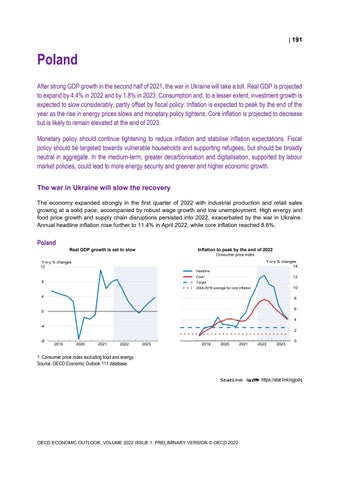
Poland After strong GDP growth in the second half of 2021, the war in Ukraine will take a toll. Real GDP is projected to expand by 4.4% in 2022 and by 1.8% in 2023. Consumption and, to a lesser extent, investment growth is expected to slow considerably, partly offset by fiscal policy. Inflation is expected to peak by the end of the year as the rise in energy prices slows and monetary policy tightens. Core inflation is projected to decrease but is likely to remain elevated at the end of 2023. Monetary policy should continue tightening to reduce inflation and stabilise inflation expectations. Fiscal policy should be targeted towards vulnerable households and supporting refugees, but should be broadly neutral in aggregate. In the medium-term, greater decarbonisation and digitalisation, supported by labour market policies, could lead to more energy security and greener and higher economic growth. The war in Ukraine will slow the recovery The economy expanded strongly in the first quarter of 2022 with industrial production and retail sales growing at a solid pace, accompanied by robust wage growth and low unemployment. High energy and food price growth and supply chain disruptions persisted into 2022, exacerbated by the war in Ukraine. Annual headline inflation rose further to 11.4% in April 2022, while core inflation reached 8.6%.
Poland Real GDP growth is set to slow
Inflation to peak by the end of 2022 Consumer price index Y-o-y % changes 14
Y-o-y % changes 12 Headline
12
Core¹
8
Target
10
2004-2019 average for core inflation
4
8 6
0
4 -4
-8
2 2019
2020
2021
2022
2023
0
0
2019
2020
2021
2022
2023
0
1. Consumer price index excluding food and energy. Source: OECD Economic Outlook 111 database. StatLink 2 https://stat.link/njgodq
OECD ECONOMIC OUTLOOK, VOLUME 2022 ISSUE 1: PRELIMINARY VERSION © OECD 2022
192
Poland: Demand, output and prices 2018
2019
GDP at market prices Private consumption Government consumption Gross fixed capital formation
2021
2022
2023
Percentage changes, volume (2015 prices)
Current prices PLN billion
Poland
2020
2 121.6 1 239.8 376.3 386.4
4.7 3.9 6.5 6.1
-2.2 -2.8 4.9 -4.9
5.9 6.0 3.4 3.8
4.4 4.4 1.3 3.3
1.8 1.0 2.4 3.5
Final domestic demand Stockbuilding¹
2 002.5 54.1
4.8 -1.0
-1.7 -1.1
5.1 2.4
3.6 1.4
1.7 0.0
Total domestic demand Exports of goods and services Imports of goods and services Net exports¹
2 056.6 1 172.0 1 107.0 65.0
3.6 5.2 3.0 1.3
-2.9 0.0 -1.1 0.6
7.5 11.8 15.9 -1.2
4.9 3.5 6.9 -1.7
1.6 1.8 1.4 0.2
_ _ _ _ _ _ _ _
3.2 2.2 1.9 3.3
4.2 3.4 3.8 3.2
5.8 5.1 4.1 3.4
11.5 11.1 7.2 2.9
8.8 6.5 5.1 2.9
0.7 -0.7 45.6 0.5
6.9 -6.9 57.1 2.9
1.4 -1.9 53.8 -0.6
1.4 -4.4 52.9 -5.1
2.2 -3.1 52.5 -3.7
Memorandum items GDP deflator Consumer price index Core inflation index2 Unemployment rate (% of labour force) Household saving ratio, net (% of disposable income) General government financial balance (% of GDP) General government debt, Maastricht definition³ (% of GDP) Current account balance (% of GDP)
1. Contributions to changes in real GDP, actual amount in the first column. 2. Consumer price index excluding food and energy. 3. The Maastricht definition of general government debt includes only loans, debt securities, and currency and deposits, with debt at face value rather than market value. Source: OECD Economic Outlook 111 database.
StatLink 2 https://stat.link/m1dt3o
The war in Ukraine will significantly affect the Polish economy. Inflation has been pushed up by a surge in energy and food prices and the zloty’s depreciation. Returning Ukrainian men have exacerbated skill shortages in construction and transport. Meanwhile, more than three million Ukrainian refugees, mostly women and children, have entered Poland. Having been granted access to the labour market and social benefits, the projections assume an additional 350 000 workers will join the labour force, alleviating skills shortages in some sectors. Direct trade with Russia, Belarus and Ukraine, which represents 3-5% of GDP and 6-8% of total trade, will fall as exports drop while energy imports are diverted as planned, minimising the impact of the recent end to Russian natural gas imports. Higher uncertainty and lower consumer and business confidence should also damp consumption and investment growth. Nonetheless, refugee spending in Poland should bolster consumption growth.
Expansionary fiscal policy will be accompanied by tighter monetary policy Fiscal spending will rise to shield the economy against the impact of the war. The Polish New Deal, introduced in January, has been expanded. The government has also set aside an 11 billion zloty special fund for Ukrainian refugees. The Anti-Inflation Shield, introduced at the turn of the year and originally set to expire in mid-2022, is assumed to be extended until the end of 2022 to cushion households against high energy and food prices. Moreover, national defence spending is set to increase from 2.2% of GDP in 2022 to 3% by 2023. Given rising headline inflation, growing domestic inflationary pressures and an expansionary fiscal policy, the National Bank of Poland has continued raising key short-term interest rates
OECD ECONOMIC OUTLOOK, VOLUME 2022 ISSUE 1: PRELIMINARY VERSION © OECD 2022
193 from 1.25% in November to 5.25% in May. Interest rates are assumed to rise further and reach 8.5% by the end of 2023.
The economy is expected to slow amid high inflation and uncertainty Economic growth is set to slow considerably over the next two years. In 2022, inflation is expected to remain high but is likely to peak by the end of the year. Weaker real incomes and high uncertainty should lead to significantly slower consumption growth with investment and trade growth also dampened. A rise in fiscal spending will partly offset these shocks over 2022, with real GDP set to expand by 4.4%. In 2023, the effects of higher uncertainty should dissipate and, while the announced EU embargo on Russian oil will exert additional upward pressure on energy prices, headline inflation should slow as monetary policy tightens further. Core inflation should also ease but is likely to remain elevated. Fiscal policy will support activity, boosted by spending from the EU Recovery and Resilience Facility funds, but monetary policy tightening will reduce growth. Overall, real GDP is expected to slow to 1.8% in 2023. There is considerable uncertainty around this outlook and the balance of risks lies to the downside. Further escalation of the war would increase uncertainty, exacerbate inflation, and strain public finances. Additional disruptions to energy supplies would hit growth. A persistently tight labour market and continued consumption growth could further push up inflation. On the upside, a quick resolution of the war would increase GDP growth and reduce inflation.
Policies should be coordinated and facilitate a green and digital transition Aggregate fiscal policy should have a broadly neutral stance to complement monetary policy, while continuing to shield the most vulnerable households from inflation. Diversifying energy imports as planned while increasing investment in renewables would improve energy security and ensure greener growth. Policies should encourage greater use of digital technology among firms to raise productivity. Labour market policies can support this by upgrading weak basic skills, notably among older adults, improving access to lifelong training, especially for the unemployed and the low-skilled, with a focus on skills relevant for the digital and green transitions. Better childcare support and language training could facilitate the successful integration of refugees in the labour market.
OECD ECONOMIC OUTLOOK, VOLUME 2022 ISSUE 1: PRELIMINARY VERSION © OECD 2022