188
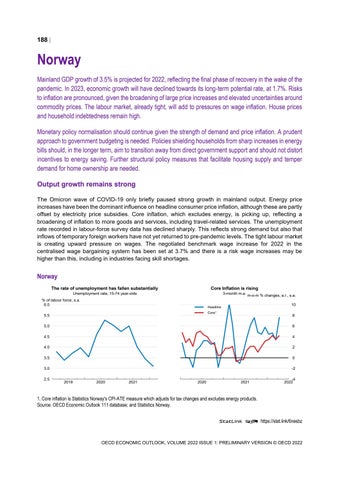
Norway Mainland GDP growth of 3.5% is projected for 2022, reflecting the final phase of recovery in the wake of the pandemic. In 2023, economic growth will have declined towards its long-term potential rate, at 1.7%. Risks to inflation are pronounced, given the broadening of large price increases and elevated uncertainties around commodity prices. The labour market, already tight, will add to pressures on wage inflation. House prices and household indebtedness remain high. Monetary policy normalisation should continue given the strength of demand and price inflation. A prudent approach to government budgeting is needed. Policies shielding households from sharp increases in energy bills should, in the longer term, aim to transition away from direct government support and should not distort incentives to energy saving. Further structural policy measures that facilitate housing supply and temper demand for home ownership are needed. Output growth remains strong The Omicron wave of COVID-19 only briefly paused strong growth in mainland output. Energy price increases have been the dominant influence on headline consumer price inflation, although these are partly offset by electricity price subsidies. Core inflation, which excludes energy, is picking up, reflecting a broadening of inflation to more goods and services, including travel-related services. The unemployment rate recorded in labour-force survey data has declined sharply. This reflects strong demand but also that inflows of temporary foreign workers have not yet returned to pre-pandemic levels. The tight labour market is creating upward pressure on wages. The negotiated benchmark wage increase for 2022 in the centralised wage bargaining system has been set at 3.7% and there is a risk wage increases may be higher than this, including in industries facing skill shortages.
Norway The rate of unemployment has fallen substantially
Core Inflation is rising
Unemployment rate, 15-74 year-olds
3-month m.a.
% of labour force, s.a. 6.0
m-o-m % changes, a.r., s.a. 10
Headline Core¹
5.5
8
5.0
6
4.5
4
4.0
2
3.5
0
3.0
-2
2.5
2019
2020
2021
0
0
2020
2021
-4 2022
1. Core inflation is Statistics Norway's CPI-ATE measure which adjusts for tax changes and excludes energy products. Source: OECD Economic Outlook 111 database; and Statistics Norway. StatLink 2 https://stat.link/6nesbz
OECD ECONOMIC OUTLOOK, VOLUME 2022 ISSUE 1: PRELIMINARY VERSION © OECD 2022
189
Norway: Demand, output and prices 2018
Norway
2019
2021
2022
2023
Percentage changes, volume (2019 prices)
Current prices NOK billion
Mainland GDP at market prices1
2020
2 935.4 3 553.9 1 526.9 826.1 850.3
2.0 0.7 1.1 1.3 9.5
-2.3 -0.7 -6.6 1.8 -5.6
4.1 3.9 4.9 3.8 -0.9
3.5 4.0 5.8 0.1 3.9
1.7 2.3 1.5 1.2 2.3
Final domestic demand Stockbuilding²
3 203.3 146.8
3.4 -1.1
-4.2 -0.4
2.9 0.2
3.7 0.2
1.6 -0.3
Total domestic demand Exports of goods and services Imports of goods and services
3 350.1 1 349.5 1 145.7
2.1 1.1 5.1
-4.5 -1.2 -11.9
3.0 4.7 2.3
3.9 3.3 5.4
1.2 3.5 1.5
203.8
-1.2
3.7
0.8
-0.2
1.4
_ _ _ _ _ _ _ _
-0.5 2.2 2.3 3.7
-3.6 1.3 2.7 4.6
16.9 3.5 1.7 4.3
20.6 4.6 3.3 2.8
1.5 3.3 3.0 2.8
7.0 6.6 47.0 2.9
14.2 -2.6 53.8 0.7
13.1 9.1 49.6 15.3
10.3 10.6 .. 27.0
8.9 10.9 .. 26.8
Total GDP at market prices Private consumption Government consumption Gross fixed capital formation
Net exports² Memorandum items GDP deflator Consumer price index Core inflation index³ Unemployment rate (% of labour force) Household saving ratio, net (% of disposable income) General government financial balance (% of GDP) General government gross debt (% of GDP) Current account balance (% of GDP) 1. GDP excluding oil and shipping. 2. Contributions to changes in real GDP, actual amount in the first column. 3. Consumer price index excluding food and energy. Source: OECD Economic Outlook 111 database.
StatLink 2 https://stat.link/o2z5rw
The war in Ukraine is principally affecting the economy via its impact on global commodity and energy prices; direct trade links with Russia and Ukraine are not substantial. There is only limited capacity to ramp up oil and gas production in the near term to address shortages in Europe arising from the phase-out of Russian imports. Norway plans on taking in around 40 000 - 50 000 refugees from Ukraine (equivalent to about 1% of Norway’s population). Public spending of about 0.5% of mainland GDP has been allocated to accommodating refugees and strengthening civil and military preparedness. Norway is also providing military and other aid to Ukraine.
Fiscal and monetary support is being withdrawn The mainland fiscal deficit is projected to decline over the projections reflecting government adherence to the fiscal rule. The fiscal space generated by phasing out COVID-19 support plus strong revenue growth (in part linked to energy-price increases) will outweigh costs associated with the Ukraine crisis and outlays on electricity-bill subsidies. The latter are scheduled to terminate in March 2023 and to cost around 0.8% of mainland GDP. In recent months, the krone value of Norway’s wealth fund has been boosted by greater inflows from high oil and gas prices but adversely impacted by falls in global equity prices; the net effect is so far negative. Norges Bank is appropriately continuing to tighten monetary policy. The Bank’s policy rate is expected to reach 2.5% by the end of 2023, a rate which is estimated to be broadly neutral, where it neither stimulates nor weighs on the economy. This pace of tightening should help control inflation while limiting risks of straining borrowers, especially households.
OECD ECONOMIC OUTLOOK, VOLUME 2022 ISSUE 1: PRELIMINARY VERSION © OECD 2022
190
Growth and inflation will moderate Moderating real income growth and dwindling reserves of spare capacity will see mainland output growth decline from 3.5% in 2022 towards potential at 1.7% in 2023. Growth in the volumes of household consumption and business investment will be strong in the second quarter of 2022, due to a bounce back from a weak first quarter, but then diminish partly due to inflation. Easing demand will reduce consumer price inflation, along with modest decline in commodity prices. Nevertheless, core inflation will still be above the central bank’s 2% target by the end of 2023 and there is a risk of more substantial price and wage pressures. Commodity price risks tied to the war in Ukraine add uncertainty to the economic outlook. As an oil and gas producer with considerable hydropower capacity, Norway faces comparatively small energy security risks. New waves of Covid-19 infections or more virulent variants remain a risk. In the absence of renewed constraints on movement, recovering migrant worker inflows may alleviate labour market tensions, reducing pressures on wage growth.
Carbon-price increases are key for green transition Progress in green transition needs to continue, including follow-through on planned carbon-price increases. As regards green investment, a recently announced plan for a large expansion of offshore wind power capacity is encouraging. Meanwhile, energy-bill subsidies to help households cope with the cost-of-living should remain temporary. Government plans to facilitate more fixed-price contracting in the energy supply chain, in order to reduce the frequency and volatility of price changes for households, could be an effective solution. In addition, more action to make housing more affordable is needed, such as lighter land-use restrictions. Steps to reduce the tax concessions that boost demand for home ownership and put upward pressure on prices are also needed.
OECD ECONOMIC OUTLOOK, VOLUME 2022 ISSUE 1: PRELIMINARY VERSION © OECD 2022