221
New Zealand After a rebound in the second half of 2020 from the COVID-19 slump, economic growth in 2021 will average around 2¾ per cent, with rising unemployment weighing on private consumption and high uncertainty holding back business investment. Assuming that the border re-opens at the beginning of 2022 after a rollout of an effective vaccine around the world, tourism and immigration will drive further the recovery, with economic growth in 2022 of just over 2½ per cent. Until immunisation is attained, the recovery may be interrupted by intermittent localised COVID-19 outbreaks and associated containment measures. The government should stand ready to deploy greater fiscal and monetary stimulus than currently assumed if the economic recovery falters. It should also strengthen measures to support the reallocation of workers from economic activities that are not viable in the long run to those that are. Localised confinement was imposed to curb a potential outbreak After eliminating domestic COVID-19 infections in June, New Zealand saw a localised outbreak in Auckland in the second half of August. The government promptly imposed containment measures in Auckland, shutting down businesses that require close physical contact and prohibiting travel to other parts of the country, while placing the rest of the country under milder restrictions. The containment measures were lifted nationwide in early October after a period without domestic infections. Daily new COVID-19 cases are likely to remain in low, single digits, and mostly involve people in quarantine facilities for international arrivals as New Zealand maintains strict border controls and a pre-emptive containment policy.
New Zealand The GDP loss was similar to the OECD average despite a larger drop in mobility % changes 0
Electronic card spending rebounded
% changes 0
Retail industries³
Hospitality
NZD million s.a. 8000
-2
-5
-4
-10
-6
-15
-8
-20
5000
-10
-25
4000
-12
-30
3000
-14
← Decline in GDP level¹
-35
-16
Fall in mobility² →
-40
-18 -20
7000 6000
2000 1000
-45 KOR
AUS
JPN
NZL
OECD
-50
0 Sep-19
Dec-19
Mar-20
Jun-20
Sep-20
0
1. Values refer to percentage difference between 2019Q4 and 2020Q2 GDP levels. 2. Data refer to the fall in mobility from the baseline between 1st of March and 27th of June. The baseline is the median value of mobility during the 5-week period January 3-February 6, 2020. 3. Retail industries include retail trade, accommodation and food services (ANZSIC Divisions G and H). Source: OECD, National Accounts database; Statistics New Zealand; and Google LLC, Google COVID-19 Community Mobility Reports, https://www.google.com/covid19/mobility/. StatLink 2 https://doi.org/10.1787/888934219204
OECD ECONOMIC OUTLOOK, VOLUME 2020 ISSUE 2: PRELIMINARY VERSION © OECD 2020
222 ď ź
New Zealand: Demand, output and prices 2017
2018
Current prices NZD billion
New Zealand GDP at market prices Private consumption Government consumption Gross fixed capital formation Final domestic demand Stockbuilding1 Total domestic demand Exports of goods and services Imports of goods and services Net exports1
285.3 164.3 51.3 65.2 280.8 1.8 282.6 78.1 75.4 2.6
Memorandum items GDP deflator Consumer price index Core inflation index2 Unemployment rate (% of labour force) Household saving ratio, net (% of disposable income) General government financial balance (% of GDP) General government gross debt (% of GDP) Current account balance (% of GDP)
_ _ _ _ _ _ _ _
2019
2020
2021
2022
Percentage changes, volume (2009/2010 prices)
3.2 3.3 3.7 5.6 3.9 0.3 4.2 2.9 6.3 -0.9
2.2 2.9 4.2 2.5 3.0 -0.8 2.2 2.4 2.2 0.0
-4.8 -4.6 5.7 -15.8 -5.3 -1.5 -6.8 -11.2 -16.7 1.6
2.7 3.1 2.8 2.9 3.0 0.4 3.5 2.0 6.2 -1.0
2.6 2.9 1.5 3.2 2.7 0.0 2.7 6.8 7.1 0.0
1.2 1.6 1.2 4.3 -0.3 1.2 34.0 -4.2
2.3 1.6 1.8 4.1 1.2 -0.6 32.6 -3.4
2.5 1.6 2.1 4.9 4.7 -9.1 43.8 -1.6
1.1 1.1 1.3 5.8 3.1 -8.5 48.2 -2.7
1.7 1.6 1.6 5.4 1.9 -5.5 53.1 -2.9
1. Contributions to changes in real GDP, actual amount in the first column. 2. Consumer price index excluding food and energy. Source: OECD Economic Outlook 108 database.
StatLink 2 https://doi.org/10.1787/888934219223
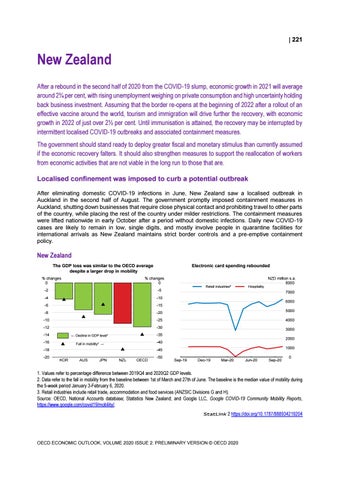
The economy rebounded but is not yet on a firm recovery path Despite a large drop in mobility, the fall in real GDP between the last quarter of 2019 and the second quarter of 2020 was close to the OECD average. Electronic card spending bounced back quickly from a sharp fall in April and remains robust. Consumer confidence remains low despite rapidly rising house prices and robust export commodity prices, reflecting a large increase in the number of unemployed in the third quarter of 2020. Business confidence is improving from a very low level thanks to sizeable fiscal support, a pick-up in domestic tourism as well as strong housing and construction activity.
Massive fiscal and monetary stimulus is supporting jobs and businesses The government is providing substantial financial support to households and businesses over 2020-21, with 70% of the fiscal response package to the COVID-19 crisis (20% of GDP) to be spent by June 2021. The primary focus of the package is the retention of existing jobs. The costliest measure is the Wage Subsidy Scheme, for which NZD 14 billion (4.5% of GDP) was disbursed to businesses for retaining paid employees. Additional temporary wage subsidies were introduced for the period of heightened restrictions. This large income support scheme, covering 71% of businesses and 60% of employment at one point, was gradually reduced by tightening the eligibility conditions and expired in November 2020. The Reserve Bank of New Zealand stepped up measures aimed at boosting credit supply and lowering lending costs. It substantially increased the size of its large-scale asset purchase programme, which it estimates to have lowered 10-year government bond yields by more than 100 basis points. The mortgage interest rates have declined as well, supporting a robust housing market. In December, the Reserve Bank of New Zealand is also to start the Funding for Lending Programme, which will provide low-cost funding to banks based on OECD ECONOMIC OUTLOOK, VOLUME 2020 ISSUE 2: PRELIMINARY VERSION Š OECD 2020
ď ź 223 their outstanding credit to domestic borrowers and increases in lending. The Official Cash Rate has remained at 0.25% since March, when it was lowered from 1%. The start date of the increased capital requirements for banks was further pushed back to July 2022.
The recovery will moderate and be subject to COVID-19-related developments Following a rebound in activity in the second half of 2020, the recovery will moderate owing to a sustained increase in unemployment following the end of the Wage Subsidy Scheme, which will weigh on private consumption. Business investment will be anaemic as firms seek to consolidate their balance sheets and build up cash buffers to cope with the economic fallout from potential further virus outbreaks. International tourism, which represented 20% of total exports in 2019, will be constrained to nil as the border remains closed to foreign non-residents, although this impact is partially offset by increased domestic tourism. Large slack in the economy will keep inflation and wage growth low. Assuming that the border reopens in January 2022 after a global deployment of an effective vaccine, economic growth will pick up as stronger exports stimulate business investment and hiring. The economic recovery may be delayed by sporadic outbreaks of infection, necessitating localised containment measures to eradicate them, or by a worse-than-foreseen global COVID-19 resurgence that would depress export market growth. On the other hand, a faster rollout of a vaccine against COVID-19 would allow an earlier reopening of the border, possibly at first through safe travel zones.
The government should stand ready to deploy additional stimulus Should downside risks materialise in 2021, particularly a large-scale virus outbreak that necessitates containment measures in major cities, more fiscal and monetary policy support than currently envisaged will be needed to ensure that the economic recovery remains on track. Swift implementation of the infrastructure investment component of the fiscal response package to the COVID-19 crisis and of the New Zealand Upgrade Programme in the areas of housing and green infrastructure would underpin the recovery and improve the wellbeing of New Zealanders. The government should also facilitate the reallocation of workers away from jobs that may no longer be viable, along the lines of the scheme that retrains workers in hospitality and aviation for jobs in construction, agriculture, manufacturing and healthcare. In addition, the government should strengthen support for workers during job transitions through reforms to the welfare system (Job seeker Support), introduction of unemployment insurance, or some hybrid approach.
OECD ECONOMIC OUTLOOK, VOLUME 2020 ISSUE 2: PRELIMINARY VERSION Š OECD 2020