185
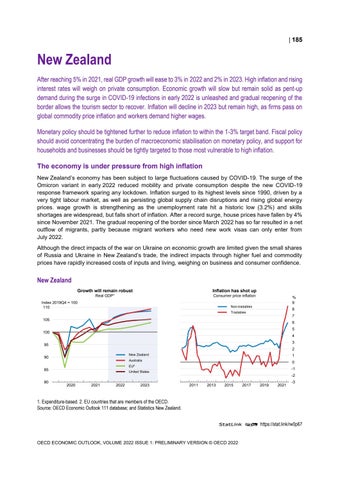
New Zealand After reaching 5% in 2021, real GDP growth will ease to 3% in 2022 and 2% in 2023. High inflation and rising interest rates will weigh on private consumption. Economic growth will slow but remain solid as pent-up demand during the surge in COVID-19 infections in early 2022 is unleashed and gradual reopening of the border allows the tourism sector to recover. Inflation will decline in 2023 but remain high, as firms pass on global commodity price inflation and workers demand higher wages. Monetary policy should be tightened further to reduce inflation to within the 1-3% target band. Fiscal policy should avoid concentrating the burden of macroeconomic stabilisation on monetary policy, and support for households and businesses should be tightly targeted to those most vulnerable to high inflation. The economy is under pressure from high inflation New Zealand’s economy has been subject to large fluctuations caused by COVID-19. The surge of the Omicron variant in early 2022 reduced mobility and private consumption despite the new COVID-19 response framework sparing any lockdown. Inflation surged to its highest levels since 1990, driven by a very tight labour market, as well as persisting global supply chain disruptions and rising global energy prices. wage growth is strengthening as the unemployment rate hit a historic low (3.2%) and skills shortages are widespread, but falls short of inflation. After a record surge, house prices have fallen by 4% since November 2021. The gradual reopening of the border since March 2022 has so far resulted in a net outflow of migrants, partly because migrant workers who need new work visas can only enter from July 2022. Although the direct impacts of the war on Ukraine on economic growth are limited given the small shares of Russia and Ukraine in New Zealand’s trade, the indirect impacts through higher fuel and commodity prices have rapidly increased costs of inputs and living, weighing on business and consumer confidence.
New Zealand Growth will remain robust
Inflation has shot up
Real GDP¹
Consumer price inflation
Index 2019Q4 = 100 110
% 9
Non-tradables
8
Tradables
7
105
6 5
100
4 3
95
2 New Zealand
90
0
EU²
85 80
1
Australia
-1
United States
2020
2021
2022
2023
-2 0
0
2011
2013
2015
2017
2019
2021
-3
1. Expenditure-based. 2. EU countries that are members of the OECD. Source: OECD Economic Outlook 111 database; and Statistics New Zealand. StatLink 2 https://stat.link/rw0p67
OECD ECONOMIC OUTLOOK, VOLUME 2022 ISSUE 1: PRELIMINARY VERSION © OECD 2022
186
New Zealand: Demand, output and prices 2018
2019
GDP at market prices Private consumption Government consumption Gross fixed capital formation
2021
2022
2023
Percentage changes, volume (2009/2010 prices)
Current prices NZD billion
New Zealand
2020
302.6 174.9 54.8 70.8
3.3 3.1 5.1 4.4
-0.9 -1.1 6.8 -7.0
5.0 6.2 10.2 9.6
3.0 0.8 7.5 6.7
2.0 1.1 1.4 3.6
Final domestic demand Stockbuilding¹
300.4 2.6
3.8 -0.5
-1.0 -0.8
7.8 1.6
3.5 0.0
1.7 0.0
Total domestic demand Exports of goods and services Imports of goods and services Net exports¹
303.1 84.0 84.5 - 0.5
3.2 2.4 2.1 0.1
-1.8 -12.7 -16.1 0.9
9.5 -3.0 15.7 -4.3
3.5 6.4 8.2 -0.7
1.7 5.5 3.7 0.3
_ _ _ _ _ _ _ _
2.4 1.6 1.8 4.1
2.2 1.7 2.2 4.6
2.8 3.9 3.7 3.8
3.6 6.6 5.3 3.2
3.4 4.6 4.5 3.5
2.9 -0.6 36.3 -2.9
5.8 -7.3 42.4 -1.1
5.2 -4.2 42.6 -5.6
3.9 -5.1 47.4 -6.5
2.9 -3.6 50.5 -6.7
Memorandum items GDP deflator Consumer price index Core inflation index2 Unemployment rate (% of labour force) Household saving ratio, net (% of disposable income) General government financial balance (% of GDP) General government gross debt (% of GDP) Current account balance (% of GDP) 1. Contributions to changes in real GDP, actual amount in the first column. 2. Consumer price index excluding food and energy. Source: OECD Economic Outlook 111 database.
StatLink 2 https://stat.link/n6tisp
Macroeconomic policies should be better coordinated to contain inflationary pressures The fiscal stance will be expansionary in 2022 due to the fiscal outlays to compensate for higher living costs but will turn contractionary in 2023, as the temporary support expires and the government phases out the large pandemic fiscal stimulus, such as the “shovel-ready” infrastructure investment (1% of GDP) to be implemented by end-2022. As a response to large increases in fuel prices, the government cut fuel taxes and road user charges for diesel vehicles by 25 cents per litre and halved the cost of public transport for three months starting from mid-March. Budget 2022 extended both of these measures for a further two months and introduced a temporary income support of NZD 350 to individuals earning less than NZD 70 000 per year and who are not eligible for the Winter Energy Payment. In order to avoid fuelling inflationary pressure in the near term, any additional fiscal support against higher living costs should be more targeted. The government should also consider deferring some of its infrastructure investment. The Reserve Bank of New Zealand (RBNZ) initiated monetary tightening in October 2021, increasing its Official Cash Rate (OCR) to 2% by May 2022. The OCR is assumed to rise to 3.9% by mid-2023 with some frontloading to anchor inflation expectations. From July 2022, the RBNZ will start selling its large holdings of government bonds. The faster increase in the OCR in the near term and the start of quantitative tightening are adequate and signal a strong commitment to price stability.
OECD ECONOMIC OUTLOOK, VOLUME 2022 ISSUE 1: PRELIMINARY VERSION © OECD 2022
187
Economic growth will moderate Private consumption will recover from the second quarter of 2022 but will be held back by high inflation, a negative wealth effect from declining house prices, and higher mortgage interest rates. 78% of mortgage rates will be reset within one year. Border reopening paves the way for a gradual recovery of tourism exports, which comprised 18% of exports on the eve of the pandemic, and inflows of migrant workers, which will alleviate skills shortages. Resumed international business travel and migrant workers inflows will encourage business and residential investment, despite falling house prices. Inflation will decline moderately in 2023, as fiscal and monetary policy tightening will slow growth, alleviating capacity constraints. Risks are tilted to the downside. An outbreak of a more virulent COVID-19 variant could stifle the recovery of private consumption. A further escalation in the war in Ukraine and sanctions against Russia could bring about higher and more persistent inflation and weaker external demand. Prolonged lockdowns in large cities in China, New Zealand’s largest export market, would also reduce exports and add to inflationary pressure by exacerbating disruptions in global supply chains. Conversely, China’s shift toward a less stringent COVID-19 policy would boost exports and alleviate supply chain disruptions.
Structural reforms can pave the way to more resilient growth To ease inflationary pressure and skills shortages in the near term, the government should facilitate the inflow of migrant workers after the full border opening in July 2022 by ensuring the smooth implementation of the new work visa and employer accreditation system. Swift and concrete policy actions to enhance competition in the retail grocery sector are warranted, given the Commerce Commission’s conclusion that imperfect competition is resulting in high grocery prices and profit margins of major grocery retailers by international comparison. Strengthening the domestic pipeline of digital skills, letting regulations evolve with technological change and promoting exports by firms exploiting digital technologies would support the digital transformation and productivity. The fiscal rule announced in May 2022, which aims to maintain a small budget surplus and caps the net debt level at 30% of GDP will underpin long-run fiscal sustainability in the face of population ageing and rising healthcare expenditure. The government has unveiled greenhouse gas emissions budgets through 2035 that are consistent with achieving net zero emissions by 2050. Rising carbon prices and complementary measures will be needed for New Zealand to meet its abatement objectives. The Climate Emergency Response Fund amounting to 1.4% of GDP established with Emissions Trading Scheme revenue will finance investments in transport sector decarbonisation, energy transition, agriculture emission mitigation and long-term carbon sinks.
OECD ECONOMIC OUTLOOK, VOLUME 2022 ISSUE 1: PRELIMINARY VERSION © OECD 2022