218
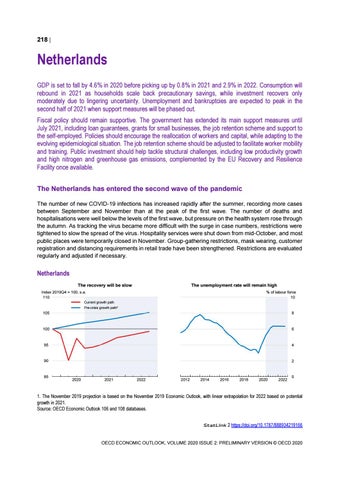
Netherlands GDP is set to fall by 4.6% in 2020 before picking up by 0.8% in 2021 and 2.9% in 2022. Consumption will rebound in 2021 as households scale back precautionary savings, while investment recovers only moderately due to lingering uncertainty. Unemployment and bankruptcies are expected to peak in the second half of 2021 when support measures will be phased out. Fiscal policy should remain supportive. The government has extended its main support measures until July 2021, including loan guarantees, grants for small businesses, the job retention scheme and support to the self-employed. Policies should encourage the reallocation of workers and capital, while adapting to the evolving epidemiological situation. The job retention scheme should be adjusted to facilitate worker mobility and training. Public investment should help tackle structural challenges, including low productivity growth and high nitrogen and greenhouse gas emissions, complemented by the EU Recovery and Resilience Facility once available. The Netherlands has entered the second wave of the pandemic The number of new COVID-19 infections has increased rapidly after the summer, recording more cases between September and November than at the peak of the first wave. The number of deaths and hospitalisations were well below the levels of the first wave, but pressure on the health system rose through the autumn. As tracking the virus became more difficult with the surge in case numbers, restrictions were tightened to slow the spread of the virus. Hospitality services were shut down from mid-October, and most public places were temporarily closed in November. Group-gathering restrictions, mask wearing, customer registration and distancing requirements in retail trade have been strengthened. Restrictions are evaluated regularly and adjusted if necessary.
Netherlands The recovery will be slow
The unemployment rate will remain high
Index 2019Q4 = 100, s.a. 110
% of labour force 10
Current growth path Pre-crisis growth path¹
105
8
100
6
95
4
90
2
85
2020
2021
2022
0
0
2012
2014
2016
2018
2020
2022
0
1. The November 2019 projection is based on the November 2019 Economic Outlook, with linear extrapolation for 2022 based on potential growth in 2021. Source: OECD Economic Outlook 106 and 108 databases. StatLink 2 https://doi.org/10.1787/888934219166 OECD ECONOMIC OUTLOOK, VOLUME 2020 ISSUE 2: PRELIMINARY VERSION © OECD 2020
ď ź 219
Netherlands: Demand, output and prices 2017
Netherlands GDP at market prices Private consumption Government consumption Gross fixed capital formation Final domestic demand Stockbuilding1 Total domestic demand Exports of goods and services Imports of goods and services Net exports1 Memorandum items GDP deflator Harmonised index of consumer prices Harmonised index of core inflation2 Unemployment rate (% of labour force) Household saving ratio, net3 (% of disposable income) General government financial balance (% of GDP) General government gross debt (% of GDP) General government debt, Maastricht definition (% of GDP) Current account balance (% of GDP)
2018
_ _ _ _ _ _ _ _ _
2020
2021
2022
Percentage changes, volume (2015 prices)
Current prices EUR billion
738.8 327.3 179.6 148.8 655.6 3.7 659.3 616.3 536.8 79.5
2019
2.3 2.1 1.7 3.5 2.3 0.1 2.4 4.2 4.6 0.2
1.6 1.5 1.6 4.5 2.2 -0.2 1.9 2.6 3.1 -0.1
-4.6 -6.7 -0.3 -5.1 -4.6 0.0 -4.6 -3.8 -3.8 -0.4
0.8 2.7 2.2 -3.2 1.1 -0.3 0.8 4.7 5.3 0.1
2.9 3.4 1.2 5.0 3.1 0.0 3.1 3.3 3.5 0.1
2.4 1.6 1.0 3.8 9.1 1.4 66.0 52.4 10.8
2.9 2.7 1.9 3.4 10.0 1.7 62.5 48.7 9.9
2.4 1.0 1.9 4.1 18.2 -6.4 69.7 55.9 9.5
1.3 0.9 1.0 6.1 16.4 -8.0 76.8 63.1 9.8
0.8 1.1 1.1 6.3 13.8 -5.9 81.1 67.3 9.1
1. Contributions to changes in real GDP, actual amount in the first column. 2. Harmonised index of consumer prices excluding food, energy, alcohol and tobacco. 3. Including savings in life insurance and pension schemes. Source: OECD Economic Outlook 108 database.
StatLink 2 https://doi.org/10.1787/888934219185
The economic environment remains fragile Economic activity in the second quarter of 2020 recorded the largest contraction since World War II. A rapid implementation of sizeable policy support measures and allowing most economic activities to resume, subject to distancing and hygiene measures, avoided an even steeper fall. Over the summer, the economic environment turned initially more favourable, reflected in strong GDP growth in the third quarter. The rise in unemployment levelled off at the end of the third quarter, partly due to the job retention scheme (NOW) that enabled companies to retain employees. Bankruptcies are well below 2019 levels owing to financial support measures for firms. The initial recovery of producer confidence stalled in the face of the second wave and investment in tangible fixed assets continued to decline. Consumer confidence remains low and has slightly deteriorated in October. Similarly, mobility for retail and recreation has fallen steadily since the virus resurged.
Support to firms and workers is substantial The government is maintaining generous discretionary support measures and allowing the automatic fiscal stabilisers to operate fully. The main support measures, including loan guarantees and grants for small businesses, have been extended until July 2021. The job retention scheme is also set to close in July 2021, following a gradual reduction over three phases of three months each to give businesses time to adapt. From October 2020 onwards, businesses need to apply for each phase and compensation in wage cost is
OECD ECONOMIC OUTLOOK, VOLUME 2020 ISSUE 2: PRELIMINARY VERSION Š OECD 2020
220 subsequently reduced from a maximum of 80% to a maximum of 60% during the last phase. The income support and loan scheme for the self-employed will be complemented by training and career advice from 2021. Business taxes accrued in 2020 have been deferred up to two years, and interest on overdue taxes will remain at almost zero until the end of 2021.
The recovery will be gradual and vulnerable to infection outbreaks Output is projected to improve gradually in 2021 and 2022. Pent-up consumption will drive the initial pick-up. However, rising unemployment, as the job retention scheme is being phased out, combined with limited wage growth and declining housing wealth, will hold back private consumption growth over 2021-22. Business investment will remain subdued, reflecting weak demand and lingering uncertainty. Government consumption and investment are projected to grow, reflecting rising healthcare expenditure, higher construction and infrastructure investment and additional capital spending from the national growth fund. Public debt will rise from 49% of GDP in 2019 to 67% of GDP in 2022. Effective treatment or effective vaccines are assumed to be widely distributed at the turn of 2021 and 2022. New effective treatment methods or earlier-than-assumed distribution of an effective vaccine is a clear upside risk. There are, however, substantial downward risks. Households’ high indebtedness as well as high and illiquid housing and pension wealth add to risks from the health situation. A fall in house prices, pension cuts and an increase to pension premiums are downside risks to consumption. Some pension funds might not meet the legally required funding ratio, despite an exceptional reduction from 100% to 90% in 2020, due to persistently low interest rates. The economy is also particularly sensitive to developments in global trade, including the outcome of the trade negotiations between the United Kingdom and the European Union.
The policy stance should continue to be supportive Fiscal policy should remain supportive and flexible to adapt to a changing environment. The crisis highlights the need to reduce tax and other incentives to hire workers on non-standard contracts. Self-employed workers on freelance or on-call contracts are particularly vulnerable to job termination as the job retention scheme mainly protected workers on permanent contracts. Although access to social benefits was eased for the self-employed, the crisis exacerbates income inequality. Fiscal stimulus should support the reallocation and adaptability of workers in vulnerable sectors by providing timely training and re-education opportunities. Public investment, in the longer term also supported by the EU Recovery and Resilience Facility, should address structural challenges, including increasing productivity growth, expanding renewable energy generation capacity and reducing nitrogen emissions from agriculture.
OECD ECONOMIC OUTLOOK, VOLUME 2020 ISSUE 2: PRELIMINARY VERSION © OECD 2020