176
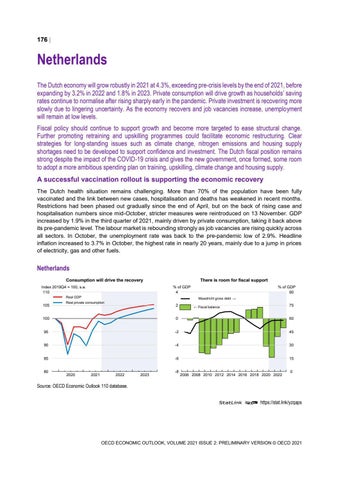
Netherlands The Dutch economy will grow robustly in 2021 at 4.3%, exceeding pre-crisis levels by the end of 2021, before expanding by 3.2% in 2022 and 1.8% in 2023. Private consumption will drive growth as households’ saving rates continue to normalise after rising sharply early in the pandemic. Private investment is recovering more slowly due to lingering uncertainty. As the economy recovers and job vacancies increase, unemployment will remain at low levels. Fiscal policy should continue to support growth and become more targeted to ease structural change. Further promoting retraining and upskilling programmes could facilitate economic restructuring. Clear strategies for long-standing issues such as climate change, nitrogen emissions and housing supply shortages need to be developed to support confidence and investment. The Dutch fiscal position remains strong despite the impact of the COVID-19 crisis and gives the new government, once formed, some room to adopt a more ambitious spending plan on training, upskilling, climate change and housing supply. A successful vaccination rollout is supporting the economic recovery The Dutch health situation remains challenging. More than 70% of the population have been fully vaccinated and the link between new cases, hospitalisation and deaths has weakened in recent months. Restrictions had been phased out gradually since the end of April, but on the back of rising case and hospitalisation numbers since mid-October, stricter measures were reintroduced on 13 November. GDP increased by 1.9% in the third quarter of 2021, mainly driven by private consumption, taking it back above its pre-pandemic level. The labour market is rebounding strongly as job vacancies are rising quickly across all sectors. In October, the unemployment rate was back to the pre-pandemic low of 2.9%. Headline inflation increased to 3.7% in October, the highest rate in nearly 20 years, mainly due to a jump in prices of electricity, gas and other fuels.
Netherlands Consumption will drive the recovery
There is room for fiscal support
Index 2019Q4 = 100, s.a. 110
% of GDP 4
Real GDP
105
% of GDP 90 Maastricht gross debt →
Real private consumption
2
← Fiscal balance
75
100
0
60
95
-2
45
90
-4
30
85
-6
15
80
2020
2021
2022
2023
0
-8
2006 2008 2010 2012 2014 2016 2018 2020 2022
0
Source: OECD Economic Outlook 110 database. StatLink 2 https://stat.link/yzqaps
OECD ECONOMIC OUTLOOK, VOLUME 2021 ISSUE 2: PRELIMINARY VERSION © OECD 2021
177
Netherlands: Demand, output and prices 2018
Netherlands GDP at market prices Private consumption Government consumption Gross fixed capital formation Final domestic demand Stockbuilding¹ Total domestic demand Exports of goods and services Imports of goods and services Net exports¹ Memorandum items GDP deflator Harmonised index of consumer prices Harmonised index of core inflation² Unemployment rate (% of labour force)
2019
2020
2021
2022
2023
Percentage changes, volume (2015 prices)
Current prices EUR billion
774.4 341.6 188.7 158.2 688.5 4.3 692.8 655.5 573.9 81.6
1.9 0.9 2.8 6.1 2.6 0.3 2.9 1.9 3.1 -0.7
-3.8 -6.6 1.0 -4.2 -3.9 -0.3 -4.3 -4.8 -5.5 0.1
4.3 2.8 4.1 2.3 3.1 -0.3 2.8 6.9 5.2 1.8
3.2 4.9 1.3 2.0 3.2 0.2 3.3 5.1 5.5 0.3
1.8 2.8 0.5 3.1 2.2 0.0 2.2 3.2 3.8 -0.1
_ _ _ _ _ _ _ _ _
3.0 2.7 1.9 3.4 11.4 1.7 62.4 48.5 9.4
2.3 1.1 1.9 3.8 17.8 -4.2 69.8 54.4 7.0
2.4 2.4 1.7 3.4 15.3 -5.9 73.1 57.6 8.5
2.4 3.1 2.1 3.5 12.6 -2.7 73.6 58.1 8.9
1.8 1.7 1.7 3.4 12.5 -1.4 73.5 58.1 9.0
Household saving ratio, net3 (% of disposable income) General government financial balance (% of GDP) General government gross debt (% of GDP) General government debt, Maastricht definition⁴ (% of GDP) Current account balance (% of GDP)
1. Contributions to changes in real GDP, actual amount in the first column. 2. Harmonised index of consumer prices excluding food, energy, alcohol and tobacco. 3. Including savings in life insurance and pension schemes. 4. The Maastricht definition of general government debt includes only loans, debt securities, and currency and deposits, with debt at face value rather than market value. Source: OECD Economic Outlook 110 database.
StatLink 2 https://stat.link/qy5lxo
Support measures will fade as the recovery is advancing The main COVID-19 fiscal support measures were terminated by the end of September 2021. As new restrictions were introduced on 13 November, the government has announced a new corona business support package for adversely affected businesses until the end of 2021. Moreover, some of the credit and loan schemes remain available for businesses until the end of 2021, but spending on support measures is expected to end in 2022. As the Netherlands is still ruled by a caretaker government, investments in the recently published budget are only the very necessary ones. Spending on climate measures will increase, including on renewable energy and other technologies that reduce CO 2 emissions, energy infrastructure, and the implementation of existing agreements from the Climate Agreement. Once a new government is formed, more ambitious programmes are expected, for instance in education, healthcare, taxes, work and income. The fiscal deficit is projected to narrow from 5.9% of GDP in 2021 to 1.4% of GDP in 2023, reflecting the end of pandemic support programmes and strong economic growth over this period.
The economy is set to continue its recovery Output is projected to grow by 3.2% in 2022 and 1.8% in 2023. Consumption will continue to drive growth, boosted by some households, especially higher-income ones, drawing on savings accumulated during the pandemic. However, increased pension premiums will dampen overall private consumption growth. Public debt is expected to stay below the Maastricht benchmark of 60% of GDP in 2021 and stabilise over 2022 and 2023, keeping some room to support growth. Due to supply bottlenecks, resilient domestic demand
OECD ECONOMIC OUTLOOK, VOLUME 2021 ISSUE 2: PRELIMINARY VERSION © OECD 2021
178 and base effects, annual headline inflation is projected to remain high at around 3.7% in early 2022, before gradually slowing as supply chain issues fade and domestic demand stabilises. Cautious wage agreements following the COVID-19 crisis are expected to slow down wage growth, limiting the impact of labour costs on inflation in 2021 and 2022. Business investment will recover more slowly due to lingering uncertainty. While higher spending than assumed in the forecast is a clear upside risk, there remain several downside ones. The most prominent risk remains the persistence of the recent rise in COVID-19 cases that could lead to stricter and longer lockdowns than is the case today. Increased business debt during the crisis could dampen productive investment, hampering the recovery. While it has not been the case so far, a continuation of rising house prices could eventually increase macroeconomic vulnerabilities.
Long-standing structural challenges need to be addressed to sustain the recovery More targeted fiscal policy should continue to support growth, as the crisis has widened pre-existing inequalities. Students from disadvantaged backgrounds fell further behind during school closures, and income inequality increased as temporary workers were particularly vulnerable to job termination during the crisis, although the quick recovery allowed many of them to be reemployed. Initiatives like the National Education Programme are a first step towards addressing learning gaps but risk being delayed due to a shortage of teachers. Aligning tax rates and social security contributions between different contract types for workers doing similar jobs could lead to greater equity on the job market. Further supporting retraining and upskilling by programmes such as the Personal Learning and Development Budget (STAP) are promising initiatives to support economic restructuring. The National Growth Fund and, to a lesser degree, the Next Generation EU funds are sources of public investment over the coming years to stimulate the economy. Once the new government is in place it should allocate these funds efficiently and go further in addressing long-standing structural challenges via public investment, notably boosting housing supply and facilitating the green transition and digitalisation, including expanding renewable energy generation capacity and reducing nitrogen emissions from agriculture.
OECD ECONOMIC OUTLOOK, VOLUME 2021 ISSUE 2: PRELIMINARY VERSION © OECD 2021