182
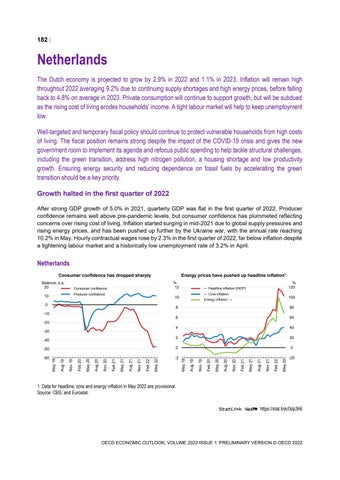
Netherlands The Dutch economy is projected to grow by 2.9% in 2022 and 1.1% in 2023. Inflation will remain high throughout 2022 averaging 9.2% due to continuing supply shortages and high energy prices, before falling back to 4.8% on average in 2023. Private consumption will continue to support growth, but will be subdued as the rising cost of living erodes households’ income. A tight labour market will help to keep unemployment low. Well-targeted and temporary fiscal policy should continue to protect vulnerable households from high costs of living. The fiscal position remains strong despite the impact of the COVID-19 crisis and gives the new government room to implement its agenda and refocus public spending to help tackle structural challenges, including the green transition, address high nitrogen pollution, a housing shortage and low productivity growth. Ensuring energy security and reducing dependence on fossil fuels by accelerating the green transition should be a key priority. Growth halted in the first quarter of 2022 After strong GDP growth of 5.0% in 2021, quarterly GDP was flat in the first quarter of 2022. Producer confidence remains well above pre-pandemic levels, but consumer confidence has plummeted reflecting concerns over rising cost of living. Inflation started surging in mid-2021 due to global supply pressures and rising energy prices, and has been pushed up further by the Ukraine war, with the annual rate reaching 10.2% in May. Hourly contractual wages rose by 2.3% in the first quarter of 2022, far below inflation despite a tightening labour market and a historically low unemployment rate of 3.2% in April.
Netherlands Consumer confidence has dropped sharply Balance, s.a. 20
Energy prices have pushed up headline inflation¹ % 12
Consumer confidence Producer confidence
10
← Core inflation
10
0 -10
% 120
← Headline inflation (HICP)
100
Energy inflation →
8
80
6
60
4
40
2
20
0
0
-2
-20
May 22
Feb 22
Nov 21
Aug 21
May 21
Feb 21
Nov 20
Aug 20
Feb 20
0
May 20
Feb 22
May 22
Nov 21
Aug 21
May 21
Feb 21
Nov 20
Aug 20
May 20
Feb 20
Nov 19
Aug 19
-60
May 19
-50
Nov 19
-40
Aug 19
-30
May 19
-20
1. Data for headline, core and energy inflation in May 2022 are provisional. Source: CBS; and Eurostat. StatLink 2 https://stat.link/0dp3h6
OECD ECONOMIC OUTLOOK, VOLUME 2022 ISSUE 1: PRELIMINARY VERSION © OECD 2022
183
Netherlands: Demand, output and prices 2018
Netherlands GDP at market prices Private consumption Government consumption Gross fixed capital formation
2019
2020
2021
2022
2023
Percentage changes, volume (2015 prices)
Current prices EUR billion
774.4 341.6 188.7 158.2
1.9 0.9 2.8 6.1
-3.8 -6.6 1.0 -4.2
5.0 3.5 5.5 3.5
2.9 3.7 0.4 2.5
1.1 1.0 2.7 1.7
Final domestic demand Stockbuilding¹
688.5 4.3
2.6 0.3
-3.9 -0.3
4.1 -0.3
2.5 0.4
1.6 0.0
Total domestic demand Exports of goods and services Imports of goods and services Net exports¹
692.8 655.5 573.9 81.6
2.9 1.9 3.1 -0.7
-4.3 -4.8 -5.5 0.1
3.8 6.6 5.1 1.7
2.9 1.6 1.3 0.4
1.6 2.4 3.1 -0.3
_ _ _ _ _ _ _ _ _
3.0 2.7 1.9 4.4
2.3 1.1 1.9 4.9
2.4 2.8 1.8 4.2
4.5 9.2 4.2 3.8
3.7 4.8 4.7 4.4
11.4 1.7 62.4 48.5 9.4
17.8 -3.7 69.8 54.4 7.0
17.3 -2.5 66.3 52.1 9.5
13.9 -0.9 64.6 50.4 8.8
12.5 -1.2 64.3 50.1 8.8
Memorandum items GDP deflator Harmonised index of consumer prices Harmonised index of core inflation² Unemployment rate (% of labour force) Household saving ratio, net3 (% of disposable income) General government financial balance (% of GDP) General government gross debt (% of GDP) General government debt, Maastricht definition⁴ (% of GDP) Current account balance (% of GDP)
1. Contributions to changes in real GDP, actual amount in the first column. 2. Harmonised index of consumer prices excluding food, energy, alcohol and tobacco. 3. Including savings in life insurance and pension schemes. 4. The Maastricht definition of general government debt includes only loans, debt securities, and currency and deposits, with debt at face value rather than market value. Source: OECD Economic Outlook 111 database.
StatLink 2 https://stat.link/ht93q1
The Netherlands has limited direct trade and financial linkages with Russia and Ukraine, but has some dependence on Russian energy imports. About 15% of the gas consumed and 18% of oil product imports come directly from Russia. The Dutch economy is also vulnerable to spill-over effects from sanctions on Russia through rising global energy and food prices and supply chain disruptions. By late May, more than 59 000 (0.34% of population) Ukrainian refugees had arrived in the Netherlands who are entitled to health care, education for minor children and permission to work under the EU Temporary Protection Directive.
Fiscal policy will tighten moderately over the projection period The fiscal deficit is projected to fall over the projection period from 2.5% of GDP in 2021 to 1.2% of GDP in 2023 supported by the phasing out of COVID-19 support measures and continuous, albeit slowing, economic growth. The new government plans to increase public expenditure to reduce nitrogen pollution, support the energy transition, research & development, education, housing and childcare. However, there is significant uncertainty around the timeline for the implementation of budgetary plans owing to persistent supply chain issues, a tight labour market and procedural delays. In March, the government extended the support package to cushion the impact of energy prices on households to a total of EUR 6.1 billion (0.71% of GDP). The VAT rate on energy will be lowered from 21% to 9% in July and the excise duty on petrol and diesel has been cut by 21%. The package also includes measures that support vulnerable households, including a one off EUR 800 energy discount, and EUR 300 million to help with the insulation of their home.
OECD ECONOMIC OUTLOOK, VOLUME 2022 ISSUE 1: PRELIMINARY VERSION © OECD 2022
184
Economic growth will continue to slow Output is projected to grow by 2.9% in 2022 and 1.1% in 2023. Headline inflation will start to moderate from end-2022 due to base effects but higher energy prices due to the oil embargo, as well as high core inflation, will keep inflation at elevated levels throughout 2023. Wages will grow more moderately than inflation over 2022, as automatic indexation is not widespread, but will catch up with inflation over 2023. Private consumption will continue to support growth but be subdued as rising prices erode households’ income. Following some improvement due to the better health situation early 2022, growth in business investment will remain subdued. The outlook is surrounded by significant downside risks. Lower consumption and business investment could weigh on growth if disruptions of energy supply due to the Ukraine war translate into even higher prices or if new COVID strains lead to a resurgence of cases. A worsening economic outlook in the Netherlands’ main trading partners (Germany, Belgium, United Kingdom and France) could also further weigh on the economy. Higher spending than assumed in the forecast is an upside risk, if wealthier households spend more excess savings than projected.
Long-standing structural challenges need to be addressed to sustain the recovery Well-targeted fiscal policy support to protect vulnerable households from high living costs is needed as long as high energy costs persist. The new government should address long-standing structural challenges and accelerate progress towards net zero to enhance energy security and reduce dependence on fossil fuels. The government is planning to take steps in this direction by stimulating the supply of renewable energy, the use of electric cars, improved insulation of houses, and making preparations for new nuclear power plants. Other important policy objectives are to reduce the high level of nitrogen pollution, increase housing supply, reduce childcare expenditure for parents to narrow the gap in working hours between women and men, and ensure equal opportunities for all in education.
OECD ECONOMIC OUTLOOK, VOLUME 2022 ISSUE 1: PRELIMINARY VERSION © OECD 2022