106
Mexico The Mexican economy is projected to expand by 5% in 2021 and 3.2% in 2022. Manufacturing exports will support growth benefiting from the strong recovery and policy support in the United States. Private consumption will strengthen gradually, aided by remittances and the rollout of vaccines. Inflation increased in the first half of 2021 due to a low-base effect and higher energy prices, but it is expected to edge down amid large spare capacity. Poverty, inequalities and gender gaps have widened again due to the pandemic. Accelerating the vaccination campaign is crucial to reinvigorate the recovery. Greater income and training support would help the hardest-hit workers, both in the informal and formal sectors. Expanding access to childcare would facilitate female labour force participation. Bolstering private investment will be key for a stronger recovery, in particular by reducing regulatory burdens and uncertainty concerning private sector’s involvement in some key sectors. With inflation expectations well anchored, monetary policy easing would be appropriate if inflation edges down in the second half of 2021. A gradual vaccination effort is in progress The number of new COVID-19 cases has been on a decreasing trend since mid-February and mobility restrictions have been gradually relaxed in several states. Vaccination started at the end of 2020 and is proceeding gradually. The authorities expect it to be completed in the first quarter of 2022. The proportion of the population currently vaccinated is smaller than in other OECD countries.
Mexico Exports are back to pre-pandemic levels
The labour market is slowly improving
Index 2019 = 100 110
% of labour force 25
100 20 Unemployment rate
90
Underemployment rate¹
15
80 70
Total
10
United States
60
Rest of World
5 50 40
2018
2019
2020
0
0
2018
2019
0
1. The underemployment rate refers to the share of economically-active individuals aged 15 and over who have the ability and desire to work more than their current occupation permits. Source: Bank of Mexico; and INEGI. StatLink 2 https://stat.link/zjdtgu
OECD ECONOMIC OUTLOOK, VOLUME 2021 ISSUE 1: PRELIMINARY VERSION © OECD 2021
107
Mexico: Demand, output and prices 2017
Mexico GDP at market prices Private consumption Government consumption Gross fixed capital formation Final domestic demand Stockbuilding1 Total domestic demand Exports of goods and services Imports of goods and services Net exports1 Memorandum items GDP deflator Consumer price index Core inflation index2 Unemployment rate3 (% of labour force) Current account balance (% of GDP)
2018
Current prices MXN billion
21 934.2 14 305.3 2 548.0 4 845.7 21 699.0 632.7 22 331.7 8 258.6 8 656.1 - 397.6 _ _ _ _ _
2019
2020
2021
2022
Percentage changes, volume (2013 prices)
2.2 2.5 2.9 0.9 2.2 -0.1 2.0 6.0 6.4 -0.2
-0.1 0.6 -1.3 -4.6 -0.8 -0.3 -1.2 1.5 -0.7 0.8
-8.2 -10.4 2.3 -18.2 -10.5 0.0 -10.6 -7.3 -14.8 2.8
5.0 4.6 2.2 3.5 4.1 0.0 4.3 12.2 10.1 1.1
3.2 3.2 1.8 2.5 2.9 0.0 2.9 6.6 6.2 0.4
4.9 4.9 3.8 3.3 -2.1
4.0 3.6 3.7 3.5 -0.3
3.1 3.4 3.8 4.4 2.5
3.8 4.1 3.8 4.1 -0.3
3.1 3.1 3.1 3.9 -0.7
1. Contributions to changes in real GDP, actual amount in the first column. 2. Consumer price index excluding volatile items: agricultural, energy and tariffs approved by various levels of government. 3. Based on National Employment Survey. Source: OECD Economic Outlook 109 database.
StatLink 2 https://stat.link/zan3jq
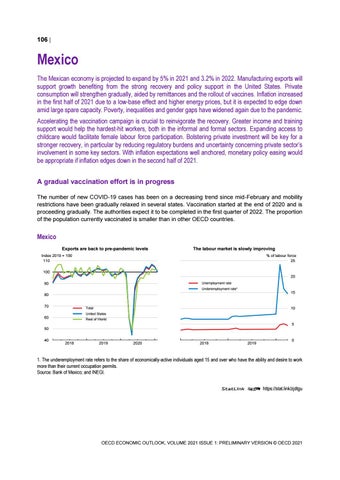
A two-speed recovery is underway The recovery has so far been mainly driven by external demand, with manufacturing exports above their pre-pandemic levels as they benefit from the strong rebound in the United States. Consumption remains 6% below its pre-pandemic level despite robust remittances. Investment is 13% below its pre-pandemic level and has been on a decreasing trend since 2018. Activity decelerated at the beginning of the year as mobility restrictions were reinstated in some states due to the intensification of the pandemic, supply disruptions of specific inputs and weather effects. As from mid-February, restrictions have been gradually relaxed, supporting more dynamic activity. Inflation has picked up, driven by energy prices and a low base effect. The labour market is improving, albeit very gradually, with underemployment remaining well above its pre-pandemic level. Nearly 550 thousand formal jobs have been lost since the start of the pandemic. Gender gaps in the labour market have increased as women were disproportionally affected by the crisis.
Monetary and financial policies are supporting the recovery The central bank resumed its easing cycle in February and has reduced policy rates by 325 basis points since February 2020. The financial sector is supported by large liquidity and credit facilities and a regulatory forbearance programme. Boosting access to finance is a key priority for the government, which has the potential to foster inclusive growth and private investment. The increase in public spending was moderate and revenues were resilient, supported by an enhanced administration and tax settlements with several large companies, resulting in a limited increase in the budget deficit to 3.9% of GDP in 2020. The official measure of public debt increased to 52% of GDP at end-2020 due to the budget deficit, the depreciation of the peso and the fall in GDP. The announced budget for 2021 foresees a reduction of the deficit to 3.3% of GDP and a stabilisation of the public debt-to-GDP ratio. OECD ECONOMIC OUTLOOK, VOLUME 2021 ISSUE 1: PRELIMINARY VERSION © OECD 2021
108
The recovery will become broader The economy is projected to expand by 5% in 2021. In the first half of the year, growth is estimated to have been mainly driven by exports. In the second half of 2021 and in 2022, with a larger share of the population vaccinated and the gradual improvement in the labour market, domestic consumption will also strengthen and become a key driver of growth. Investment will also pick up, partly thanks to planned infrastructure projects. Uncertainty remains very high. In case of a significant increase in infections, the restoration of containment measures would be needed, hampering economic activity. Disruptions in the vaccination rollout would slow the recovery of private consumption. Inflation may be higher than anticipated, eroding purchasing power, particularly of vulnerable households. Financial volatility in other emerging-market economies may trigger greater global risk aversion, reduce net financial inflows and increase Mexico’s financing costs. The flexible exchange rate is helping the economy to absorb external shocks, with further backstops provided by ample international reserves, USD swap lines and precautionary credit lines. On the upside, if the recovery in trading partners is stronger than anticipated, exports and job creation could be more robust. Supply-chain integration could deepen further thanks to the updated trade agreement with the United States and Canada, which entered into force in July 2020.
Fiscal policy could provide more support Containing new COVID-19 outbreaks and accelerating vaccination as much as possible are the key shortterm priorities. Fiscal prudence over the past years and rigorous public debt management provide Mexico with some space for additional temporary fiscal support, which could be targeted at individuals and firms hardest hit by the pandemic. Phasing out regressive tax exemptions could strengthen revenues in an inclusive way, creating additional fiscal space that would allow the government to strengthen social policies and public investment to facilitate the transition towards a greener and more digital economy.
OECD ECONOMIC OUTLOOK, VOLUME 2021 ISSUE 1: PRELIMINARY VERSION © OECD 2021