215
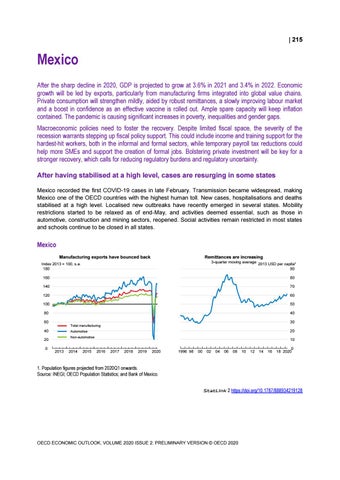
Mexico After the sharp decline in 2020, GDP is projected to grow at 3.6% in 2021 and 3.4% in 2022. Economic growth will be led by exports, particularly from manufacturing firms integrated into global value chains. Private consumption will strengthen mildly, aided by robust remittances, a slowly improving labour market and a boost in confidence as an effective vaccine is rolled out. Ample spare capacity will keep inflation contained. The pandemic is causing significant increases in poverty, inequalities and gender gaps. Macroeconomic policies need to foster the recovery. Despite limited fiscal space, the severity of the recession warrants stepping up fiscal policy support. This could include income and training support for the hardest-hit workers, both in the informal and formal sectors, while temporary payroll tax reductions could help more SMEs and support the creation of formal jobs. Bolstering private investment will be key for a stronger recovery, which calls for reducing regulatory burdens and regulatory uncertainty. After having stabilised at a high level, cases are resurging in some states Mexico recorded the first COVID-19 cases in late February. Transmission became widespread, making Mexico one of the OECD countries with the highest human toll. New cases, hospitalisations and deaths stabilised at a high level. Localised new outbreaks have recently emerged in several states. Mobility restrictions started to be relaxed as of end-May, and activities deemed essential, such as those in automotive, construction and mining sectors, reopened. Social activities remain restricted in most states and schools continue to be closed in all states.
Mexico Manufacturing exports have bounced back
Remittances are increasing 3-quarter moving average 2013 USD per capita¹ 90
Index 2013 = 100, s.a. 180 160
80
140
70
120
60
100
50
80
40
60 40
20
Automotive Non-automotive
20 0
30
Total manufacturing
2013
2014
2015
10 2016
2017
2018
2019
0 2020
0
1996 98
00
02
04
06
08
10
12
14
16
0 18 2020
1. Population figures projected from 2020Q1 onwards. Source: INEGI; OECD Population Statistics; and Bank of Mexico. StatLink 2 https://doi.org/10.1787/888934219128
OECD ECONOMIC OUTLOOK, VOLUME 2020 ISSUE 2: PRELIMINARY VERSION © OECD 2020
216 ď ź
Mexico: Demand, output and prices 2017
2018
Current prices MXN billion
Mexico GDP at market prices Private consumption Government consumption Gross fixed capital formation Final domestic demand Stockbuilding1 Total domestic demand Exports of goods and services Imports of goods and services Net exports1 Memorandum items GDP deflator Consumer price index Core inflation index2 Unemployment rate3 (% of labour force) Current account balance (% of GDP)
21 934.2 14 305.3 2 548.0 4 845.7 21 699.0 632.7 22 331.7 8 258.6 8 656.1 - 397.6 _ _ _ _ _
2019
2020
2021
2022
Percentage changes, volume (2013 prices)
2.2 2.4 2.8 1.0 2.1 -0.1 2.0 5.9 5.9 0.0
-0.3 0.4 -1.4 -5.1 -1.0 -0.2 -1.3 1.4 -0.9 0.9
-9.2 -10.9 2.4 -20.5 -11.3 -0.1 -11.5 -15.7 -17.5 0.6
3.6 2.3 -2.4 4.2 2.1 0.1 2.3 6.5 6.5 0.1
3.4 2.9 0.4 6.2 3.2 0.0 3.3 6.8 6.5 0.2
4.9 4.9 3.8 3.3 -2.1
3.3 3.6 3.7 3.5 -0.3
2.6 3.4 3.8 5.3 -0.2
3.1 3.2 3.3 5.0 -0.5
3.0 3.0 3.0 4.8 -0.9
1. Contributions to changes in real GDP, actual amount in the first column. 2. Consumer price index excluding volatile items: agricultural, energy and tariffs approved by various levels of government. 3. Based on National Employment Survey. Source: OECD Economic Outlook 108 database.
StatLink 2 https://doi.org/10.1787/888934219147
The economy has started to recover After a deep contraction in the second quarter, activity has started to recover. Manufacturing production, particularly in the automotive sector, is picking up. Construction has also started to recover, while services and retail sales have dropped about 10% since February 2020. According to short-term indicators, investment remains 17% below its level in 2019. Exports have bounced back, driven by the rebound in the United States. The labour market has also started to improve. The labour force declined by 12 million people in the second quarter, but it has increased by around 8 million people since then. However, the recovery in female labour participation has been more muted. Formal employment, which contracted by over one million during the first seven months of the year, has started to grow, particularly in those states with stronger links to global value chains. Employment in services related to finance and hospitality continues to contract.
A wide range of fiscal, financial and monetary policy measures have been taken Health spending has increased thanks to a substantial effort to reallocate spending. This allowed the hiring of 50 thousand additional health workers and pre-purchasing of vaccines to cover around 90% of the population. Other key fiscal measures include loans, front-loaded social pension payments, accelerated procurement processes and VAT refunds. The fiscal measures, although smaller in size than those taken in advanced and major emerging-market economies, go in the right direction. Efforts to continue reallocating spending are assumed to endure over the coming two years. The central bank has reduced interest rates by 400 basis points since mid-2019, to 4.25%. It has also supported the functioning of
OECD ECONOMIC OUTLOOK, VOLUME 2020 ISSUE 2: PRELIMINARY VERSION Š OECD 2020
217 financial markets and provided additional liquidity, up to 3.5% of GDP, to foster credit provision. Bank accounting regulations have also been adapted to facilitate credit restructuring.
The recovery will be moderate and uncertain GDP growth is projected at 3.6% in 2021, partly reflecting the carryover from the rebound in the second half of 2020. Exports of the manufacturing sector, strongly linked with US growth prospects, will be robust. An infrastructure plan, mainly financed by the private sector, and lower interest rates will contribute to a partial recovery of investment. The projections assume localised new virus outbreaks during 2021, requiring the persistence of some containment measures, which will weigh particularly on services requiring social interactions. The assumed rolling-out of a vaccine will boost confidence and consumption. Due to the economic contraction and the peso depreciation, the official measure of public debt will increase to above 55% of GDP this year, but it would decline gradually thereafter if government fiscal targets are met. Uncertainty remains very high. In case of a significant increase in infections, which could be aggravated by the start of the influenza season, restoring containment measures would be needed, hampering mobility and economic activity. A stronger risk aversion could reduce financial flows to emerging-market economies, increasing Mexico’s financing costs. The flexible exchange rate is helping the economy to absorb external shocks, with further backstops provided by ample international reserves, swap lines and precautionary credit lines. Additional disruptions in global value chains or foreign trade barriers would damage manufacturing activity. On the upside, if the recovery in trading partners is stronger than anticipated, exports and job creation could be higher. Integration in value chains could deepen further thanks to the new trade agreement with the United States and Canada.
Fiscal and monetary policies can provide more support Containing new COVID-19 outbreaks remains the imminent priority, requiring improvements in testing, tracing and isolating, while continuing to strengthen the health system. Fiscal and monetary policies have a key role to play to support the recovery. Fiscal prudence over the past years and rigorous public debt management provide Mexico with space for additional temporary fiscal support, which should be targeted at those individuals and firms hardest hit by the pandemic. This can be facilitated by better-than-expected tax revenues, thanks to recent successes by the tax administration to combat tax evasion. In the medium term, phasing out regressive tax exemptions could strengthen revenues in an inclusive way. With inflation expectations well anchored and ample spare capacity holding back inflation in the short term, lower monetary policy rates would provide further support to investment.
OECD ECONOMIC OUTLOOK, VOLUME 2020 ISSUE 2: PRELIMINARY VERSION © OECD 2020