173
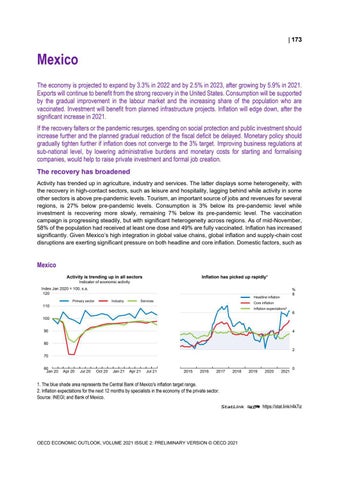
Mexico The economy is projected to expand by 3.3% in 2022 and by 2.5% in 2023, after growing by 5.9% in 2021. Exports will continue to benefit from the strong recovery in the United States. Consumption will be supported by the gradual improvement in the labour market and the increasing share of the population who are vaccinated. Investment will benefit from planned infrastructure projects. Inflation will edge down, after the significant increase in 2021. If the recovery falters or the pandemic resurges, spending on social protection and public investment should increase further and the planned gradual reduction of the fiscal deficit be delayed. Monetary policy should gradually tighten further if inflation does not converge to the 3% target. Improving business regulations at sub-national level, by lowering administrative burdens and monetary costs for starting and formalising companies, would help to raise private investment and formal job creation. The recovery has broadened Activity has trended up in agriculture, industry and services. The latter displays some heterogeneity, with the recovery in high-contact sectors, such as leisure and hospitality, lagging behind while activity in some other sectors is above pre-pandemic levels. Tourism, an important source of jobs and revenues for several regions, is 27% below pre-pandemic levels. Consumption is 3% below its pre-pandemic level while investment is recovering more slowly, remaining 7% below its pre-pandemic level. The vaccination campaign is progressing steadily, but with significant heterogeneity across regions. As of mid-November, 58% of the population had received at least one dose and 49% are fully vaccinated. Inflation has increased significantly. Given Mexico’s high integration in global value chains, global inflation and supply-chain cost disruptions are exerting significant pressure on both headline and core inflation. Domestic factors, such as
Mexico Activity is trending up in all sectors
Inflation has picked up rapidly¹
Indicator of economic activity Index Jan 2020 = 100, s.a. 120 Primary sector
Industry
% 8
Headline inflation
Services
Core inflation
110
Inflation expectations²
6 100 90
4
80 2 70 60 Jan 20
Apr 20
Jul 20
Oct 20
Jan 21
Apr 21
Jul 21
0
0
2015
2016
2017
2018
2019
2020
2021
0
1. The blue shade area represents the Central Bank of Mexico's inflation target range. 2. Inflation expectations for the next 12 months by specialists in the economy of the private sector. Source: INEGI; and Bank of Mexico. StatLink 2 https://stat.link/r4k7iz
OECD ECONOMIC OUTLOOK, VOLUME 2021 ISSUE 2: PRELIMINARY VERSION © OECD 2021
174
Mexico: Demand, output and prices 2018
2019
GDP at market prices Private consumption Government consumption Gross fixed capital formation Final domestic demand Stockbuilding¹ Total domestic demand Exports of goods and services Imports of goods and services Net exports¹ Memorandum items GDP deflator Consumer price index Core inflation index² Unemployment rate³ (% of labour force) Current account balance (% of GDP)
2021
2022
2023
Percentage changes, volume (2013 prices)
Current prices MXN billion
Mexico
2020
23 524.4 15 238.4 2 721.8 5 179.0
-0.2 0.4 -1.3 -4.7
-8.3 -10.5 2.3 -18.3
5.9 7.7 3.1 9.8
3.3 2.5 4.0 5.5
2.5 2.3 2.3 4.5
23 139.3 866.0
-0.9 -0.2
-10.5 -0.1
7.6 0.1
3.2 -0.1
2.7 0.0
24 005.3 9 235.1 9 716.0 - 480.9
-1.2 1.5 -0.7 0.8
-10.6 -7.3 -14.6 2.7
7.8 8.2 14.3 -1.9
3.2 6.4 5.6 0.4
2.8 5.3 5.8 -0.1
_ _ _ _ _
4.1 3.6 3.7 3.5 -0.3
2.9 3.4 3.8 4.4 2.3
6.2 5.6 4.5 4.1 -0.5
4.6 4.4 4.0 3.8 -0.6
3.2 3.3 3.3 3.6 -0.7
1. Contributions to changes in real GDP, actual amount in the first column. 2. Consumer price index excluding volatile items: agricultural, energy and tariffs approved by various levels of government. 3. Based on National Employment Survey. Source: OECD Economic Outlook 110 database.
StatLink 2 https://stat.link/wfe31u
the recovery in the demand for some services, and additional upward pressures on some food and energy prices are fuelling inflation. The labour market is gradually recovering. The standard unemployment rate, at 4.2%, is 0.8 percentage point above the level of late 2019. The rate jumps to 27% when considering also the population that remains outside the labour force and would accept a job and those who would like to work more hours.
Fiscal policy has become more supportive and monetary policy started to tighten The fiscal stance, while remaining cautious, is less restrictive than foreseen in the 2021 budget, mildly supporting the ongoing recovery. The budget deficit is expected to increase to 3.4% of GDP in 2021 (from 2.9% of GDP in 2020), remain broadly unchanged in 2022 and decrease thereafter. The official measure of public debt is expected to stabilise around 51% of GDP. Mexico’s tax-to-GDP ratio is the lowest in the OECD and lower than that of regional peers. Responding to increasing spending needs in education, health or social protection, while maintaining the commitment to debt sustainability, would require increasing tax revenues. This could be achieved by broadening tax bases, phasing out inefficient and regressive exemptions, and strengthening the property tax, once the recovery is well-established. The Central Bank of Mexico reduced policy rates by 325 basis points after February 2020 to support the recovery and provided large liquidity and credit facilities. As inflation significantly increased, the central bank appropriately raised policy rates by 25 basis points in its June, August, September and November meetings, bringing the policy rate to 5%. It is assumed that the rate will increase further to 5.25% by end-2021. If price pressures continue and inflation does not converge gradually to the 3% target, additional interest rate increases would be warranted.
OECD ECONOMIC OUTLOOK, VOLUME 2021 ISSUE 2: PRELIMINARY VERSION © OECD 2021
175
The recovery will continue The economy is projected to expand by 3.3% in 2022 and by 2.5% in 2023. With an increasing share of the population vaccinated and the improvement in the labour market, consumption will be a key growth driver. Exports will continue to benefit from deep integration into value chains. Inflation is expected to slow gradually in 2022 and 2023, as the effects of monetary policy tightening kick in, supply disruptions abate and ample spare capacity limits wage pressures. However, the inflation outlook remains very uncertain and subject to risks. Inflation may be higher for longer than anticipated, eroding purchasing power, particularly of vulnerable households, and requiring a larger tightening of monetary policy than projected, which would weaken the recovery. If infections significantly increase, restoring containment measures would be needed, hampering economic activity. Episodes of financial volatility in other emerging-market economies may trigger greater risk aversion, reduce net financial inflows and increase Mexico’s financing costs. On the upside, if growth in the United States is stronger than anticipated, exports and job creation could be more robust. Supply-chain integration could deepen further, due to the updated trade agreement with the United States and Canada. The recovery in tourism could be stronger than anticipated, boosting job creation in some regions.
Rebooting investment and boosting productivity are key priorities Expanding access to financial services, by boosting competition in financial markets and expediting the legal enforcement of contracts, would enable SMEs to invest more, grow and increase productivity. Improving access and the quality of childcare would increase female labour force participation and reduce educational inequalities. Allocating more resources towards primary education would mitigate the adverse effects of the pandemic on educational outcomes and long-term growth. Transitioning towards massive urban and inter-urban transport could substantially reduce traffic congestion and emissions.
OECD ECONOMIC OUTLOOK, VOLUME 2021 ISSUE 2: PRELIMINARY VERSION © OECD 2021