179
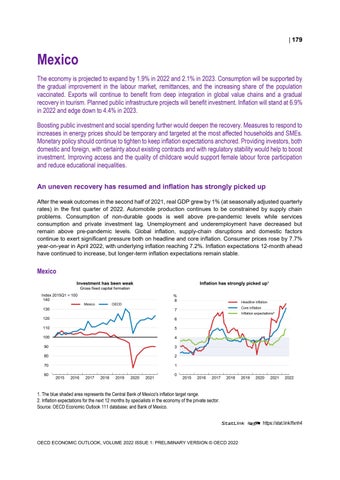
Mexico The economy is projected to expand by 1.9% in 2022 and 2.1% in 2023. Consumption will be supported by the gradual improvement in the labour market, remittances, and the increasing share of the population vaccinated. Exports will continue to benefit from deep integration in global value chains and a gradual recovery in tourism. Planned public infrastructure projects will benefit investment. Inflation will stand at 6.9% in 2022 and edge down to 4.4% in 2023. Boosting public investment and social spending further would deepen the recovery. Measures to respond to increases in energy prices should be temporary and targeted at the most affected households and SMEs. Monetary policy should continue to tighten to keep inflation expectations anchored. Providing investors, both domestic and foreign, with certainty about existing contracts and with regulatory stability would help to boost investment. Improving access and the quality of childcare would support female labour force participation and reduce educational inequalities. An uneven recovery has resumed and inflation has strongly picked up After the weak outcomes in the second half of 2021, real GDP grew by 1% (at seasonally adjusted quarterly rates) in the first quarter of 2022. Automobile production continues to be constrained by supply chain problems. Consumption of non-durable goods is well above pre-pandemic levels while services consumption and private investment lag. Unemployment and underemployment have decreased but remain above pre-pandemic levels. Global inflation, supply-chain disruptions and domestic factors continue to exert significant pressure both on headline and core inflation. Consumer prices rose by 7.7% year-on-year in April 2022, with underlying inflation reaching 7.2%. Inflation expectations 12-month ahead have continued to increase, but longer-term inflation expectations remain stable.
Mexico Investment has been weak
Inflation has strongly picked up¹
Gross fixed capital formation Index 2015Q1 = 100 140 Mexico
% 8
OECD
130
7
120
6
110
5
100
4
90
3
80
2
70
1
60
2015
2016
2017
2018
2019
2020
2021
0
0
Headline inflation Core inflation Inflation expectations²
2015
2016
2017
2018
2019
2020
2021
0 2022
1. The blue shaded area represents the Central Bank of Mexico's inflation target range. 2. Inflation expectations for the next 12 months by specialists in the economy of the private sector. Source: OECD Economic Outlook 111 database; and Bank of Mexico. StatLink 2 https://stat.link/lfxnh4
OECD ECONOMIC OUTLOOK, VOLUME 2022 ISSUE 1: PRELIMINARY VERSION © OECD 2022
180
Mexico: Demand, output and prices 2018
2019
GDP at market prices Private consumption Government consumption Gross fixed capital formation
2021
2022
2023
Percentage changes, volume (2013 prices)
Current prices MXN billion
Mexico
2020
23 524.4 15 238.4 2 721.8 5 179.0
-0.2 0.4 -1.8 -4.7
-8.2 -10.5 0.1 -17.8
4.8 7.4 1.0 10.0
1.9 4.1 3.2 2.3
2.1 2.7 2.2 2.7
Final domestic demand Stockbuilding¹
23 139.3 866.0
-1.0 -0.2
-10.7 -0.4
7.2 0.2
3.6 0.0
2.7 0.0
Total domestic demand Exports of goods and services Imports of goods and services Net exports¹
24 005.3 9 235.1 9 716.0 - 480.9
-1.3 1.5 -0.7 0.8
-11.3 -7.3 -13.7 2.4
7.6 6.9 13.7 -2.2
3.5 6.3 4.3 0.8
2.7 5.1 6.2 -0.4
_ _ _ _ _
4.1 3.6 3.7 3.5 -0.3
4.0 3.4 3.8 4.4 2.3
7.1 5.7 4.7 4.1 -0.4
7.0 6.9 6.7 3.6 -0.5
4.3 4.4 4.4 3.8 -0.7
Memorandum items GDP deflator Consumer price index Core inflation index² Unemployment rate³ (% of labour force) Current account balance (% of GDP) 1. Contributions to changes in real GDP, actual amount in the first column.
2. Consumer price index excluding volatile items: agricultural, energy and tariffs approved by various levels of government. 3. Based on National Employment Survey. Source: OECD Economic Outlook 111 database.
StatLink 2 https://stat.link/ozg4nr
The geopolitical turmoil resulting from war in Ukraine has generated a new source of uncertainty for the Mexican economy. While trade and financial ties with the countries in conflict are weak, Mexican exports would be impacted indirectly, mainly through the US economy. Global increases in commodity prices are also adding to existing inflationary pressures. Tax relief measures and generalised tax credits are cushioning the impact of higher energy prices. Higher interest rates in global financial markets will increase Mexico’s sovereign financing costs.
Fiscal policy can foster growth prospects The budget deficit is expected to increase to 3.1% of GDP in 2022, from 2.9% of GDP in 2021, and to decrease to 2.8% of GDP in 2023. The official measure of public debt is expected to stabilise around 50% of GDP. The ongoing recovery and medium-term growth prospects could be strengthened by increasing public investment, based on cost-benefit analysis, and targeted spending on social programmes. The commitment to debt sustainability could be maintained by gradually broadening tax bases, phasing out inefficient and regressive exemptions, and strengthening the property tax. To respond to mounting inflationary pressures, the central bank has increased interest rates in its last eight board meetings, leaving the rate at 7%. With widespread price pressures expected to persist, further interest rate increases are warranted. The interest rate is assumed to increase to 9% by the first quarter of 2023 and remain at that level in the rest of 2023. The government has taken steps to mitigate pressures in basic goods prices, including the elimination of tariffs for basic goods, cooperation with the private sector to freeze the prices of 24 key products (mainly food) for six months, measures to increase production of basic grains and the reduction of customs fees for basic goods.
OECD ECONOMIC OUTLOOK, VOLUME 2022 ISSUE 1: PRELIMINARY VERSION © OECD 2022
181
Growth will be moderate The economy is projected to expand by 1.9% in 2022 and 2.1% in 2023. Domestic consumption will be a key growth driver while services related to tourism will gradually recover. Exports will continue to benefit from deep integration into value chains. Inflation is expected to increase in 2022 and gradually slowdown in 2023, as the impact of higher interest rates take effect and ample spare capacity limits wage pressures. However, the inflation outlook remains very uncertain. Inflation may be higher for longer, eroding purchasing power, particularly of vulnerable households, and requiring a larger tightening of monetary policy. If infections increase, mobility could decrease, hampering economic activity. Episodes of financial volatility may trigger greater risk aversion, reduce net financial inflows and increase financing costs. On the upside, near-shoring opportunities could imply stronger exports. The recovery in tourism could be quicker than anticipated.
Restarting investment and boosting productivity are key priorities Improving business regulations at sub-national level, by lowering administrative burdens and monetary costs for starting and formalising companies, would help to raise investment and formal job creation. Ensuring independent competition authorities and regulators, with sufficient budget to carry out their functions, would also boost competition and productivity. Allocating more resources towards primary education would mitigate the adverse effects the pandemic had on educational outcomes. Transitioning towards massive urban and interurban transport and promoting renewables energies could reduce emissions and the use of fossil fuels.
OECD ECONOMIC OUTLOOK, VOLUME 2022 ISSUE 1: PRELIMINARY VERSION © OECD 2022