SMEs and Entrepreneurship: scaling opportunities for inclusive growth
SMEs are the backbone of MENA economies
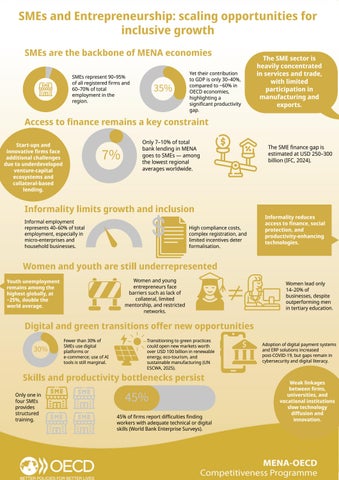
SMEs represent 90–95% of all registered firms and 60–70% of total employment in the region.
Yet their contribution to GDP is only 30–40%, compared to ~60% in OECD economies, highlighting a significant productivity gap.
Access to finance remains a key constraint
Start-ups and innovative firms face additional challenges due to underdeveloped venture-capital ecosystems and collateral-based lending.
Only 7–10% of total bank lending in MENA goes to SMEs — among the lowest regional averages worldwide.
Informality limits growth and inclusion
Informal employment represents 40–60% of total employment, especially in micro-enterprises and household businesses.
High compliance costs, complex registration, and limited incentives deter formalisation.
Women and youth are still underrepresented
The SME sector is heavily concentrated in services and trade, with limited participation in manufacturing and exports.
The SME finance gap is estimated at USD 250–300 billion (IFC, 2024).
Informality reduces access to finance, social protection, and productivity-enhancing technologies.

Women lead only 14–20% of businesses, despite outperforming men in tertiary education. Youth unemployment remains among the highest globally, at ~25%, double the world average.
Women and young entrepreneurs face barriers such as lack of collateral, limited mentorship, and restricted networks.
Digital and green transitions offer new opportunities
Fewer than 30% of SMEs use digital platforms or e-commerce; use of AI tools is still marginal.
Transitioning to green practices could open new markets worth over USD 100 billion in renewable energy, eco-tourism, and sustainable manufacturing (UN ESCWA, 2025).
Skills and productivity bottlenecks persist
Only one in four SMEs provides structured training.
45% of firms report difficulties finding workers with adequate technical or digital skills (World Bank Enterprise Surveys).
Adoption of digital payment systems and ERP solutions increased post-COVID-19, but gaps remain in cybersecurity and digital literacy.
Weak linkages between firms, universities, and vocational institutions slow technology diffusion and innovation.