103
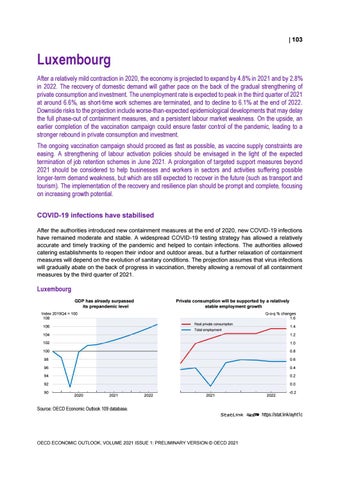
Luxembourg After a relatively mild contraction in 2020, the economy is projected to expand by 4.8% in 2021 and by 2.8% in 2022. The recovery of domestic demand will gather pace on the back of the gradual strengthening of private consumption and investment. The unemployment rate is expected to peak in the third quarter of 2021 at around 6.6%, as short-time work schemes are terminated, and to decline to 6.1% at the end of 2022. Downside risks to the projection include worse-than-expected epidemiological developments that may delay the full phase-out of containment measures, and a persistent labour market weakness. On the upside, an earlier completion of the vaccination campaign could ensure faster control of the pandemic, leading to a stronger rebound in private consumption and investment. The ongoing vaccination campaign should proceed as fast as possible, as vaccine supply constraints are easing. A strengthening of labour activation policies should be envisaged in the light of the expected termination of job retention schemes in June 2021. A prolongation of targeted support measures beyond 2021 should be considered to help businesses and workers in sectors and activities suffering possible longer-term demand weakness, but which are still expected to recover in the future (such as transport and tourism). The implementation of the recovery and resilience plan should be prompt and complete, focusing on increasing growth potential. COVID-19 infections have stabilised After the authorities introduced new containment measures at the end of 2020, new COVID-19 infections have remained moderate and stable. A widespread COVID-19 testing strategy has allowed a relatively accurate and timely tracking of the pandemic and helped to contain infections. The authorities allowed catering establishments to reopen their indoor and outdoor areas, but a further relaxation of containment measures will depend on the evolution of sanitary conditions. The projection assumes that virus infections will gradually abate on the back of progress in vaccination, thereby allowing a removal of all containment measures by the third quarter of 2021.
Luxembourg GDP has already surpassed its prepandemic level
Private consumption will be supported by a relatively stable employment growth
Index 2019Q4 = 100 108
Q-o-q % changes 1.6 Real private consumption
106
1.4
Total employment
104
1.2
102
1.0
100
0.8
98
0.6
96
0.4
94
0.2
92 90
0.0 2020
2021
2022
0
0
2021
2022
-0.2
Source: OECD Economic Outlook 109 database. StatLink 2 https://stat.link/ayht1c
OECD ECONOMIC OUTLOOK, VOLUME 2021 ISSUE 1: PRELIMINARY VERSION © OECD 2021
104
Luxembourg 2017
2018
GDP at market prices Private consumption Government consumption Gross fixed capital formation Final domestic demand Stockbuilding1 Total domestic demand Exports of goods and services Imports of goods and services Net exports1 Memorandum items GDP deflator Harmonised index of consumer prices Harmonised index of core inflation2 Unemployment rate (% of labour force) Household saving ratio, net (% of disposable income) General government financial balance (% of GDP) General government gross debt (% of GDP) General government debt, Maastricht definition (% of GDP) Current account balance (% of GDP)
2020
2021
2022
Percentage changes, volume (2010 prices)
Current prices EUR billion
Luxembourg
2019
56.8 16.9 9.4 10.7 37.0 - 0.1 36.8 123.6 103.6 20.0
3.1 3.3 4.0 -6.1 0.8 1.0 2.3 0.4 -0.3 1.6
2.3 2.8 4.9 3.9 3.7 -0.2 3.3 0.8 0.9 0.2
-1.3 -6.9 6.0 -8.2 -3.7 -0.5 -4.3 2.4 2.1 1.4
4.8 6.4 2.9 6.1 5.3 -0.3 4.7 7.6 7.2 3.6
2.8 5.0 2.3 5.0 4.2 0.0 4.3 4.2 5.0 0.2
_ _ _ _ _ _ _ _ _
2.5 2.0 0.9 5.4 16.0 3.0 28.9 21.0 4.8
3.4 1.6 1.8 5.4 18.1 2.4 30.0 22.0 4.6
2.3 0.0 1.2 6.3 27.4 -4.1 33.0 24.9 4.3
2.2 2.2 1.2 6.4 22.1 -3.6 33.4 25.2 5.1
1.3 1.3 1.3 6.2 19.2 -2.5 33.9 25.8 5.3
1. Contributions to changes in real GDP, actual amount in the first column. 2. Harmonised index of consumer prices excluding food, energy, alcohol and tobacco. Source: OECD Economic Outlook 109 database.
StatLink 2 https://stat.link/gjt1ar
The recovery has lost some momentum The economy experienced a limited contraction in 2020, thanks to a strong performance in the second half of the year. In recent quarters, the industry purchasing managers' index (PMI) has improved, but remains below pre-crisis levels. Retail sales have flattened since the fourth quarter of 2020, but the labour market has gradually improved in 2021, with the unemployment rate falling since January.
The fiscal stance will be broadly neutral in 2021 Large tax, expenditure and financial measures were put in place in 2020 to mitigate the impact of the pandemic on the economy. Tax and social contributions deferrals were introduced to alleviate the liquidity situation of businesses and the self-employed during the lockdown. Eligible companies benefited from repayable advances, which aimed to support SMEs affected by the COVID-19 outbreak. Job retention schemes were extended in duration and modified to maximise their take-up. Additional funds have been budgeted for 2021 to support firms and the most affected activities, such as hotels, restaurants and bars, for a total of about EUR 100 million. However, the overall fiscal stance in 2021 will be roughly neutral, on account of the progressive reduction of social benefits linked to the planned termination of some support measures, such as those linked to the strengthening and time extension of job retention schemes. In 2022, the fiscal stance will become slightly contractionary, on the back of the termination of current business support programmes.
OECD ECONOMIC OUTLOOK, VOLUME 2021 ISSUE 1: PRELIMINARY VERSION © OECD 2021
105
The recovery will be underpinned by growth in domestic demand GDP is projected to grow by 4.8% in 2021, and then slow to 2.8% in 2022. Domestic demand will gradually strengthen through 2021 and 2022. Private consumption will be underpinned by a gradual improvement in the labour market, and by the gradual normalisation of saving after an increase in the saving rate in the wake of the crisis. Private investment will rebound on the back of the expansion in domestic consumption and stable external demand. Public investments linked to the implementation of the recovery and resilience plan will be deployed from the second half of 2021. The unemployment rate started to decline in the second half of 2020, but is expected to increase again, albeit temporarily, in the third quarter of 2021, on the back of the planned termination of short-time work schemes. Downside risks to the projection include worse-than-expected epidemiological developments that may delay the full phase-out of containment measures currently in place. A slower-than-expected recovery in the labour market could weaken the rebound in private consumption. On the upside, an earlier completion of the vaccination campaign could lead to faster control of the pandemic and induce a stronger rebound in private consumption and investment.
Targeted policy support should continue The expected termination of job retention schemes in June calls for a strengthening of activation policies to speed up job re-allocation. Maintaining a high speed of vaccination is crucial for a stable improvement of the sanitary situation. A prolongation of targeted support measures beyond 2021 should be considered in support of businesses and workers in sectors and activities suffering possible longer-term demand weakness, but which are still expected to recover in the future (such as transport and tourism). The policy focus should be on the prompt implementation of the EU recovery and resilience plan, as to restore growth and create jobs by achieving environmental goals. To this end, infrastructure investment should be boosted to facilitate connectivity and improving environmental outcomes, for example by ameliorating sustainability in transport infrastructure and construction.
OECD ECONOMIC OUTLOOK, VOLUME 2021 ISSUE 1: PRELIMINARY VERSION © OECD 2021