212
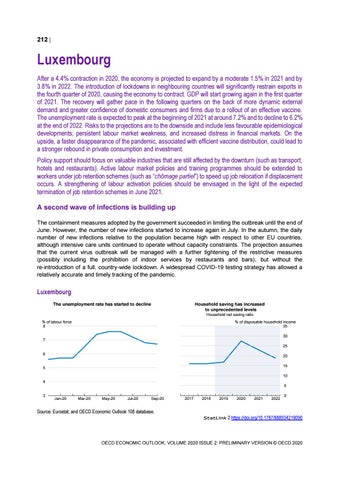
Luxembourg After a 4.4% contraction in 2020, the economy is projected to expand by a moderate 1.5% in 2021 and by 3.8% in 2022. The introduction of lockdowns in neighbouring countries will significantly restrain exports in the fourth quarter of 2020, causing the economy to contract. GDP will start growing again in the first quarter of 2021. The recovery will gather pace in the following quarters on the back of more dynamic external demand and greater confidence of domestic consumers and firms due to a rollout of an effective vaccine. The unemployment rate is expected to peak at the beginning of 2021 at around 7.2% and to decline to 6.2% at the end of 2022. Risks to the projections are to the downside and include less favourable epidemiological developments, persistent labour market weakness, and increased distress in financial markets. On the upside, a faster disappearance of the pandemic, associated with efficient vaccine distribution, could lead to a stronger rebound in private consumption and investment. Policy support should focus on valuable industries that are still affected by the downturn (such as transport, hotels and restaurants). Active labour market policies and training programmes should be extended to workers under job retention schemes (such as “chômage partiel”) to speed up job relocation if displacement occurs. A strengthening of labour activation policies should be envisaged in the light of the expected termination of job retention schemes in June 2021. A second wave of infections is building up The containment measures adopted by the government succeeded in limiting the outbreak until the end of June. However, the number of new infections started to increase again in July. In the autumn, the daily number of new infections relative to the population became high with respect to other EU countries, although intensive care units continued to operate without capacity constraints. The projection assumes that the current virus outbreak will be managed with a further tightening of the restrictive measures (possibly including the prohibition of indoor services by restaurants and bars), but without the re-introduction of a full, country-wide lockdown. A widespread COVID-19 testing strategy has allowed a relatively accurate and timely tracking of the pandemic.
Luxembourg The unemployment rate has started to decline
Household saving has increased to unprecedented levels Household net saving ratio
% of labour force 8
% of disposable household income 35 30
7
25 6
20 15
5
10 4 3
5 Jan-20
Mar-20
May-20
Jul-20
0 Sep-20
0
2017
2018
2019
2020
2021
2022
0
Source: Eurostat; and OECD Economic Outlook 108 database. StatLink 2 https://doi.org/10.1787/888934219090
OECD ECONOMIC OUTLOOK, VOLUME 2020 ISSUE 2: PRELIMINARY VERSION © OECD 2020
213
Luxembourg: Demand, output and prices 2017
Luxembourg GDP at market prices Private consumption Government consumption Gross fixed capital formation Final domestic demand Stockbuilding1 Total domestic demand Exports of goods and services Imports of goods and services Net exports1 Memorandum items GDP deflator Harmonised index of consumer prices Harmonised index of core inflation2 Unemployment rate (% of labour force) Household saving ratio, net (% of disposable income) General government financial balance (% of GDP) General government gross debt (% of GDP) General government debt, Maastricht definition (% of GDP) Current account balance (% of GDP)
2018
2019
2020
2021
2022
Percentage changes, volume (2010 prices)
Current prices EUR billion
56.8 16.9 9.4 10.7 37.0 - 0.1 36.8 123.5 103.6 20.0
3.1 3.3 4.0 -6.1 0.8 1.0 2.3 0.5 -0.3 1.7
2.3 2.8 4.9 4.0 3.7 -0.2 3.4 0.8 0.9 0.2
-4.4 -12.4 4.0 -17.5 -9.3 -0.2 -9.5 -1.2 -2.4 1.6
1.5 2.7 2.2 5.1 3.1 0.0 3.1 2.5 3.1 -0.2
3.8 5.7 1.0 6.5 4.4 0.0 4.4 3.5 3.7 1.1
_ _ _ _ _ _ _ _ _
2.5 2.0 0.9 5.5 16.0 3.1 28.9 21.0 4.8
3.4 1.6 1.8 5.4 16.8 2.4 30.0 22.0 4.6
3.2 0.1 1.2 6.4 27.4 -6.1 35.3 27.3 2.7
1.6 0.9 1.1 7.0 23.1 -6.1 42.8 34.9 2.7
1.2 1.3 1.3 6.4 18.8 -4.7 49.4 41.5 3.5
1. Contributions to changes in real GDP, actual amount in the first column. 2. Harmonised index of consumer prices excluding food, energy, alcohol and tobacco. Source: OECD Economic Outlook 108 database.
StatLink 2 https://doi.org/10.1787/888934219109
The economic rebound has been interrupted In the second quarter of 2020, the economy shrank by 7.2% quarter-on-quarter, on the back of a steep decline in private consumption and investment. This was the largest-ever GDP drop over a single quarter, but smaller than in most other EU economies. This is partially thanks to the relative resilience of the financial sector and its large role in the economy. From May onwards, a gradual relaxation of containment measures enabled an economic rebound. Industry purchasing managers' index (PMI) and retail sales have recovered from the lows in April, and the labour market has continued to improve, with the unemployment rate declining from its peak of 7.4% in May. However, in line with the deterioration in the epidemiological situation in Europe, and as a consequence of the introduction of new strict containment measures in some key trading partners, such as France and Germany, the economy is estimated to have contracted in the last quarter of 2020 and the recovery is to resume only in 2021.
The policy support has been strong A number of tax, expenditure and financial measures have been put in place to reduce the impact of the pandemic and related containment measures on the economy. Tax and social security charge deferrals were introduced to alleviate the liquidity situation of businesses and the self-employed during the lockdown. Eligible companies benefited from repayable advances which aimed to support SMEs affected by the COVID-19 outbreak. This adds to the six-month moratorium on debt repayments voluntarily agreed by banks in April. At the same time, to facilitate new lending, the government set up a loan guarantee facility of EUR 2.5 billion for new credit lines until the end of 2020. The short-time work scheme (“chômage partiel”) has been extended until June 2021. OECD ECONOMIC OUTLOOK, VOLUME 2020 ISSUE 2: PRELIMINARY VERSION © OECD 2020
214
The recovery will gather pace from mid-2021 but risks persist After an estimated GDP contraction in the fourth quarter of 2020, driven by a steep decline in exports, the recovery will resume in early 2021. It will gain momentum throughout that year, on the back of more dynamic external demand and greater confidence of domestic consumers and firms. GDP is projected to grow at 1.5% in 2021 and 3.8% in 2022, assuming that the pandemic gradually gets under control with the implementation of an effective vaccine. After a large fiscal expansion in 2020, the fiscal stance will be slightly contractionary in 2021 and 2022. The unemployment rate is expected to peak in the first quarter of 2021 at 7.2% and to decline to 6.2% at the end of 2022. Favourable financing conditions and funds provided through the EU Recovery and Resilience Facility will support investment in 2021. Risks to the projections are to the downside and include a worsening of the epidemiological situation and prolonged weakness in some employment-intensive industries, such as hotels and restaurants. Subdued external demand can weigh on the economy for longer, and possible increased distress in the financial sector could derail the recovery. On the upside, a faster control of the current virus outbreak, or better-than-expected outcomes in the development and distribution of vaccines, could lead to a stronger rebound.
Policy support should become better targeted To prepare for the expected termination of short-time work schemes, labour activation policies should be expanded and extended to workers in job retention schemes (such as “chômage partiel”) to speed up re-employment. Should the recovery be delayed further, a selective extension of short-time work schemes beyond mid-2021 should be considered in sectors particularly hit by the crisis but with longer-term viability (i.e. transport, restaurants and hospitality).
OECD ECONOMIC OUTLOOK, VOLUME 2020 ISSUE 2: PRELIMINARY VERSION © OECD 2020