170
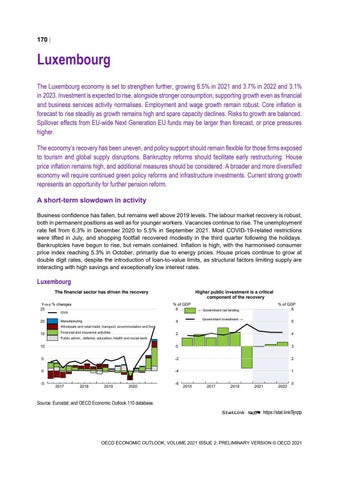
Luxembourg The Luxembourg economy is set to strengthen further, growing 6.5% in 2021 and 3.7% in 2022 and 3.1% in 2023. Investment is expected to rise, alongside stronger consumption, supporting growth even as financial and business services activity normalises. Employment and wage growth remain robust. Core inflation is forecast to rise steadily as growth remains high and spare capacity declines. Risks to growth are balanced. Spillover effects from EU-wide Next Generation EU funds may be larger than forecast, or price pressures higher. The economy’s recovery has been uneven, and policy support should remain flexible for those firms exposed to tourism and global supply disruptions. Bankruptcy reforms should facilitate early restructuring. House price inflation remains high, and additional measures should be considered. A broader and more diversified economy will require continued green policy reforms and infrastructure investments. Current strong growth represents an opportunity for further pension reform. A short-term slowdown in activity Business confidence has fallen, but remains well above 2019 levels. The labour market recovery is robust, both in permanent positions as well as for younger workers. Vacancies continue to rise. The unemployment rate fell from 6.3% in December 2020 to 5.5% in September 2021. Most COVID-19-related restrictions were lifted in July, and shopping footfall recovered modestly in the third quarter following the holidays. Bankruptcies have begun to rise, but remain contained. Inflation is high, with the harmonised consumer price index reaching 5.3% in October, primarily due to energy prices. House prices continue to grow at double digit rates, despite the introduction of loan-to-value limits, as structural factors limiting supply are interacting with high savings and exceptionally low interest rates.
Luxembourg The financial sector has driven the recovery
Higher public investment is a critical component of the recovery
Y-o-y % changes 25
% of GDP 6
GVA
20
Manufacturing
% of GDP 6
← Government net lending Government investment →
4
5
Wholesale and retail trade, transport, accommodation and food
15
Financial and insurance activities
2
4
10
0
3
5
-2
2
0
-4
1
Public admin., defence, education, health and social work
-5
2017
2018
2019
2020
0
-6
2015
2017
2019
2021
2023
0
Source: Eurostat; and OECD Economic Outlook 110 database. StatLink 2 https://stat.link/9jrqtp
OECD ECONOMIC OUTLOOK, VOLUME 2021 ISSUE 2: PRELIMINARY VERSION © OECD 2021
171
Luxembourg: Demand, output and prices 2018
Luxembourg GDP at market prices Private consumption Government consumption Gross fixed capital formation Final domestic demand Stockbuilding¹ Total domestic demand Exports of goods and services Imports of goods and services Net exports¹ Memorandum items GDP deflator Harmonised index of consumer prices Harmonised index of core inflation² Unemployment rate (% of labour force) Household saving ratio, net (% of disposable income) General government financial balance (% of GDP) General government gross debt (% of GDP) General government debt, Maastricht definition³ (% of GDP) Current account balance (% of GDP)
2019
_ _ _ _ _ _ _ _ _
2021
2022
2023
Percentage changes, volume (2015 prices)
Current prices EUR billion
60.3 20.2 10.1 9.8 40.1 0.5 40.6 118.5 98.8 19.7
2020
3.3 2.5 3.8 9.9 4.6 0.0 4.7 5.8 6.9 0.1
-1.8 -6.9 6.7 -4.3 -2.7 0.2 -2.8 1.2 1.6 -0.3
6.5 3.2 3.5 11.5 5.4 -0.3 4.7 10.8 10.2 4.6
3.7 6.0 2.9 5.2 5.0 0.2 5.4 3.4 4.1 0.2
3.1 3.0 3.3 2.9 3.0 0.1 3.3 3.0 3.1 1.0
0.6 1.6 1.8 5.4 7.9 2.3 30.3 22.3 4.6
4.3 0.0 1.2 6.4 18.1 -3.5 32.6 24.8 4.3
4.6 3.2 1.3 5.8 19.9 -0.1 33.7 25.8 4.4
2.2 2.9 1.8 5.3 17.3 0.3 36.5 26.1 4.2
2.0 2.0 2.0 5.2 14.0 0.6 38.3 25.9 4.3
1. Contributions to changes in real GDP, actual amount in the first column. 2. Harmonised index of consumer prices excluding food, energy, alcohol and tobacco. 3. The Maastricht definition of general government debt includes only loans, debt securities, and currency and deposits, with debt at face value rather than market value. Source: OECD Economic Outlook 110 database.
StatLink 2 https://stat.link/0t1vzh
Fiscal policy aims to encourage higher investment and greener growth The government’s crisis response included existing household income support, supplemented with liquidity and financing of short-time work schemes and more generous parental and sick leave. More generous short-time wage support was extended to firms struggling with severe flooding in July this year and construction materials shortages. The government plans for the budget deficit to almost close by 2023, as the economic recovery reduces transfers and incentive schemes, and revenues recover. The OECD forecast is for a faster improvement, thanks to stronger growth. Higher public investment of over 4% of GDP between 2022 and 2023 is intended to support infrastructure and innovation. Most of the recovery and resilience plan spending (EUR 183 million or 0.3% of GDP) will be completed by 2024. The government introduced a carbon tax in January 2021 to raise the price of carbon to EUR 20 per tonne; the price will rise to EUR 30 per tonne in 2023. To help mitigate the impact, public transport has been free since the beginning of 2021. The government’s green policy also includes efforts to improve private energy efficiency, encourage electric vehicle adoption and raise recycling capacity.
OECD ECONOMIC OUTLOOK, VOLUME 2021 ISSUE 2: PRELIMINARY VERSION © OECD 2021
172
Continued expansion is likely as sectors hit by COVID-19 normalise GDP growth is expected to be 6.5% in 2021 before moderating to 3.7% in 2022 and 3.1% in 2023. Household consumption will rise in 2022, due to reduced restrictions, the return to more on-site working and a robust recovery in employment. Public sector investments will be positive throughout the forecast period. COVID-related incentives to support a greener investment path will increase private investment, particularly in 2021, with strong demand sustaining growth from 2022. Export growth will moderate in 2022 and 2023 following exceptionally strong financial market services activity in 2021, but is forecast to remain positive as supply-chain restrictions lift. Core inflation is expected to rise as a tight labour market raises cost pressures against a backdrop of strong demand. Automatic wage indexation raised all gross salaries by 2.5% in October 2021. Risks to the outlook are balanced. Spillover effects from Next Generation EU funds or stronger than expected financial market performance could raise export growth relative to the forecast. Heightened global financial market volatility could negatively affect activity, exports and financial sector earnings. A faster rise in COVID infections could slow the pace of recovery.
A stronger recovery requires a consistent focus on productivity and investment The government must remain ready to act, despite the strong recovery. Viable firms exposed to tourism and global supply disruptions may still require targeted support. Cross-border labour tax agreements may still be necessary depending on the pandemic’s global evolution. Increasing the economy’s productive capacity, with more investment and faster firm growth, would help offset rising inflationary pressures. Bankruptcy reforms should enable early restructuring and facilitate second chances. Additional macro-prudential measures to manage the pace of house price growth and its inflationary impact should be considered. Public investment in housing market infrastructure and cross-border rail systems can be complemented with congestion charges, smart electricity grids and better interconnectivity in electricity and gas markets to further support behaviour change. This would reinforce carbon pricing. The fast recovery from the crisis provides an opportunity to improve the fiscal balance in the long term by raising the reabsorption rate of older workers into the workforce through pension reforms.
OECD ECONOMIC OUTLOOK, VOLUME 2021 ISSUE 2: PRELIMINARY VERSION © OECD 2021