176
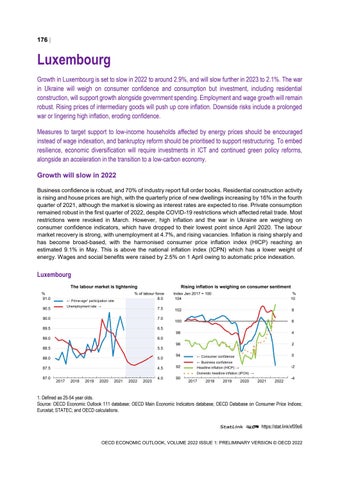
Luxembourg Growth in Luxembourg is set to slow in 2022 to around 2.9%, and will slow further in 2023 to 2.1%. The war in Ukraine will weigh on consumer confidence and consumption but investment, including residential construction, will support growth alongside government spending. Employment and wage growth will remain robust. Rising prices of intermediary goods will push up core inflation. Downside risks include a prolonged war or lingering high inflation, eroding confidence. Measures to target support to low-income households affected by energy prices should be encouraged instead of wage indexation, and bankruptcy reform should be prioritised to support restructuring. To embed resilience, economic diversification will require investments in ICT and continued green policy reforms, alongside an acceleration in the transition to a low-carbon economy. Growth will slow in 2022 Business confidence is robust, and 70% of industry report full order books. Residential construction activity is rising and house prices are high, with the quarterly price of new dwellings increasing by 16% in the fourth quarter of 2021, although the market is slowing as interest rates are expected to rise. Private consumption remained robust in the first quarter of 2022, despite COVID-19 restrictions which affected retail trade. Most restrictions were revoked in March. However, high inflation and the war in Ukraine are weighing on consumer confidence indicators, which have dropped to their lowest point since April 2020. The labour market recovery is strong, with unemployment at 4.7%, and rising vacancies. Inflation is rising sharply and has become broad-based, with the harmonised consumer price inflation index (HICP) reaching an estimated 9.1% in May. This is above the national inflation index (ICPN) which has a lower weight of energy. Wages and social benefits were raised by 2.5% on 1 April owing to automatic price indexation.
Luxembourg The labour market is tightening % 91.0
← Prime-age¹ participation rate
Rising inflation is weighing on consumer sentiment
% of labour force 8.0
Unemployment rate →
90.5
7.5
90.0
7.0
89.5
6.5
89.0
6.0
88.5
5.5
88.0
5.0
Index Jan 2017 = 100 104
% 10
102
8
100
6
98
4
96
2
94
0
← Consumer confidence ← Business confidence
87.5
4.5
92
-2
Headline inflation (HICP) → Domestic headline inflation (IPCN) →
87.0
2017
2018
2019
2020
2021
2022
2023
4.0
90
2017
2018
2019
2020
2021
2022
-4
1. Defined as 25-54 year olds. Source: OECD Economic Outlook 111 database; OECD Main Economic Indicators database; OECD Database on Consumer Price Indices; Eurostat; STATEC; and OECD calculations. StatLink 2 https://stat.link/xf09o6 OECD ECONOMIC OUTLOOK, VOLUME 2022 ISSUE 1: PRELIMINARY VERSION © OECD 2022
177
Luxembourg: Demand, output and prices 2018
Luxembourg GDP at market prices Private consumption Government consumption Gross fixed capital formation Final domestic demand Stockbuilding¹ Total domestic demand Exports of goods and services Imports of goods and services Net exports¹ Memorandum items GDP deflator Harmonised index of consumer prices Harmonised index of core inflation² Unemployment rate (% of labour force) Household saving ratio, net (% of disposable income) General government financial balance (% of GDP) General government gross debt (% of GDP) General government debt, Maastricht definition³ (% of GDP) Current account balance (% of GDP)
2019
2020
2021
2022
2023
Percentage changes, volume (2015 prices)
Current prices EUR billion
60.3 20.2 10.1 9.8
3.3 2.5 3.8 10.0
-1.8 -6.9 6.8 -4.3
6.9 7.4 4.7 11.8
2.9 3.4 3.6 4.2
2.1 2.2 3.5 4.1
40.1 0.5
4.6 0.0
-2.7 0.2
7.8 -0.2
3.7 -0.5
3.0 0.0
40.6 118.5 98.8 19.7
4.7 5.8 6.9 0.2
-2.8 1.2 1.6 -0.3
7.2 9.8 10.5 2.1
2.7 0.8 0.7 0.5
3.0 2.3 2.6 0.1
0.6 1.6 1.8 5.4
4.3 0.0 1.2 6.4
6.8 3.5 1.5 5.7
5.8 8.0 4.3 4.7
1.9 3.3 3.4 5.0
7.9 2.3 29.9 22.3 4.6
18.1 -3.4 32.3 24.8 4.1
17.1 0.9 30.6 24.4 4.8
15.3 0.9 33.7 27.5 3.4
15.3 0.9 34.6 28.4 3.7
_ _ _ _ _ _ _ _ _
1. Contributions to changes in real GDP, actual amount in the first column. 2. Harmonised index of consumer prices excluding food, energy, alcohol and tobacco. 3. The Maastricht definition of general government debt includes only loans, debt securities, and currency and deposits, with debt at face value rather than market value. Source: OECD Economic Outlook 111 database.
StatLink 2 https://stat.link/scdr3q
Luxembourg’s economy is relatively sheltered from direct negative consequences from the war in Ukraine or the sanctions imposed on Russia, as total trade exposure is minimal. Most gas imports are from LNG facilities in Belgium and the Netherlands, with a large share of Norwegian gas. Total energy imports are roughly 12% of total trade, with Russian oil accounting for less than 5% of direct oil imports. The authorities have taken steps to diversify supply by sourcing oil from the Middle East. However, the EU oil embargo on Russia in 2023 will further increase energy prices, which will spill over into electricity, transport and food prices, as well as intermediary goods. Luxembourg has taken in almost 5 000 Ukrainian refugees, around 1% of the population, mostly women and minors. They have been granted exceptional status, which allows them to seek work. Affordable accommodation is scarce, and temporary hosting facilities have reached full occupancy, putting the housing market further under strain.
Fiscal policy will remain supportive In response to the energy price shock, the government has implemented several measures, including a cash allowance to disadvantaged households, and reduced network costs for gas and electricity. The total support to mitigate rising energy prices is around EUR 830 million with an additional EUR 500 million in business loan guarantees (around 1.7% of GDP in total). Public investment of over 4% of GDP in 2022 and 2023 will be implemented in order to support infrastructure and innovation. The government is implementing the carbon tax, which was introduced in 2021, with a EUR 5 increase in 2022 to EUR 25 per tonne and EUR 30 per tonne in 2023. The government has announced its intention to accelerate the switch to renewable energy. OECD ECONOMIC OUTLOOK, VOLUME 2022 ISSUE 1: PRELIMINARY VERSION © OECD 2022
178
Economic growth will return closer to potential over the next two years GDP growth recovered strongly to 6.9% in 2021 and is expected to moderate to 2.9% in 2022, and 2.1% in 2023. Revised data point to robust household consumption in recent quarters, but it is expected to slow in the second quarter of 2022. High inflation is eroding confidence as well as disposable incomes. Public sector investment will support growth in 2022-23, and residential construction will gradually pick up. Incentives to accelerate the green transition will increase private investment, particularly in 2022. Export growth will moderate in 2022 and 2023 following strong financial market services activity in 2021. Supply-chain restrictions will also weigh on the export outlook this year. Core inflation is projected to rise on the back of rising wages, a still tight labour market, and persistent supply-side bottlenecks, and is likely to linger in 2023. Risks to the outlook are mainly on the downside. A prolonged war in Ukraine will weigh on business and consumer sentiment, as will an extended period of high inflation. Increasing financial market volatility, against a backdrop of rising insecurity linked to the war, would negatively affect activity, exports and financial sector earnings.
To embed resilience, policy should focus on productivity and investment Vulnerable households affected by rising energy prices could benefit more from means-tested income support rather than automatic wage indexation, which kicks in when the six-month moving average of inflation is 2.5% higher than its level at the time of the previous wage indexation. Private investment and faster firm growth would boost productive capacity. Draft bankruptcy reforms should be enacted quickly to help restructure failing firms, and allow exit of non-viable ones. Additional macro-prudential measures to manage the pace of house price growth and its inflationary impact should be considered. To reinforce the behavioural change expected from carbon pricing, public investment in infrastructure, smart grids and cross-border rail systems can be complemented with measures to reduce the incentive to drive, such as congestion charges. The fiscal balance can be improved in the long term by absorbing older workers into the workforce. This can happen through upskilling, more flexible working conditions, and pension reforms to allow phased retirement.
OECD ECONOMIC OUTLOOK, VOLUME 2022 ISSUE 1: PRELIMINARY VERSION © OECD 2022