100
Lithuania The Lithuanian economy has proved relatively resilient to the pandemic shock. GDP is projected to grow by close to 4% per annum in 2021 and 2022. Pent-up demand and strengthening investment will support the recovery, as confidence improves with the rollout of vaccines. Nevertheless, unemployment will remain above the pre-pandemic level. Higher oil prices and firmer domestic demand will push up inflation. Fiscal policy continues to support the recovery, even though less comprehensively than in the early stages of the pandemic. Increasingly targeted measures are appropriate to underpin the recovery. Reducing poverty should remain a policy priority. The work support scheme and higher social benefits are protecting the most vulnerable groups. Effective job assistance and training and re-training programmes are vital for the reallocation of workers and sustainable growth. Vaccination has yet to gain momentum A gradual easing of the partial lockdown introduced in November 2020 to contain the second wave of the pandemic commenced in mid-April. Non-essential shops and gyms reopened, albeit subject to restrictions regarding closing times and distancing. Cultural activities and events also reopened at restricted capacity. Education continues to be provided remotely, except for secondary education where a hybrid mode applies. By late May 2021, over one-third of the adult population had received at least one vaccine dose. The vaccination process is scheduled to accelerate.
Lithuania The economy is recovering Balance, s.a. 10
Unemployment disparities are large
Index Dec 2019 = 100 120
% of labour force 30 Lithuania
5
Utena
110
25
Vilnius
0
100
-5
90
-10
80
20 15 10 -15
← Consumer confidence
-20 -25
70
← Business confidence
2015
2016
2017
2018
2019
5
60
Retail sales (volume) →
2020
50
0
2006
2008
2010
2012
2014
2016
2018
2020
0
Source: OECD Main Economic Indicators database; and Statistics Lithuania. StatLink 2 https://stat.link/ij9z27
OECD ECONOMIC OUTLOOK, VOLUME 2021 ISSUE 1: PRELIMINARY VERSION © OECD 2021
101
Lithuania: Demand, output and prices 2017
Lithuania GDP at market prices Private consumption Government consumption Gross fixed capital formation Final domestic demand Stockbuilding1 Total domestic demand Exports of goods and services Imports of goods and services Net exports1 Memorandum items GDP deflator Harmonised index of consumer prices Harmonised index of core inflation2 Unemployment rate (% of labour force) Household saving ratio, net (% of disposable income) General government financial balance (% of GDP) General government gross debt (% of GDP) General government debt, Maastricht definition (% of GDP) Current account balance (% of GDP)
2018
2019
2020
2021
2022
Percentage changes, volume (2015 prices)
Current prices EUR billion
42.3 26.3 6.9 8.5 41.7 - 0.4 41.3 31.1 30.1 1.0
3.9 3.7 0.2 10.0 4.4 -1.1 3.3 6.8 6.0 0.7
4.3 3.4 0.1 6.2 3.4 -1.5 2.0 9.5 6.3 2.5
-0.9 -2.0 0.6 -0.2 -1.1 -3.5 -4.8 0.0 -5.3 3.8
3.7 3.4 0.5 5.5 3.4 -1.7 1.6 8.9 6.9 2.1
4.0 3.6 0.3 5.8 3.4 0.0 3.9 5.2 5.3 0.5
_ _ _ _ _ _ _ _ _
3.5 2.5 1.9 6.1 -3.6 0.6 40.7 33.7 0.2
2.8 2.2 2.3 6.3 0.6 0.5 44.4 35.9 3.4
1.1 1.1 2.6 8.5 9.5 -7.4 56.0 47.1 8.4
1.8 1.8 1.6 8.2 7.4 -7.8 62.7 53.8 8.6
1.9 1.8 1.8 7.6 5.8 -5.9 67.0 58.1 8.9
1. Contributions to changes in real GDP, actual amount in the first column. 2. Harmonised index of consumer prices excluding food, energy, alcohol and tobacco. Source: OECD Economic Outlook 109 database.
StatLink 2 https://stat.link/ihrjo2
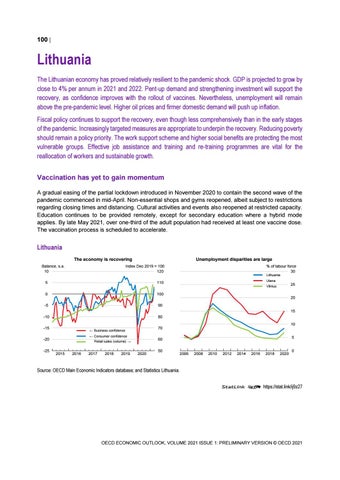
The economy has weathered well the resurgence of the pandemic GDP has recovered after contracting slightly in the last quarter of 2020, following the strong rebound in the third quarter and also reflecting the second lockdown in response to the resurgence of the virus. Consumer and business expectations, as well as retail sales, have picked up. Buoyant wage growth, albeit slower than before the crisis, measures to help the most vulnerable and increased public investment have been supporting domestic demand. Residential investment has also recovered, financed partly by increased household saving since the onset of the crisis. The unemployment rate peaked in the third quarter of 2020, but is still high compared to its pre-crisis level, with large regional disparities. Joblessness would have been higher without the short-time work scheme. Moreover, the economy still faces headwinds from the remaining restrictions arising from the containment measures and associated uncertainty.
Fiscal policy remains supportive The 2021 draft budget continues to support the recovery, albeit less comprehensively than in 2020. The budget allocates the equivalent of around 1.1% of GDP for subsidies to companies and, in particular, for the extension of the short-time work scheme. Other COVID-19-related measures, such as the temporary jobseeker allowance, are also extended to 2021. The budget also provides for increases in social security benefits, including for old-age pensions, and raises the tax-exempt threshold of the personal income tax to help the most vulnerable. Funds are also provided for the implementation of the government multiannual investment programme covering a wide range of areas.
OECD ECONOMIC OUTLOOK, VOLUME 2021 ISSUE 1: PRELIMINARY VERSION © OECD 2021
102
Growth will strengthen Economic growth is projected to reach 4% in 2022, as confidence strengthens with the expected pick-up in vaccination and as policies remain supportive. Lower saving out of disposable income will boost consumption. Investment will also increase, driven by faster implementation of EU-funded projects and of the government multi-annual public investment programme, allocating around 4% of GDP in new investment projects in education, innovation, climate change and other key areas. Reduced uncertainty is also expected to stimulate business investment. Unemployment will decline but remain above its prepandemic level. Inflation will rise in the near term on the back of recent increases of oil prices, and the pick-up in activity, which reduces slack. Further waves of COVID-19, with adverse effects on domestic demand, as well as weaker-than-expected growth in Lithuania’s trading partners, would slow the recovery. Upside risks include a faster rollout of effective vaccines and a swifter-than-expected use of EU recovery funds.
Policies need to address poverty and skill-related challenges The crisis heightened the need for an effective social safety net to protect the most vulnerable groups from adverse shocks. Further increases in social benefits and better tailoring of social support to individuals’ needs are necessary to reduce poverty. Helping displaced workers to find new, good jobs through appropriate job placement assistance is also essential. A swift recovery further hinges upon effective re-skilling and up-skilling of the labour force. This would facilitate the reallocation of workers to sectors with more favourable prospects. The participation of under-represented groups in lifelong training programmes should be encouraged, including through well-designed financial incentives. Further progress on skills requires that the education system responds to rapidly changing labour demand and technologies by equipping students with relevant and transferable skills.
OECD ECONOMIC OUTLOOK, VOLUME 2021 ISSUE 1: PRELIMINARY VERSION © OECD 2021