209
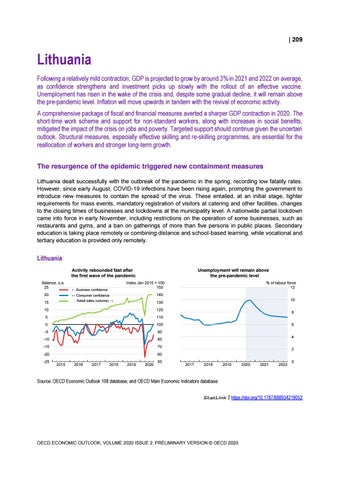
Lithuania Following a relatively mild contraction, GDP is projected to grow by around 3% in 2021 and 2022 on average, as confidence strengthens and investment picks up slowly with the rollout of an effective vaccine. Unemployment has risen in the wake of the crisis and, despite some gradual decline, it will remain above the pre-pandemic level. Inflation will move upwards in tandem with the revival of economic activity. A comprehensive package of fiscal and financial measures averted a sharper GDP contraction in 2020. The short-time work scheme and support for non-standard workers, along with increases in social benefits, mitigated the impact of the crisis on jobs and poverty. Targeted support should continue given the uncertain outlook. Structural measures, especially effective skilling and re-skilling programmes, are essential for the reallocation of workers and stronger long-term growth. The resurgence of the epidemic triggered new containment measures Lithuania dealt successfully with the outbreak of the pandemic in the spring, recording low fatality rates. However, since early August, COVID-19 infections have been rising again, prompting the government to introduce new measures to contain the spread of the virus. These entailed, at an initial stage, tighter requirements for mass events, mandatory registration of visitors at catering and other facilities, changes to the closing times of businesses and lockdowns at the municipality level. A nationwide partial lockdown came into force in early November, including restrictions on the operation of some businesses, such as restaurants and gyms, and a ban on gatherings of more than five persons in public places. Secondary education is taking place remotely or combining distance and school-based learning, while vocational and tertiary education is provided only remotely.
Lithuania Activity rebounded fast after the first wave of the pandemic Balance, s.a. 25 20
Unemployment will remain above the pre-pandemic level
Index Jan 2015 = 100 150
← Business confidence
140
← Consumer confidence Retail sales (volume) →
15
120
5
110
0
100
-5
90
-10
80
-15
70
-20
60 2015
2016
2017
2018
10
130
10
-25
% of labour force 12
2019
2020
50
8 6 4 2 0
2017
2018
2019
2020
2021
2022
0
Source: OECD Economic Outlook 108 database; and OECD Main Economic Indicators database. StatLink 2 https://doi.org/10.1787/888934219052
OECD ECONOMIC OUTLOOK, VOLUME 2020 ISSUE 2: PRELIMINARY VERSION © OECD 2020
210
Lithuania: Demand, output and prices 2017
2018
GDP at market prices Private consumption Government consumption Gross fixed capital formation Final domestic demand Stockbuilding1 Total domestic demand Exports of goods and services Imports of goods and services Net exports1 Memorandum items GDP deflator Harmonised index of consumer prices Harmonised index of core inflation2 Unemployment rate (% of labour force) Household saving ratio, net (% of disposable income) General government financial balance (% of GDP) General government gross debt (% of GDP) General government debt, Maastricht definition (% of GDP) Current account balance (% of GDP)
2020
2021
2022
Percentage changes, volume (2015 prices)
Current prices EUR billion
Lithuania
2019
42.3 26.3 6.9 8.5 41.7 - 0.4 41.3 31.1 30.1 1.0
3.9 3.7 0.2 10.0 4.4 -1.1 3.3 6.8 6.0 0.7
4.3 3.4 0.1 6.2 3.4 -1.5 2.0 9.5 6.3 2.5
-2.0 -3.2 5.9 -6.6 -2.4 -0.9 -3.4 -4.7 -6.9 1.4
2.7 2.8 4.7 3.8 3.4 0.2 3.8 3.7 5.5 -0.9
3.1 3.0 1.1 4.3 2.9 0.0 3.0 4.9 5.0 0.3
_ _ _ _ _ _ _ _ _
3.5 2.5 1.9 6.1 -3.6 0.6 40.7 33.7 0.2
2.8 2.2 2.3 6.3 0.6 0.3 44.5 35.9 3.5
1.1 1.2 2.7 8.8 6.9 -8.9 53.6 45.0 5.2
1.5 1.5 1.6 8.1 5.6 -5.4 58.1 49.5 3.9
1.8 1.8 1.8 7.3 4.3 -3.9 60.7 52.1 4.2
1. Contributions to changes in real GDP, actual amount in the first column. 2. Harmonised index of consumer prices excluding food, energy, alcohol and tobacco. Source: OECD Economic Outlook 108 database.
StatLink 2 https://doi.org/10.1787/888934219071
The confinement-related decrease in activity was relatively mild Economic activity contracted in the second quarter of the year amid containment measures, heightened uncertainty and a deterioration of the external environment. The dip was short-lived, however, with retail sales and consumer confidence rebounding quickly once the confinement measures started to be eased in mid-April. Crisis-related measures to protect jobs and incomes have sustained private consumption. Unemployment rose sharply in the wake of the health crisis, but the rise was mitigated by a short-time work scheme. The economy faces headwinds from the new containment measures due to the resurgence of the pandemic and the associated increase in uncertainty. Investment remains weak, despite increased public spending, as business confidence is still low.
Fiscal policy continues to support the recovery The government swiftly provided fiscal and financial support to households and firms to alleviate the economic consequences of the crisis. Total fiscal measures account for over 6% of GDP in 2020. The 2021 draft budget envisages continued, yet less comprehensive, support to the recovery. Some of the measures introduced during the confinement period, including the short-time work scheme and the temporary job seeker’s allowance, will be extended into 2021. Additional initiatives include higher social benefits and higher wages for some public employees, such as doctors and educational staff. The draft budget also gives special attention to the acceleration of investment programmes, including through the co-financing of climate-related projects. Fiscal support remains appropriate in a context of still weak activity and the resurgence of the pandemic.
OECD ECONOMIC OUTLOOK, VOLUME 2020 ISSUE 2: PRELIMINARY VERSION © OECD 2020
211
The economy is set to recover After a comparatively mild contraction in 2020, growth is projected at 2.7% in 2021 and 3.1% in 2022. Stronger confidence and policy measures will support the recovery. Investment will pick up gradually, aided by the faster implementation of EU-funded projects and a stepping-up of the multi-annual public investment programme covering a wide range of areas. While declining from its crisis peak, unemployment will remain above the pre-pandemic level. Prolonged effects of the pandemic on domestic demand and weaker-than-expected growth in Lithuania’s trading partners could slow the recovery. On the upside, a swifter-than-expected use of EU recovery funds could foster stronger output growth.
Policies should support the vulnerable and promote reallocation High poverty rates before the onset of the crisis underline the need to protect vulnerable groups more effectively. Higher social spending and a better tailoring of social benefits and services to individuals’ needs are essential in this regard. Policies should also facilitate the reallocation of workers and capital from declining to expanding sectors. This will require further progress on skills, including by strengthening vocational education and re-skilling and up-skilling programmes for adults. The rise of new technologies further heightens the need to improve digital skills and encourage firms to adopt these technologies. Moreover, lower administrative burdens could provide a welcome boost to business dynamism.
OECD ECONOMIC OUTLOOK, VOLUME 2020 ISSUE 2: PRELIMINARY VERSION © OECD 2020