167
Lithuania The Lithuanian economy has rebounded rapidly from the pandemic shock, with GDP growth projected at over 5% in 2021 and close to 3.7% on average in 2022 and 2023. Rapid wage increases, pent-up demand and continued EU-fund flows will remain the main drivers of domestic activity. Unemployment will fall gradually to pre-crisis levels. However, the resurgence of the pandemic casts a shadow on the outlook. Higher oil prices will have an impact on inflation, adding to underlying price pressures. Fiscal policy continues to support the recovery, but in a more targeted manner. This is appropriate to ensure the effectiveness of support and help rebuild fiscal buffers. Further increases in social benefits are necessary to protect the most vulnerable groups. Boosting digital skills through a more responsive education system and effective training programmes is key to productivity growth during the recovery. Regional gaps in digital infrastructure need to be addressed. Economic activity has bounced back, but infections have been rising again Lithuania gradually relaxed the restrictions introduced in November 2020 to contain the second wave of the pandemic. However, infections started rising again in mid-July 2021, peaking in late October. From 13 September, it has become compulsory to hold a COVID-19 pass to access all contact services, entertainment and public events. Non-holders can only access essential shops and services, including health care, education and social services. By 22 November this year, 63% of the total population had been fully vaccinated.
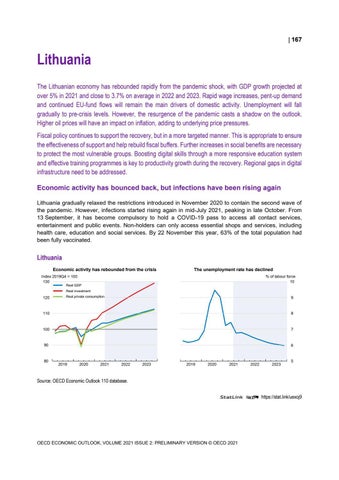
Lithuania Economic activity has rebounded from the crisis
The unemployment rate has declined
Index 2019Q4 = 100 130
% of labour force 10
Real GDP Real investment
120
Real private consumption
9
110
8
100
7
90
6
80
2019
2020
2021
2022
2023
0
0
2019
2020
2021
2022
2023
5
Source: OECD Economic Outlook 110 database. StatLink 2 https://stat.link/uexoj9
OECD ECONOMIC OUTLOOK, VOLUME 2021 ISSUE 2: PRELIMINARY VERSION © OECD 2021
168
Lithuania: Demand, output and prices 2018
2019
GDP at market prices Private consumption Government consumption Gross fixed capital formation Final domestic demand Stockbuilding¹ Total domestic demand Exports of goods and services Imports of goods and services Net exports¹ Memorandum items GDP deflator Harmonised index of consumer prices Harmonised index of core inflation² Unemployment rate (% of labour force) Household saving ratio, net (% of disposable income) General government financial balance (% of GDP) General government gross debt (% of GDP) General government debt, Maastricht definition³ (% of GDP) Current account balance (% of GDP)
2021
2022
2023
Percentage changes, volume (2015 prices)
Current prices EUR billion
Lithuania
2020
45.5 28.0 7.5 9.5
4.6 3.1 -0.3 6.6
-0.1 -2.1 -0.4 -1.8
5.1 5.4 0.2 11.8
3.8 4.9 0.1 7.6
3.5 3.8 0.1 6.2
45.0 - 0.3
3.3 -1.7
-1.8 -1.9
5.7 -1.5
4.6 0.0
3.6 0.0
44.7 34.2 33.4 0.8
1.6 9.9 6.1 3.0
-3.8 0.4 -4.4 3.5
4.7 11.7 16.1 -1.7
4.8 6.2 7.7 -0.8
3.7 5.2 5.5 -0.1
2.7 2.2 2.3 6.3
1.5 1.1 2.6 8.5
4.4 3.8 2.9 7.1
3.5 3.2 2.4 6.5
2.5 2.5 2.5 6.1
-0.2 0.5 44.5 35.9 4.0
9.0 -7.2 55.5 46.6 5.3
6.2 -4.3 54.7 45.9 4.3
4.5 -3.2 54.2 45.3 2.4
2.9 -2.8 55.1 46.2 2.3
_ _ _ _ _ _ _ _ _
1. Contributions to changes in real GDP, actual amount in the first column. 2. Harmonised index of consumer prices excluding food, energy, alcohol and tobacco. 3. The Maastricht definition of general government debt includes only loans, debt securities, and currency and deposits, with debt at face value rather than market value. Source: OECD Economic Outlook 110 database.
StatLink 2 https://stat.link/spbr7u
Output surpassed its pre-pandemic level already in early 2021 and strengthened further in the second quarter of the year with the gradual lifting of restrictions to contain the second wave of the pandemic. GDP barely increased in the third quarter, however. The improvement in confidence has fuelled business investment, coming on top of strong public investment and household spending. Private consumption has also benefited from an unwinding of savings accumulated during the lockdowns and strong wage growth. Credit card spending was buoyant in the third quarter. The unemployment rate declined to 6.8% in the third quarter from a peak of 9½ per cent around a year earlier. Harmonised consumer price inflation reached 8.2% in October 2021, driven mainly by oil price increases. Economic activity is also influenced by the containment measures introduced in September, although the new restrictions apply solely to the nonholders of a COVID-19 pass.
Fiscal policy continues to support the recovery, but in a more targeted manner Budget spending on COVID-19-related programmes has been reduced in the course of 2021, as some measures expired and others became more targeted. For instance, the short-time work scheme has been extended but eligibility has been tightened. This streamlining is appropriate to ensure the effectiveness of the measures and help rebuild fiscal buffers, while supporting the recovery. The fiscal stance is expected to gradually become less supportive in 2022 and 2023. The 2022 draft budget has an increased focus on structural priorities and sustainable growth, incorporating increased funding for the implementation of the government’s multi-year investment programme, while continuing to address the needs of vulnerable OECD ECONOMIC OUTLOOK, VOLUME 2021 ISSUE 2: PRELIMINARY VERSION © OECD 2021
169 groups through further increases in social benefits and minimum wages. Lithuania will receive about 4.5% of 2020 GDP from the EU Recovery and Resilience Facility, over half of which is expected to be spent by 2023.
Growth will remain robust Following the strong rebound in 2021, real GDP is projected to grow by 3.8% in 2022 and 3.5% in 2023. Investment will remain the main driver of growth over the next two years supported by continued EU-fund flows and implementation of the government’s multi-year investment programme in key fields, such as digital innovation and energy efficiency. Reduced uncertainty will stimulate business investment. Rising wages on the back of increasing minimum pay and higher compensation for public servants, and a decline in the household saving ratio will support private consumption. Labour market conditions will tighten as unemployment falls gradually to its pre-crisis level and skill mismatches remain large. Upward pressure from higher oil prices and supply bottlenecks are likely to dissipate, leading to a decline in headline inflation, even though underlying inflationary pressures will persist as slack declines. The risks surrounding the projections relate mainly to the development of the pandemic, the strength of the recovery in Lithuania’s trading partners and geopolitical tensions. A combination of stronger wage growth and prolonged supply bottlenecks could lead to higher-than-expected inflation. Upside risks to the outlook include a faster rollout of effective vaccination and swifter-than-expected use of EU recovery funds.
Boosting productivity remains a key priority for long-term growth Policies that address skills-related challenges and promote a wider diffusion of digital technologies could help improve productivity and support solid growth in the post-COVID-19 era. Boosting digital skills, through a more responsive education system and effective training and re-training programmes, is key in this regard, and will also limit the higher inequalities that may arise from digitalisation. Training for teachers should be increased to ensure effective use of digital technologies in schools. Sharpening firms’ incentives to adopt digital technologies will require regional gaps in digital infrastructure to be addressed and easier access to finance for young innovative firms. Making R&D business support more effective could also encourage innovation. Further digitalisation of government would boost productivity and promote more inclusive growth by enabling a better tailoring of social benefits and services to individuals’ needs.
OECD ECONOMIC OUTLOOK, VOLUME 2021 ISSUE 2: PRELIMINARY VERSION © OECD 2021