173
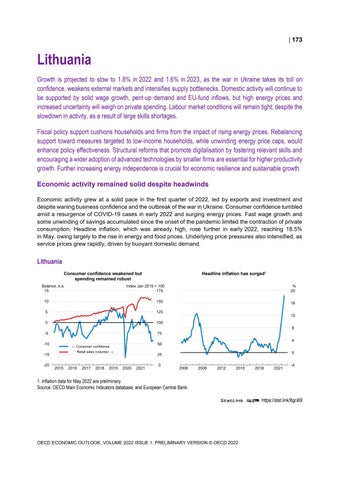
Lithuania Growth is projected to slow to 1.8% in 2022 and 1.6% in 2023, as the war in Ukraine takes its toll on confidence, weakens external markets and intensifies supply bottlenecks. Domestic activity will continue to be supported by solid wage growth, pent-up demand and EU-fund inflows, but high energy prices and increased uncertainty will weigh on private spending. Labour market conditions will remain tight, despite the slowdown in activity, as a result of large skills shortages. Fiscal policy support cushions households and firms from the impact of rising energy prices. Rebalancing support toward measures targeted to low-income households, while unwinding energy price caps, would enhance policy effectiveness. Structural reforms that promote digitalisation by fostering relevant skills and encouraging a wider adoption of advanced technologies by smaller firms are essential for higher productivity growth. Further increasing energy independence is crucial for economic resilience and sustainable growth. Economic activity remained solid despite headwinds Economic activity grew at a solid pace in the first quarter of 2022, led by exports and investment and despite waning business confidence and the outbreak of the war in Ukraine. Consumer confidence tumbled amid a resurgence of COVID-19 cases in early 2022 and surging energy prices. Fast wage growth and some unwinding of savings accumulated since the onset of the pandemic limited the contraction of private consumption. Headline inflation, which was already high, rose further in early 2022, reaching 18.5% in May, owing largely to the rise in energy and food prices. Underlying price pressures also intensified, as service prices grew rapidly, driven by buoyant domestic demand.
Lithuania Consumer confidence weakened but spending remained robust Balance, s.a. 15
Headline inflation has surged¹
Index Jan 2015 = 100 175
10
150
5
125
0
100
-5
75
% 20 16 12 8
-10
Retail sales (volume) →
-15 -20
2015
2016
2017
2018
2019
4
50
← Consumer confidence
0
25 2020
2021
0
0
2006
2009
2012
2015
2018
2021
-4
1. Inflation data for May 2022 are preliminary. Source: OECD Main Economic Indicators database; and European Central Bank. StatLink 2 https://stat.link/8gci69
OECD ECONOMIC OUTLOOK, VOLUME 2022 ISSUE 1: PRELIMINARY VERSION © OECD 2022
174
Lithuania: Demand, output and prices 2018
2019
GDP at market prices Private consumption Government consumption Gross fixed capital formation Final domestic demand Stockbuilding¹ Total domestic demand Exports of goods and services Imports of goods and services Net exports¹ Memorandum items GDP deflator Harmonised index of consumer prices Harmonised index of core inflation² Unemployment rate (% of labour force) Household saving ratio, net (% of disposable income) General government financial balance (% of GDP) General government gross debt (% of GDP) General government debt, Maastricht definition³ (% of GDP) Current account balance (% of GDP)
2021
2022
2023
Percentage changes, volume (2015 prices)
Current prices EUR billion
Lithuania
2020
45.5 28.0 7.5 9.5
4.6 3.1 -0.3 6.6
-0.1 -2.1 -0.4 -1.8
5.0 7.3 0.5 7.0
1.8 2.1 0.3 3.9
1.6 1.6 0.2 4.4
45.0 - 0.3
3.3 -1.7
-1.7 -1.9
5.9 -0.6
2.1 -1.2
1.9 0.0
44.7 34.2 33.4 0.8
1.6 9.9 6.1 3.0
-3.7 0.4 -4.4 3.5
5.8 15.9 18.7 -0.3
1.1 -1.9 -2.7 0.5
1.8 0.5 0.8 -0.2
2.7 2.2 2.3 6.3
1.5 1.1 2.6 8.5
6.5 4.6 3.4 7.1
12.7 15.6 8.6 7.2
7.5 7.9 7.2 7.4
-0.2 0.5 44.5 35.9 3.5
9.0 -7.3 55.5 46.6 7.3
4.4 -1.0 51.4 44.3 1.3
-0.8 -4.7 50.5 43.4 -2.9
-1.7 -2.9 51.0 43.9 -2.8
_ _ _ _ _ _ _ _ _
1. Contributions to changes in real GDP, actual amount in the first column. 2. Harmonised index of consumer prices excluding food, energy, alcohol and tobacco. 3. The Maastricht definition of general government debt includes only loans, debt securities, and currency and deposits, with debt at face value rather than market value. Source: OECD Economic Outlook 111 database.
StatLink 2 https://stat.link/b0m85r
The war in Ukraine, and concomitant sanctions against Russia, weigh on Lithuania’s exports, especially transport services. Despite a gradual decoupling over the past decade, Russia accounted for 11% of Lithuania’s goods exports in 2021 (mainly consisting of re-exported goods) and 12% of imports, remaining one of Lithuania’s main trading partners. Moreover, Lithuania is highly dependent on imported energy and therefore remains vulnerable to supply shocks, even though it stopped importing gas and oil from Russia in early April 2022. Lithuania currently uses liquefied natural gas from the terminal in Klaipeda and has diversified its oil import sources. By late May 2022, Lithuania had received over 54 000 Ukrainian refugees (equivalent to 2% of the total Lithuanian population). The government has promptly taken measures to provide them with social support and access to the labour market.
Fiscal policy helps mitigate the economic consequences of the war The revised draft budget for 2022 incorporates measures to mitigate the impact of rising energy prices on households and firms, equivalent to around 1.2% of GDP. These are part of a comprehensive fiscal package announced in early April 2022 to alleviate inflationary pressures (including through energy price caps), increase energy efficiency and strengthen energy independence. The revised draft budget further provides assistance for the Ukrainian refugees (amounting to 0.6% of GDP) and envisages increased defence spending. Businesses and households will receive compensation for the portion of energy price increases above 40%. Support for vulnerable households to cope with surging energy prices includes an increase in non-taxable income, an extension of means-tested heating compensation and higher pensions. As a result of these initiatives, the fiscal stance is expected to be highly expansionary this year, before OECD ECONOMIC OUTLOOK, VOLUME 2022 ISSUE 1: PRELIMINARY VERSION © OECD 2022
175 tightening in 2023 as temporary measures expire. The tightening of fiscal policy, subject to additional support to vulnerable households and firms, is appropriate to reduce risks of prolonged inflationary pressures. Rebalancing temporary support toward measures targeted on low-income households, while unwinding energy price caps, would enhance policy effectiveness.
Growth will remain moderate Growth will slow as the war in Ukraine takes its toll on domestic demand through increased geopolitical uncertainty and intensified supply bottlenecks, as well as by adding to already high inflation. Output growth will remain subdued in 2023, even though investment will gather pace with the absorption of EU funds and implementation of the government’s multi-year investment programme. Headline inflation will decline but remain high due the EU embargo on Russian oil to take effect in 2023. Real wages will continue falling, albeit at a slower pace. A decline in the household saving ratio will support consumption. The unemployment rate will rise as a consequence of the slowdown, although large skills shortages will keep labour market conditions tight. The risks surrounding the projections relate mainly to the evolution of the war in Ukraine and sanctions against Russia, given trade links. Upside risks include a swifter-than expected use of EU recovery funds and a faster-than-foreseen integration of Ukrainian refugees into the labour market, which could alleviate skills shortages and wage pressures.
Ensuring strong and sustainable growth Measures to strengthen energy independence are crucial for economic resilience and sustainable growth. The focus of the comprehensive April 2022 fiscal package on energy efficiency through the renovation of multi-apartment buildings and on the production of solar and wind energy and electricity storage is appropriate. Achieving long-term growth also hinges on higher productivity. Promoting digitalisation is key in this regard. There is scope to further increase investment in innovation and encourage the digital take-up of smaller firms, including by reducing remaining gaps in digital infrastructure and improving access to finance for young innovative firms. Education reforms need to continue to ensure strong and relevant skills for the digital era. This is also essential to ensure that the benefits arising from digitalisation are shared widely.
OECD ECONOMIC OUTLOOK, VOLUME 2022 ISSUE 1: PRELIMINARY VERSION © OECD 2022