164
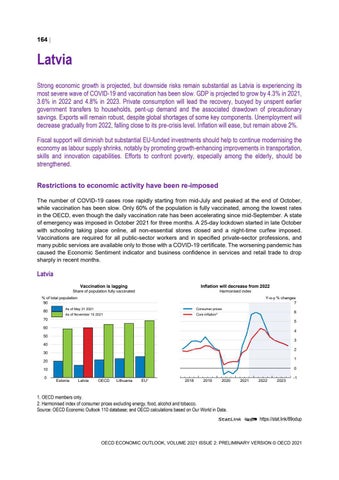
Latvia Strong economic growth is projected, but downside risks remain substantial as Latvia is experiencing its most severe wave of COVID-19 and vaccination has been slow. GDP is projected to grow by 4.3% in 2021, 3.6% in 2022 and 4.8% in 2023. Private consumption will lead the recovery, buoyed by unspent earlier government transfers to households, pent-up demand and the associated drawdown of precautionary savings. Exports will remain robust, despite global shortages of some key components. Unemployment will decrease gradually from 2022, falling close to its pre-crisis level. Inflation will ease, but remain above 2%. Fiscal support will diminish but substantial EU-funded investments should help to continue modernising the economy as labour supply shrinks, notably by promoting growth-enhancing improvements in transportation, skills and innovation capabilities. Efforts to confront poverty, especially among the elderly, should be strengthened. Restrictions to economic activity have been re-imposed The number of COVID-19 cases rose rapidly starting from mid-July and peaked at the end of October, while vaccination has been slow. Only 60% of the population is fully vaccinated, among the lowest rates in the OECD, even though the daily vaccination rate has been accelerating since mid-September. A state of emergency was imposed in October 2021 for three months. A 25-day lockdown started in late October with schooling taking place online, all non-essential stores closed and a night-time curfew imposed. Vaccinations are required for all public-sector workers and in specified private-sector professions, and many public services are available only to those with a COVID-19 certificate. The worsening pandemic has caused the Economic Sentiment indicator and business confidence in services and retail trade to drop sharply in recent months.
Latvia Vaccination is lagging
Inflation will decrease from 2022
Share of population fully vaccinated
Harmonised index
% of total population 90 80
Y-o-y % changes 7
As of May 31 2021
Consumer prices
As of November 15 2021
Core inflation²
6
70
5
60
4
50
3
40
2
30
1
20
0
10 0
Estonia
Latvia
OECD
Lithuania
EU¹
0
0
2018
2019
2020
2021
2022
2023
-1
1. OECD members only. 2. Harmonised index of consumer prices excluding energy, food, alcohol and tobacco. Source: OECD Economic Outlook 110 database; and OECD calculations based on Our World in Data. StatLink 2 https://stat.link/89odup
OECD ECONOMIC OUTLOOK, VOLUME 2021 ISSUE 2: PRELIMINARY VERSION © OECD 2021
165
Latvia: Demand, output and prices 2018
Latvia GDP at market prices Private consumption Government consumption Gross fixed capital formation Final domestic demand Stockbuilding¹ Total domestic demand Exports of goods and services Imports of goods and services Net exports¹ Memorandum items GDP deflator Harmonised index of consumer prices Harmonised index of core inflation² Unemployment rate (% of labour force) Household saving ratio, net (% of disposable income) General government financial balance (% of GDP) General government gross debt (% of GDP) General government debt, Maastricht definition³ (% of GDP) Current account balance (% of GDP)
2019
2020
2021
2022
2023
Percentage changes, volume (2015 prices)
Current prices EUR billion
29.2 17.3 5.3 6.4
2.5 0.2 3.4 6.9
-3.6 -7.6 2.6 0.2
4.3 0.3 3.6 5.4
3.6 4.2 1.9 6.2
4.8 5.6 2.0 7.4
29.0 0.3
2.3 1.0
-3.9 0.1
2.2 6.5
4.2 -1.1
5.3 0.0
29.4 17.9 18.1 - 0.2
3.1 2.1 3.0 -0.6
-3.8 -2.2 -2.5 0.2
8.4 3.9 10.7 -4.0
2.9 5.1 4.0 0.6
5.1 4.4 4.8 -0.4
2.6 2.7 2.2 6.3
-0.1 0.1 0.9 8.1
5.3 2.9 1.9 7.5
4.1 4.9 3.8 6.6
2.7 2.7 2.7 6.2
0.1 -0.6 48.1 36.7 -0.7
9.1 -4.5 56.0 43.2 2.9
12.9 -8.7 61.7 49.0 -3.3
8.2 -5.4 65.4 52.6 -2.1
4.9 -3.9 67.3 54.6 -2.3
_ _ _ _ _ _ _ _ _
1. Contributions to changes in real GDP, actual amount in the first column. 2. Harmonised index of consumer prices excluding food, energy, alcohol and tobacco. 3. The Maastricht definition of general government debt includes only loans, debt securities, and currency and deposits, with debt at face value rather than market value. Source: OECD Economic Outlook 110 database.
StatLink 2 https://stat.link/onfuql
Latvia’s GDP grew by 0.3% in the third quarter of 2021 compared with the previous quarter. Private spending has picked up since the spring. Household consumption was supported by a steep rise in wages, following increases in the statutory minimum wage and public-sector pay, as well as shortages in skill-intensive sectors. Stockbuilding made a significant contribution to growth in the first half of 2021. Export growth has also been strong: in September, exports of goods were 24% higher than a year before, led by wood and wood products. However, pandemic containment measures have caused activity in some labour-intensive sectors to remain subdued. Overall, the national definition of the unemployment rate fell to 6.4% in September, down 1.6 percentage point compared to a year earlier. Inflation accelerated to 6% in October, driven mainly by rising housing, food and fuel prices. This has been reflected in rising inflation expectations.
Fiscal policy remains supportive Most of the income-support measures introduced since the beginning of the crisis ended at mid-year. However, the government introduced in November 2021 a monthly allowance for five months for vaccinated seniors, partially to compensate for the increase in energy prices. The government is also planning to compensate employees and firms in sectors hurt by the lockdown and keep increasing doctors’, teachers’ and police officers’ pay. The underlying government primary deficit is projected to decrease from 6.2% of GDP in 2021 to 3.9% of GDP in 2023. Latvia will receive about 6.7% of 2020 GDP as grants from Next Generation EU, 35% of which is expected to be spent by 2023. About 60% will be devoted to fighting climate change and accelerating Latvia’s digital transformation.
OECD ECONOMIC OUTLOOK, VOLUME 2021 ISSUE 2: PRELIMINARY VERSION © OECD 2021
166
The recovery will gather pace in 2022 Strong economic growth is projected, but downside risks remain substantial. Goods exports will remain robust, but the sectors more dependent on face-to-face contacts (such as tourism) are projected to recover more slowly. The latest restrictions will weigh on private consumption in the fourth quarter of 2021, but it will rebound thereafter. An acceleration of capital spending supported by EU funds is expected to underpin medium-term growth but also add to overheating risks in the construction sector. Unemployment will edge up in the short term, before decreasing gradually. Headline inflation and wage growth will slow in 2022; however, uncertainty is unusually high. Inflation could rise further due to supply-chain disruptions, rising wages due to skills shortages and inflation expectations. Employment could decrease if mandatory vaccination requirements were to be met with workers’ resistance. On the other hand, a faster vaccine rollout would increase consumption and output growth.
Labour market and environmental performance should be strengthened Policies should remain supportive in the near term and should be adjusted in response to evolving health conditions, while considering the risks of overheating. Achieving more ambitious climate mitigation objectives will require a combination of investment in renewables, greater international gas and electricity market linkages and a decrease in the favourable tax treatment of natural gas, diesel for vehicle use and heating oil. To reduce long-term unemployment, tackle informality and address the challenges of a shrinking population, Latvia should enhance labour market performance and skills. Tax wedges should be reduced, and active labour market spending should be boosted, notably training.
OECD ECONOMIC OUTLOOK, VOLUME 2021 ISSUE 2: PRELIMINARY VERSION © OECD 2021