170
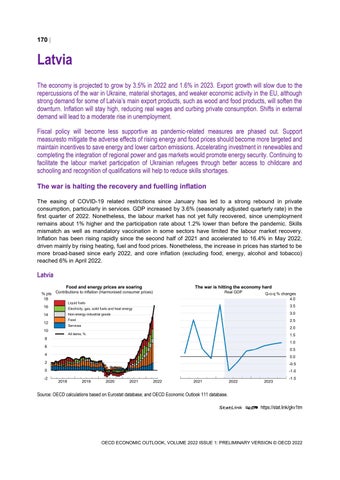
Latvia The economy is projected to grow by 3.5% in 2022 and 1.6% in 2023. Export growth will slow due to the repercussions of the war in Ukraine, material shortages, and weaker economic activity in the EU, although strong demand for some of Latvia’s main export products, such as wood and food products, will soften the downturn. Inflation will stay high, reducing real wages and curbing private consumption. Shifts in external demand will lead to a moderate rise in unemployment. Fiscal policy will become less supportive as pandemic-related measures are phased out. Support measuresto mitigate the adverse effects of rising energy and food prices should become more targeted and maintain incentives to save energy and lower carbon emissions. Accelerating investment in renewables and completing the integration of regional power and gas markets would promote energy security. Continuing to facilitate the labour market participation of Ukrainian refugees through better access to childcare and schooling and recognition of qualifications will help to reduce skills shortages. The war is halting the recovery and fuelling inflation The easing of COVID-19 related restrictions since January has led to a strong rebound in private consumption, particularly in services. GDP increased by 3.6% (seasonally adjusted quarterly rate) in the first quarter of 2022. Nonetheless, the labour market has not yet fully recovered, since unemployment remains about 1% higher and the participation rate about 1.2% lower than before the pandemic. Skills mismatch as well as mandatory vaccination in some sectors have limited the labour market recovery. Inflation has been rising rapidly since the second half of 2021 and accelerated to 16.4% in May 2022, driven mainly by rising heating, fuel and food prices. Nonetheless, the increase in prices has started to be more broad-based since early 2022, and core inflation (excluding food, energy, alcohol and tobacco) reached 6% in April 2022.
Latvia % pts 18
Food and energy prices are soaring
The war is hitting the economy hard
Contributions to inflation (Harmonised consumer prices)
Real GDP
Q-o-q % changes 4.0
Liquid fuels
16
3.5
Electricity, gas, solid fuels and heat energy
14 12
Non-energy industrial goods
3.0
Food
2.5
Services
10
2.0
All items, %
1.5
8
1.0
6
0.5
4
0.0
2
-0.5
0 -2
-1.0 2018
2019
2020
2021
0 2022
0
2021
2022
2023
-1.5
Source: OECD calculations based on Eurostat database; and OECD Economic Outlook 111 database. StatLink 2 https://stat.link/gkv1tm
OECD ECONOMIC OUTLOOK, VOLUME 2022 ISSUE 1: PRELIMINARY VERSION © OECD 2022
171
Latvia: Demand, output and prices 2018
Latvia GDP at market prices Private consumption Government consumption Gross fixed capital formation Final domestic demand Stockbuilding¹ Total domestic demand Exports of goods and services Imports of goods and services Net exports¹ Memorandum items GDP deflator Harmonised index of consumer prices Harmonised index of core inflation² Unemployment rate (% of labour force) Household saving ratio, net (% of disposable income) General government financial balance (% of GDP) General government gross debt (% of GDP) General government debt, Maastricht definition³ (% of GDP) Current account balance (% of GDP)
2019
2020
2021
2022
2023
Percentage changes, volume (2015 prices)
Current prices EUR billion
29.2 17.3 5.3 6.4
2.5 0.2 3.4 6.9
-3.8 -7.4 2.6 0.2
4.7 4.8 4.4 2.9
3.5 7.8 2.5 2.1
1.6 0.5 2.1 3.4
29.0 0.3
2.3 1.0
-3.8 0.0
4.2 5.1
5.3 1.0
1.4 0.0
29.4 17.9 18.1 - 0.2
3.1 2.1 3.0 -0.6
-3.9 -2.2 -2.5 0.2
9.1 6.2 13.5 -4.3
6.1 3.8 7.7 -2.7
1.3 1.0 0.6 0.2
2.6 2.7 2.2 6.3
-0.1 0.1 0.9 8.1
6.8 3.2 1.9 7.5
12.8 13.3 7.0 7.2
6.5 8.6 7.0 7.4
0.1 -0.6 48.1 36.7 -0.7
9.1 -4.5 56.0 43.3 2.9
8.0 -7.3 58.8 44.8 -2.9
-3.2 -4.4 60.2 46.2 -3.2
-6.0 -2.5 61.0 47.0 -2.4
_ _ _ _ _ _ _ _ _
1. Contributions to changes in real GDP, actual amount in the first column. 2. Harmonised index of consumer prices excluding food, energy, alcohol and tobacco. 3. The Maastricht definition of general government debt includes only loans, debt securities, and currency and deposits, with debt at face value rather than market value. Source: OECD Economic Outlook 111 database.
StatLink 2 https://stat.link/vizpde
Latvian firms have reduced their exposure to Russia over the past decade, especially since the annexation of Crimea in 2014. Nonetheless, Russia is still Latvia’s fifth largest trade partner and an important supplier of natural gas (accounting for all of Latvia’s imports), oil, fertilisers and raw materials. Heating bills and fuel prices have strongly increased over the past few months despite a government compensation for service fees, while electricity costs fell due to government support, which was phased out at the end of April. Business confidence has dropped sharply, as the economic sentiment indicator fell significantly in March and slightly dropped again in April. About 28 500 Ukrainian refugees have entered Latvia since the invasion (about 1.5% of the population), mainly women and children.
Targeted fiscal policy measures are key to support vulnerable households The COVID-19 income-support measures expired in February 2022. However, the government introduced new measures to compensate households and firms for the rise in energy prices. It reduced electricity bills and covered additional heating costs in regions that experienced a rapid increase in heating tariffs, but these measures ended in April 2022. A monthly allowance of about EUR 20 is given to 150 000 vulnerable households until the end of 2022 and a rise in the means-tested allowance for low-income households is envisioned. However, more is needed, as the social safety net in Latvia is limited, poverty rates are high compared to the EU average and poor households suffer the most from rising energy and food prices. The
OECD ECONOMIC OUTLOOK, VOLUME 2022 ISSUE 1: PRELIMINARY VERSION © OECD 2022
172 government expects the implemented measures to amount to about 1.3% of GDP. It also plans to raise general government employees' salaries and defence spending (from 2.2% to 2.5% of GDP by 2025). Nonetheless, there is likely to be substantial fiscal consolidation due to the phase-out of COVID-19 support measures and increasing tax revenue, with the government deficit projected to decrease from 7.3% of GDP in 2021 to 2.5% in 2023. Latvia will receive about 6.7% of 2020 GDP in grants from Next Generation EU by 2026, 35% of which is expected to be spent by 2023. The government plans to stop natural gas imports from Russia from early 2023 and substitute them by liquefied natural gas imports, mainly from neighbouring countries.
Economic growth will slow and downside risks remain high The need to replace imports of raw materials and energy from Russia and Belarus will reduce production and raise prices, and will affect private investment. EU-funded investments will rise, but high uncertainty and rising construction costs due to labour shortages and supply bottlenecks will mitigate investment growth. Nominal wage growth will be moderate, despite existing labour shortages, as the economic shock limits employment growth and the wave of refugee inflows increases the labour force by about 0.75%. The recovery of private consumption will be moderate due to high uncertainty and inflation. Headline inflation will ease somewhat in 2023, but will remain high due to the embargo on Russian oil. The annual rate of core inflation will still exceed 5% at the end of 2023. GDP growth could drop, and inflation could rise further due to supply-chain disruptions and difficulties in substituting Russian energy supply. A lack of construction materials could further slow investment. On the upside, the refugee inflow might ease labour shortages by more than expected and increase output growth.
Addressing skills shortages could help to ease inflationary pressures To support an inclusive recovery and avoid amplifying inflationary pressures, fiscal policy measures should remain targeted at vulnerable households. Support measures should maintain price incentives for firms and households to transition towards less-carbon intensive energy sources. Providing students with greater financial support, establishing training funds to raise access to training, and improving public transport services would help to boost labour productivity and ease labour shortages. Continuing to facilitate the recognition of qualifications, including VET and education degrees, enhance access to childcare, ease language restrictions and provide financial support are key for the labour market integration of refugees.
OECD ECONOMIC OUTLOOK, VOLUME 2022 ISSUE 1: PRELIMINARY VERSION © OECD 2022