167
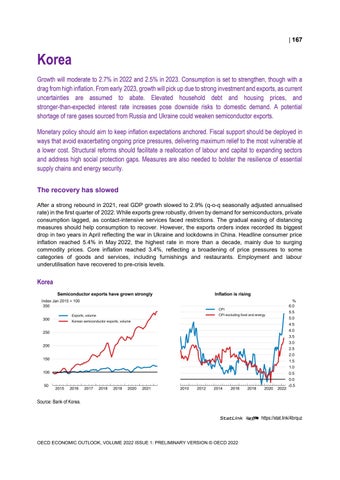
Korea Growth will moderate to 2.7% in 2022 and 2.5% in 2023. Consumption is set to strengthen, though with a drag from high inflation. From early 2023, growth will pick up due to strong investment and exports, as current uncertainties are assumed to abate. Elevated household debt and housing prices, and stronger-than-expected interest rate increases pose downside risks to domestic demand. A potential shortage of rare gases sourced from Russia and Ukraine could weaken semiconductor exports. Monetary policy should aim to keep inflation expectations anchored. Fiscal support should be deployed in ways that avoid exacerbating ongoing price pressures, delivering maximum relief to the most vulnerable at a lower cost. Structural reforms should facilitate a reallocation of labour and capital to expanding sectors and address high social protection gaps. Measures are also needed to bolster the resilience of essential supply chains and energy security. The recovery has slowed After a strong rebound in 2021, real GDP growth slowed to 2.9% (q-o-q seasonally adjusted annualised rate) in the first quarter of 2022. While exports grew robustly, driven by demand for semiconductors, private consumption lagged, as contact-intensive services faced restrictions. The gradual easing of distancing measures should help consumption to recover. However, the exports orders index recorded its biggest drop in two years in April reflecting the war in Ukraine and lockdowns in China. Headline consumer price inflation reached 5.4% in May 2022, the highest rate in more than a decade, mainly due to surging commodity prices. Core inflation reached 3.4%, reflecting a broadening of price pressures to some categories of goods and services, including furnishings and restaurants. Employment and labour underutilisation have recovered to pre-crisis levels.
Korea Semiconductor exports have grown strongly
Inflation is rising
Index Jan 2015 = 100 350
CPI
5.5
CPI excluding food and energy
Exports, volume
300
% 6.0 5.0
Korean semiconductor exports, volume
4.5 4.0
250
3.5 3.0
200
2.5 2.0
150
1.5 1.0
100
0.5 0.0
50
2015
2016
2017
2018
2019
2020
2021
0
0
2010
2012
2014
2016
2018
2020
2022
-0.5
Source: Bank of Korea. StatLink 2 https://stat.link/4brquz
OECD ECONOMIC OUTLOOK, VOLUME 2022 ISSUE 1: PRELIMINARY VERSION © OECD 2022
168
Korea: Demand, output and prices 2018
2019
GDP at market prices Private consumption Government consumption Gross fixed capital formation
2021
2022
2023
Percentage changes, volume (2015 prices)
Current prices KRW trillion
Korea
2020
1 898.2 911.6 304.7 576.6
2.2 2.1 6.4 -2.1
-0.9 -5.0 5.0 2.6
4.0 3.6 5.6 2.5
2.7 2.3 3.7 0.5
2.5 2.9 3.0 2.8
Final domestic demand Stockbuilding¹
1 792.9 21.1
1.5 0.0
-0.8 -0.6
3.6 -0.4
2.0 -0.2
2.9 0.0
Total domestic demand Exports of goods and services Imports of goods and services Net exports¹
1 814.0 791.8 707.6
1.5 0.2 -1.9 0.8
-1.5 -1.8 -3.3 0.5
3.2 9.9 8.6 0.8
1.8 9.2 7.3 1.1
2.9 4.1 4.9 -0.3
-0.8 0.4 0.7 3.8
1.3 0.5 0.4 3.9
2.3 2.5 1.4 3.6
3.0 4.8 3.4 3.2
2.3 3.8 3.1 3.1
8.1 1.0 44.2 3.6
14.1 -2.3 45.4 4.6
11.8 -3.0 47.9 4.9
10.7 -2.5 49.9 5.3
9.0 -1.9 51.1 5.0
Memorandum items GDP deflator Consumer price index Core inflation index² Unemployment rate (% of labour force) Household saving ratio, net (% of disposable income) General government financial balance (% of GDP) General government gross debt (% of GDP) Current account balance (% of GDP)
84.2 _ _ _ _ _ _ _ _
1. Contributions to changes in real GDP, actual amount in the first column. 2. Consumer price index excluding food and energy. Source: OECD Economic Outlook 111 database.
StatLink 2 https://stat.link/mgi9zt
The direct economic consequences of the war in Ukraine and sanctions on Russia have been relatively modest, given limited direct trade and financial links as well as low energy dependence on Russia. However, energy and commodity prices have risen markedly, driving up inflation. The price of neon gas, which is essential for Korean semiconductor production, tripled in early 2022 compared to a year earlier, although the impact on semiconductor production has been limited so far thanks to raw material stockpiling, diversifying imports, and localising neon gas production. The government is also investing in R&D to homeshore the production of other inputs such as krypton and xenon.
Some temporary supports have been extended Pandemic-related employment retention subsidies have been extended until the end of 2022, and a supplementary budget of KRW 16.9 trillion (0.8% of GDP) was passed in February 2022 to help small businesses. The National Assembly recently approved the largest-ever supplementary budget, amounting to KRW 62 trillion (2.9% of GDP), which is to be financed mostly by excess tax revenue. In addition, the temporary 20% fuel tax cut on gasoline, diesel and liquefied petroleum gas was increased to 30% and extended until the end of July 2022. However, the fiscal stance is projected to turn to slightly contractionary in 2023, with the assumed withdrawal of temporary measures. The Bank of Korea has embarked on monetary policy normalisation, raising the key policy rate in five steps from 0.5% to 1.75%, and has signalled further tightening. The projections assume that the key policy rate will reach 2.5% by the end of 2023.
OECD ECONOMIC OUTLOOK, VOLUME 2022 ISSUE 1: PRELIMINARY VERSION © OECD 2022
169
The recovery will continue at a slower pace, but uncertainties are high Real GDP is projected to grow by 2.7% in 2022 and 2.5% in 2023. Private consumption will recover from late spring due to high immunity, the lifting of restrictions, the latest supplementary budget, and a continued normalisation of the household saving ratio. The recovery in consumption is nonetheless expected to be gradual, as inflationary pressures from commodity prices and supply chain disruptions are being passed on to consumers. Inflation is set to remain elevated, based on the assumption that the embargo on Russian oil pushes up global oil prices in 2023. Business investment is set for solid growth, with substantial planned investments in some key industries. The underlying primary balance is expected to narrow slightly. A fasterthan-expected increase in interest rates could hold back household consumption, given elevated household debt mostly at floating rates. A prolonged war in Ukraine could harm Korean semiconductor production as stocks of rare gases run out and the local supply of raw materials falls short of demand.
Further policy action is needed for a resilient recovery Scaling back and better targeting fiscal support to those most in need would help contain inflation and address structural weaknesses. The temporary fossil fuel price cut should be replaced in due course by transfers to vulnerable households. Stepping up training and activation policies for those who lose their jobs, and strengthening the social safety net are crucial to facilitate workforce reallocation. Policies are also needed to enhance the resilience of essential supply chains. The government plans to establish an Economic Security Supply Chain Management Committee. This should be complemented by developing consistent and evidence-based policy tools to help make informed choices and improve transparency and trust from the private sector. In addition to the new government’s plan to revive nuclear plants, further policy actions that accelerate green transitions, such as aligning the K-ETS with the net-zero emission target for 2050, will be required to enhance energy security.
OECD ECONOMIC OUTLOOK, VOLUME 2022 ISSUE 1: PRELIMINARY VERSION © OECD 2022