164
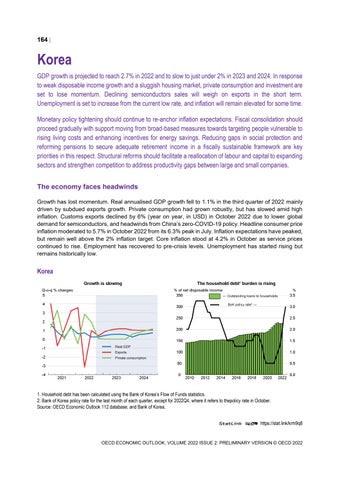
Korea GDP growth is projected to reach 2.7% in 2022 and to slow to just under 2% in 2023 and 2024. In response to weak disposable income growth and a sluggish housing market, private consumption and investment are set to lose momentum. Declining semiconductors sales will weigh on exports in the short term. Unemployment is set to increase from the current low rate, and inflation will remain elevated for some time. Monetary policy tightening should continue to re-anchor inflation expectations. Fiscal consolidation should proceed gradually with support moving from broad-based measures towards targeting people vulnerable to rising living costs and enhancing incentives for energy savings. Reducing gaps in social protection and reforming pensions to secure adequate retirement income in a fiscally sustainable framework are key priorities in this respect. Structural reforms should facilitate a reallocation of labour and capital to expanding sectors and strengthen competition to address productivity gaps between large and small companies. The economy faces headwinds Growth has lost momentum. Real annualised GDP growth fell to 1.1% in the third quarter of 2022 mainly driven by subdued exports growth. Private consumption had grown robustly, but has slowed amid high inflation. Customs exports declined by 6% (year on year, in USD) in October 2022 due to lower global demand for semiconductors, and headwinds from China’s zero-COVID-19 policy. Headline consumer price inflation moderated to 5.7% in October 2022 from its 6.3% peak in July. Inflation expectations have peaked, but remain well above the 2% inflation target. Core inflation stood at 4.2% in October as service prices continued to rise. Employment has recovered to pre-crisis levels. Unemployment has started rising but remains historically low.
Korea
1. Household debt has been calculated using the Bank of Korea’s Flow of Funds statistics. 2. Bank of Korea policy rate for the last month of each quarter, except for 2022Q4, where it refers to thepolicy rate in October. Source: OECD Economic Outlook 112 database; and Bank of Korea. StatLink 2 https://stat.link/krm9q8
OECD ECONOMIC OUTLOOK, VOLUME 2022 ISSUE 2: PRELIMINARY VERSION © OECD 2022
165
Korea: Demand, output and prices 2019
Korea
2020
General government gross debt (% of GDP) Current account balance (% of GDP)
2022
2023
2024
Percentage changes, volume (2015 prices)
Current prices KRW trillion
GDP at market prices Private consumption Government consumption Gross fixed capital formation Final domestic demand Stockbuilding¹ Total domestic demand Exports of goods and services Imports of goods and services Net exports¹ Memorandum items GDP deflator Consumer price index Core inflation index² Unemployment rate (% of labour force) Household saving ratio, net (% of disposable income) General government financial balance (% of GDP)
2021
1 924.5 935.9 328.7 579.0 1 843.6 27.1 1 870.7 755.9 702.1 53.8
-0.7 -4.8 5.1 3.5 -0.4 -0.8 -1.2 -1.7 -3.1 0.5
4.1 3.7 5.6 2.8 3.8 -0.1 3.6 10.8 10.1 0.7
2.7 4.7 3.4 -1.3 2.5 0.2 2.7 4.5 4.6 0.1
1.8 1.8 0.5 1.1 1.3 0.2 1.6 2.3 2.5 0.0
1.9 2.2 0.8 2.2 1.9 0.0 1.9 4.5 4.4 0.0
_ _ _ _ _ _ _ _
1.6 0.5 0.4 3.9 14.7 -2.7 50.0 4.5
2.5 2.5 1.4 3.6 5.9 -0.8 50.5 4.9
2.1 5.2 3.6 2.8 0.4 0.2 50.3 1.6
2.3 3.9 3.5 3.3 1.0 0.7 49.3 1.2
1.9 2.3 2.0 3.2 1.4 0.9 48.9 1.0
1. Contributions to changes in real GDP, actual amount in the first column. 2. Consumer price index excluding food and energy. Source: OECD Economic Outlook 112 database.
StatLink 2 https://stat.link/nhkvsi
Although the direct impact of Russia’s war of aggression against Ukraine has been relatively modest, given limited direct trade and financial links, global energy prices have driven up inflation. Electricity and gas prices were raised by 5% and 16% respectively in October and are set to increase further. Currency depreciation has pushed up import prices.
Macroeconomic policies are tightening The Bank of Korea has raised the key policy rate in eight steps from 0.5% to 3.0% since August 2021 to try and keep inflation expectations in check. Further policy rate increases are expected in the near term, with the OECD projection assuming increases until the first quarter of 2023. Meanwhile, policymakers should keep an eye on the rising debt of households and small businesses. To relieve the burden of soaring energy prices, the government extended a temporary fuel tax cut until the end of 2022 and plans to expand energy voucher support for vulnerable households. Fiscal policy is expected to be tightened from 2023 in line with the government’s fiscal consolidation plan. The 2023 budget proposal built in a cut in the managed budget deficit (excluding social security), to 2.6% of GDP from 5.1% of GDP in 2022, mainly by reducing pandemic supports. The recently-proposed fiscal rule limits the managed budget deficit to 3% of GDP. The fiscal stance is assumed to be broadly neutral in 2024.
OECD ECONOMIC OUTLOOK, VOLUME 2022 ISSUE 2: PRELIMINARY VERSION © OECD 2022
166
Growth is projected to weaken Real GDP growth is on course to reach 2.7% in 2022 and is expected to slow to just under 2% in 2023 and 2024. Inflation and higher interest rates will dampen private consumption. Weak global demand is set to weigh on exports. Inflation will remain high for some time in 2023 due to service and utility price pressures but will gradually moderate. The rising debt servicing burden increases the risk of accelerating the housing price correction and may trigger corporate failures, posing downside risks to consumption and investment. Increasing protectionism, such as rising tensions between the United States and China, Russia’s war against Ukraine and potential further geopolitical tensions may trigger realignments of Korean supply chains. Easing geopolitical tensions, relaxation of China’s zero-COVID-19 policy or faster-than-foreseen expansion of contact-intensive services could improve the economic outlook.
Structural challenges call for policy action Fiscal consolidation should proceed, and the proposed fiscal rule should be adopted by the National Assembly to help reduce inflationary pressures and prepare for rapid population ageing. Policy should move from broad-based crisis support and energy price support toward targeting households and businesses vulnerable to rising living costs, and ensure that incentives for energy savings are enhanced. Stepping up training and activation policies for those who lose their job and strengthening the social safety net would facilitate workforce reallocation. Reducing the stringency of product market regulation would help to lower productivity gaps between large and small firms and reduce labour market dualism. The government initiative to reform pensions is welcome and should help to secure adequate retirement income and fiscal sustainability. In addition to the government’s renewed promotion of nuclear energy, steps should be taken to align Korea’s emission trading scheme (ETS) with climate targets. Improving the institutional framework for electricity supply would allow the marginal carbon cost to pass through, enhancing the effectiveness of the ETS for electricity generation.
OECD ECONOMIC OUTLOOK, VOLUME 2022 ISSUE 2: PRELIMINARY VERSION © OECD 2022