90
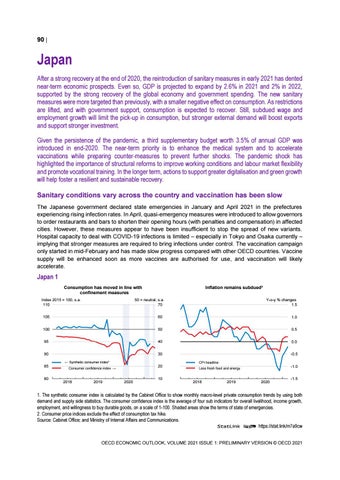
Japan After a strong recovery at the end of 2020, the reintroduction of sanitary measures in early 2021 has dented near-term economic prospects. Even so, GDP is projected to expand by 2.6% in 2021 and 2% in 2022, supported by the strong recovery of the global economy and government spending. The new sanitary measures were more targeted than previously, with a smaller negative effect on consumption. As restrictions are lifted, and with government support, consumption is expected to recover. Still, subdued wage and employment growth will limit the pick-up in consumption, but stronger external demand will boost exports and support stronger investment. Given the persistence of the pandemic, a third supplementary budget worth 3.5% of annual GDP was introduced in end-2020. The near-term priority is to enhance the medical system and to accelerate vaccinations while preparing counter-measures to prevent further shocks. The pandemic shock has highlighted the importance of structural reforms to improve working conditions and labour market flexibility and promote vocational training. In the longer term, actions to support greater digitalisation and green growth will help foster a resilient and sustainable recovery. Sanitary conditions vary across the country and vaccination has been slow The Japanese government declared state emergencies in January and April 2021 in the prefectures experiencing rising infection rates. In April, quasi-emergency measures were introduced to allow governors to order restaurants and bars to shorten their opening hours (with penalties and compensation) in affected cities. However, these measures appear to have been insufficient to stop the spread of new variants. Hospital capacity to deal with COVID-19 infections is limited – especially in Tokyo and Osaka currently – implying that stronger measures are required to bring infections under control. The vaccination campaign only started in mid-February and has made slow progress compared with other OECD countries. Vaccine supply will be enhanced soon as more vaccines are authorised for use, and vaccination will likely accelerate.
Japan 1 Inflation remains subdued²
Consumption has moved in line with confinement measures Index 2015 = 100, s.a. 110
50 = neutral, s.a. 70
Y-o-y % changes 1.5
105
60
1.0
100
50
0.5
95
40
0.0
90
30
-0.5
← Synthetic consumer index¹
85 80
CPI headline
20
Consumer confidence index →
2018
2019
2020
10
-1.0
Less fresh food and energy
0
2018
2019
2020
-1.5
1. The synthetic consumer index is calculated by the Cabinet Office to show monthly macro-level private consumption trends by using both demand and supply side statistics. The consumer confidence index is the average of four sub indicators for overall livelihood, income growth, employment, and willingness to buy durable goods, on a scale of 1-100. Shaded areas show the terms of state of emergencies. 2. Consumer price indices exclude the effect of consumption tax hike. Source: Cabinet Office; and Ministry of Internal Affairs and Communications. StatLink 2 https://stat.link/m7a9cw OECD ECONOMIC OUTLOOK, VOLUME 2021 ISSUE 1: PRELIMINARY VERSION © OECD 2021
91
Japan: Demand, output and prices 2017
2018
Current prices YEN trillion
Japan GDP at market prices Private consumption Government consumption Gross fixed capital formation Final domestic demand Stockbuilding1
553.1 302.1 107.4 138.3 547.7 1.1 548.9 97.3 93.1 4.2
Total domestic demand Exports of goods and services Imports of goods and services Net exports1 Memorandum items GDP deflator Consumer price index2
_ _
Core consumer price index3
_ _ _ _ _ _
Unemployment rate (% of labour force) Household saving ratio, net (% of disposable income) General government financial balance (% of GDP) General government gross debt (% of GDP) Current account balance (% of GDP)
2019
2020
2021
2022
Percentage changes, volume (2015 prices)
0.6 0.3 1.0 0.2 0.4 0.1 0.5 3.8 3.8 0.0
0.0 -0.3 1.9 0.9 0.4 0.0 0.5 -1.5 1.0 -0.4
-4.7 -6.0 2.7 -4.2 -3.8 -0.1 -3.9 -11.8 -7.3 -0.8
2.6 1.6 2.8 1.5 1.9 -0.2 1.7 11.5 5.1 1.0
2.0 2.2 0.1 3.1 2.0 0.0 2.0 4.4 2.9 0.3
0.0 1.0
0.6 0.5
0.9 0.0
-0.1 0.1
0.7 0.6
0.2 0.5 0.1 0.6 0.6 2.4 2.3 2.8 3.0 2.9 1.7 2.7 10.6 6.8 5.2 -2.5 -2.9 -10.1 -6.7 -4.0 220.8 222.9 238.0 241.2 241.4 3.5 3.4 3.2 3.6 3.7
1. Contributions to changes in real GDP, actual amount in the first column. 2. Calculated as the sum of the seasonally adjusted quarterly indices for each year. 3. Consumer price index excluding food and energy. Source: OECD Economic Outlook 109 database.
StatLink 2 https://stat.link/4a1mur
Japan 2 Wages have fallen since the start of the pandemic¹
Exports have recovered robustly while imports remain weak
Index 2015 = 100, s.a.² 104
Index 2015 = 100, s.a.² 120
103
115
102
110
101
105
100
100
99
95
98
Nominal wages
Total export of goods
Real wages
Total import of goods
90
97 96
85 2018
2019
2020
0
0
2018
2019
2020
80
1. Nominal wage indices are for total cash earnings per employee. Real wage indices are deflated nominal wage indices by the consumer price indices of all items less imputed rent. 2. Three-month moving average. Source: Ministry of Health, Labour and Welfare; and Bank of Japan. StatLi https://stat.link/6x3yz0
OECD ECONOMIC OUTLOOK, VOLUME 2021 ISSUE 1: PRELIMINARY VERSION © OECD 2021
92
Confinement measures have weighed on domestic demand while external demand has remained robust While consumption recovered strongly in the latter half of 2020, new confinement measures reduced it in early 2021. In contrast with earlier measures, the new restrictions were geographical rather than sectoral, and had a small effect on consumption. Consumption growth was also held back by sluggish wage growth and a large decline in “winter bonus” payments. If the sanitary shock is prolonged this may also depress “summer bonus” payments. While the strong rebound of automobile-related demand has moderated recently, exports continue strengthen as trading partners recover. Accordingly, industrial production recovered and investment picked up, with survey evidence suggesting further strengthening.
Fiscal policy has reacted to the deterioration in sanitary conditions Policy has reacted swiftly to the sanitary shocks. The third supplementary budget for fiscal year 2020 includes spending on vaccination and grants to local governments for COVID-19 counter-measures, help for the service sector (such as the “Go To campaign”), and support for structural reforms, notably investment in local government digital infrastructure and upgrading of disaster management. It also includes support for SME investment, especially for digitalisation, and the creation of new funds to enhance green R&D and investment in the private sector, as part of the government’s commitment to carbon neutrality by 2050. The supplementary budget can be used in 2021 and also in 2022. In addition, the initial fiscal year 2021 budget includes a 5 trillion yen (0.9% of GDP) contingency reserve fund for COVID-19. In case of emergency, the government can use these funds directly to support the medical system, households or SMEs. Government support in counteracting the pandemic has pushed up public debt to unprecedented levels, now exceeding 240% of GDP. Reflecting weak domestic demand pressures, headline inflation has remained depressed, notwithstanding rising energy prices. In this context, monetary policy remains accommodative. The Bank of Japan has maintained its policy stance, albeit with a few modifications in March for further effective and sustainable monetary easing. These include clarification of the range of fluctuations for long-term interest rates and the introduction of fixed-rate purchases operations to cap interest rates when needed. In addition, it has introduced a new Interest Scheme to Promote Lending, which pays interest on the outstanding amount of fund-provisioning measures including COVID-19-related operations to enable the Bank of Japan to offset adverse impacts on financial intermediation.
A steady recovery is expected, but uncertainty abounds Current containment measures are likely to be maintained until the summer, but, as the restrictions are lifted and vaccination accelerates, economic activity will strengthen. Subsidies to support the service sector (for travel and restaurant costs), which were suspended in December last year, are assumed to be restarted and boost consumption in the second half of the year. While the household saving rate is projected to decline from the level reached in 2020, albeit without fully reverting to pre-pandemic levels, sluggish wages will limit the uptick in consumption growth. Exports are set to pick up thanks to the ongoing recovery of large trading partners, including the United States, China and other Asian countries. Relatedly, investment will gain speed, helped also by government subsidies promoting digitalisation and decarbonisation. Inflation is expected to rise only gradually as domestic demand recovers, and cuts in mobile phone fees as well as the resumption of service sector subsidies will push down the headline consumer price index.
OECD ECONOMIC OUTLOOK, VOLUME 2021 ISSUE 1: PRELIMINARY VERSION © OECD 2021
93 The evolution of infections is a major risk to the outlook. Success in reducing transmission and progress in vaccination may allow a stronger recovery, whereas continued infections would hold back any recovery and may disrupt the Olympic and Paralympic games, causing further damage to the economy. Commodity price spikes and supply-chain disruptions present threats from the external sector, while progress in vaccination and fiscal packages in other countries could boost exports further.
Reducing virus transmission, while stepping up structural reform, will be key Fiscal policy should continue to support the economy in the near term. Once the recovery is secure, fiscal consolidation efforts should resume in order to ensure long-run sustainability. Monetary policy should remain accommodative while prudential policy should monitor financial soundness to limit risks associated with rising debt burdens. The government has started to lay out plans for a post-COVID-19 economy. In the meantime, sanitary risks need to be addressed to limit the spread of new variants and further stop-and-go confinement measures. This will require stepping up support to the health sector and the pace of vaccination. The measures and support for those affected should be better targeted, and the effectiveness of measures evaluated. While the labour market has generally been improving, many workers have lost their jobs and new entrants to the labour force, such as recent graduates, are facing difficulties in finding employment. To prevent scarring and protect workers from the pandemic, efforts are needed to push ahead with “work-style reforms”, supply vocational training and provide opportunities for education and employment to maintain attachment or enhance skills. In addition, the planned subsidies to support reallocation and the structural reforms prioritising digitalisation and green growth will help both in the short run and beyond, to sustain the recovery once the immediate health threat abates.
OECD ECONOMIC OUTLOOK, VOLUME 2021 ISSUE 1: PRELIMINARY VERSION © OECD 2021