157
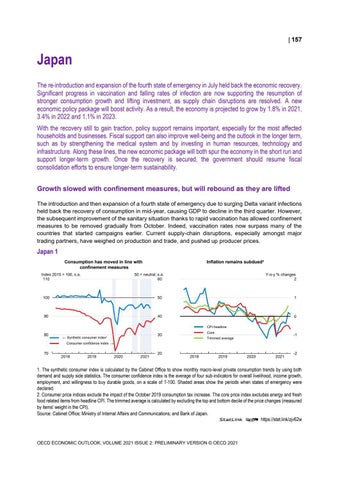
Japan The re-introduction and expansion of the fourth state of emergency in July held back the economic recovery. Significant progress in vaccination and falling rates of infection are now supporting the resumption of stronger consumption growth and lifting investment, as supply chain disruptions are resolved. A new economic policy package will boost activity. As a result, the economy is projected to grow by 1.8% in 2021, 3.4% in 2022 and 1.1% in 2023. With the recovery still to gain traction, policy support remains important, especially for the most affected households and businesses. Fiscal support can also improve well-being and the outlook in the longer term, such as by strengthening the medical system and by investing in human resources, technology and infrastructure. Along these lines, the new economic package will both spur the economy in the short run and support longer-term growth. Once the recovery is secured, the government should resume fiscal consolidation efforts to ensure longer-term sustainability. Growth slowed with confinement measures, but will rebound as they are lifted The introduction and then expansion of a fourth state of emergency due to surging Delta variant infections held back the recovery of consumption in mid-year, causing GDP to decline in the third quarter. However, the subsequent improvement of the sanitary situation thanks to rapid vaccination has allowed confinement measures to be removed gradually from October. Indeed, vaccination rates now surpass many of the countries that started campaigns earlier. Current supply-chain disruptions, especially amongst major trading partners, have weighed on production and trade, and pushed up producer prices.
Japan 1 Consumption has moved in line with confinement measures Index 2015 = 100, s.a. 110
Inflation remains subdued²
50 = neutral, s.a. 60
Y-o-y % changes 2
100
50
1
90
40
0 CPI headline
80
Core
30
← Synthetic consumer index¹
-1
Trimmed average
Consumer confidence index →
70
2018
2019
2020
2021
20
0
2018
2019
2020
2021
-2
1. The synthetic consumer index is calculated by the Cabinet Office to show monthly macro-level private consumption trends by using both demand and supply side statistics. The consumer confidence index is the average of four sub-indicators for overall livelihood, income growth, employment, and willingness to buy durable goods, on a scale of 1-100. Shaded areas show the periods when states of emergency were declared. 2. Consumer price indices exclude the impact of the October 2019 consumption tax increase. The core price index excludes energy and fresh food related items from headline CPI. The trimmed average is calculated by excluding the top and bottom decile of the price changes (measured by items' weight in the CPI). Source: Cabinet Office; Ministry of Internal Affairs and Communications; and Bank of Japan. StatLink 2 https://stat.link/zjv62w
OECD ECONOMIC OUTLOOK, VOLUME 2021 ISSUE 2: PRELIMINARY VERSION © OECD 2021
158
Japan: Demand, output and prices 2018
2019
GDP at market prices Private consumption Government consumption Gross fixed capital formation Final domestic demand Stockbuilding¹ Total domestic demand Exports of goods and services Imports of goods and services Net exports¹ Memorandum items GDP deflator Consumer price index² Core consumer price index³ Unemployment rate (% of labour force)
2021
2022
2023
Percentage changes, volume (2015 prices)
Current prices YEN trillion
Japan
2020
556.2 305.0 108.9 140.1
0.0 -0.3 1.9 0.9
-4.6 -5.8 2.8 -4.2
1.8 1.3 2.7 -0.6
3.4 4.2 1.1 4.4
1.1 1.7 -1.7 1.9
554.0 2.0
0.4 0.0
-3.7 -0.1
1.1 -0.2
3.5 0.1
1.0 0.0
556.1 101.9 101.8 0.1
0.5 -1.5 1.0 -0.4
-3.8 -11.7 -7.3 -0.7
1.0 11.3 6.0 0.8
3.6 4.3 4.9 -0.1
1.0 3.4 2.6 0.1
_ _ _ _ _ _ _ _
0.6 0.5 0.4 2.3
0.8 0.0 0.1 2.8
-0.6 -0.2 -0.5 2.8
0.6 0.8 0.5 2.6
0.7 0.8 0.8 2.4
Household saving ratio, net (% of disposable income) General government financial balance (% of GDP) General government gross debt (% of GDP) Current account balance (% of GDP)
2.7 10.7 7.1 5.8 3.3 -2.9 -9.5 -6.4 -6.9 -3.1 223.0 237.3 242.0 243.4 244.0 3.4 2.9 3.2 2.5 2.5
1. Contributions to changes in real GDP, actual amount in the first column. 2. Calculated as the sum of the seasonally adjusted quarterly indices for each year. 3. Consumer price index excluding food and energy. Source: OECD Economic Outlook 110 database.
StatLink 2 https://stat.link/b965of
Japan 2 Wages have struggled to recover¹
Trade has rebounded
Index 2015 = 100, s.a.² 104
Index 2015 = 100, s.a.² 120
102
110
100
100
98
96
2018
Nominal wages
Total export of goods
Real wages
Total import of goods
2019
2020
2021
0
0
2018
2019
90
2020
2021
80
1. Nominal wages are total cash earnings per employee. Real wages are nominal wages deflated by the consumer price index excluding imputed rent. 2. Three-month moving average. Source: Ministry of Health, Labour and Welfare; and Bank of Japan. StatLink 2 https://stat.link/gcquaw
OECD ECONOMIC OUTLOOK, VOLUME 2021 ISSUE 2: PRELIMINARY VERSION © OECD 2021
159 However, cost pressures have not been passed on to consumers with negative implications for business profitability and wage growth, which remains weak especially due to a reduction of working hours and declines in the regular summer bonus payments. Consumer price inflation has remained subdued, particularly following a cut of mobile phone fees in early 2021 (reducing inflation by 1.1 percentage point). Excluding this one-off effect, inflation has turned positive more recently, but remains below the 2% inflation target.
Fiscal and monetary policies remain supportive While Japan started its vaccination campaign after many other countries, central and local governments successfully accelerated vaccination and over 75% of the total population had been fully vaccinated by mid-November 2021. Partly thanks to fast vaccine deployment and targeted confinement measures, the number of COVID-19 infections and deaths has fallen dramatically and remains low in comparison with many other countries. The government has adapted its guidance in dealing with COVID-19 with the aim of avoiding stop-and-go confinement measures. For example, some local governments started subsidising holders of certificates of vaccination or negative test results for some services. In addition, the new Japanese government has disclosed an economic policy package, which includes measures such as increasing the health care system’s in-patient capacity, continued support for affected households and promotion of sectors that can help strengthen supply chain resilience. The package also features policies supporting longer-term growth and redistribution. Total additional government spending will be around JPY 50 trillion (9.2% of 2020 GDP), boosting economic activity mainly in 2022 and 2023. Monetary policy has remained accommodative, with yield curve control maintaining longer-term interest rates around zero as well. The Bank of Japan has also supported lending to businesses affected by the coronavirus and has recently extended the duration of this support by six months until the end of March 2022 as firms remain under stress. In addition, the Bank of Japan has decided to introduce support for financial institutions that lend or invest in green projects, using interest rate differentials as an incentive. This scheme will become operational in December 2021, and will continue until early 2031 to provide long-term support towards climate targets.
Economic growth will continue, but risks remain Private consumption is projected to continue to recover as remaining confinement measures are lifted, supported by measures in the new economic policy package including benefits to households and a resumption of the “Go To Travel” campaign. While they are currently affected by supply-chain disruptions, exports are set to expand steadily as trade partners recover. Imports will also grow, reflecting the recovery of domestic consumption and business investment. Recent surveys point to strong planned investment including in software and R&D. Investment will be buoyed by the recovery of exports and production, plus the subsidies to SMEs and R&D, especially in the digital and green areas. The labour market will continue improving, although wage growth may remain sluggish in the near term, partly due to composition effects with the re-employment of lower-wage workers and squeezes on corporate profits. Consumer price inflation will gradually increase as domestic demand grows, but remain below target. Accordingly, monetary policy will remain accommodative. Sanitary risks remain important. Even with a high vaccination rate, breakthrough infections by a new variant could occur. Further sanitary shocks in other countries would strongly affect trade and prices, weakening production and investment. In contrast, faster improvement of the sanitary situation globally and rapid deployment of effective therapeutic medicines or a swift easing of supply-chain restraints would boost confidence, consumption and investment.
OECD ECONOMIC OUTLOOK, VOLUME 2021 ISSUE 2: PRELIMINARY VERSION © OECD 2021
160
Further reforms are required for sustainable growth In order to secure a resilient recovery, the government should continue to support affected households and firms. However, support should become more targeted. Spending to enhance the medical system, including by developing vaccines and medicines for COVID-19, will improve the country’s resilience in case of a new public health emergency. To avoid scarring effects and offset the effects of an ageing population, continuing “work-style” reform to encourage greater participation and enhancing vocational training and education to improve the chances of entering employment are important. The digital transformation could also serve to improve resilience to sanitary shocks and boost productivity. In addition, greater digitalisation may enable the economy to cope more effectively with supply shocks. Against this backdrop, the Digital Agency, established in September 2021, should support greater digitalisation in both public and private sectors. As also highlighted in the new policy package, increasing R&D and investment in digitalisation and to reach climate change objectives could enhance longer-term growth and sustainability, while supporting the economy as the recovery gains greater traction. Timely and successful implementation, with regular evaluation, will help achieve these goals. However, this large-scale stimulus will push up government debt further still. Once the economic recovery is well on track, fiscal consolidation efforts should resume on both the expenditure and the revenue side, including social security and tax system reforms, to ensure longer-term sustainability in the face of demographic headwinds.
OECD ECONOMIC OUTLOOK, VOLUME 2021 ISSUE 2: PRELIMINARY VERSION © OECD 2021