163
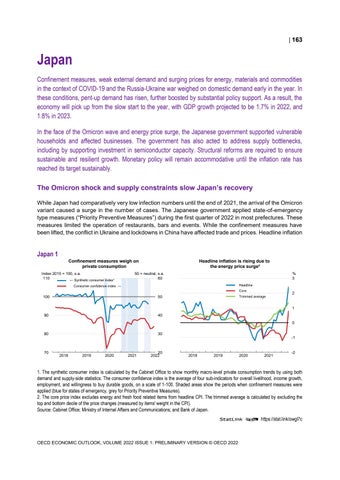
Japan Confinement measures, weak external demand and surging prices for energy, materials and commodities in the context of COVID-19 and the Russia-Ukraine war weighed on domestic demand early in the year. In these conditions, pent-up demand has risen, further boosted by substantial policy support. As a result, the economy will pick up from the slow start to the year, with GDP growth projected to be 1.7% in 2022, and 1.8% in 2023. In the face of the Omicron wave and energy price surge, the Japanese government supported vulnerable households and affected businesses. The government has also acted to address supply bottlenecks, including by supporting investment in semiconductor capacity. Structural reforms are required to ensure sustainable and resilient growth. Monetary policy will remain accommodative until the inflation rate has reached its target sustainably. The Omicron shock and supply constraints slow Japan’s recovery While Japan had comparatively very low infection numbers until the end of 2021, the arrival of the Omicron variant caused a surge in the number of cases. The Japanese government applied state-of-emergency type measures (“Priority Preventive Measures”) during the first quarter of 2022 in most prefectures. These measures limited the operation of restaurants, bars and events. While the confinement measures have been lifted, the conflict in Ukraine and lockdowns in China have affected trade and prices. Headline inflation
Japan 1 Confinement measures weigh on private consumption Index 2015 = 100, s.a. 110 ← Synthetic consumer index¹
Headline inflation is rising due to the energy price surge²
50 = neutral, s.a. 60
% 3 Headline
Consumer confidence index →
Core
100
50
90
40
Trimmed average
2
1
0 80
70
30
2018
2019
2020
2021
20 2022
-1
0
2018
2019
2020
2021
-2
1. The synthetic consumer index is calculated by the Cabinet Office to show monthly macro-level private consumption trends by using both demand and supply-side statistics. The consumer confidence index is the average of four sub-indicators for overall livelihood, income growth, employment, and willingness to buy durable goods, on a scale of 1-100. Shaded areas show the periods when confinement measures were applied (blue for states of emergency, grey for Priority Preventive Measures). 2. The core price index excludes energy and fresh food related items from headline CPI. The trimmed average is calculated by excluding the top and bottom decile of the price changes (measured by items' weight in the CPI). Source: Cabinet Office; Ministry of Internal Affairs and Communications; and Bank of Japan. StatLink 2 https://stat.link/owgl7c
OECD ECONOMIC OUTLOOK, VOLUME 2022 ISSUE 1: PRELIMINARY VERSION © OECD 2022
164
Japan: Demand, output and prices 2018
2019
GDP at market prices Private consumption Government consumption Gross fixed capital formation
2021
2022
2023
Percentage changes, volume (2015 prices)
Current prices YEN trillion
Japan
2020
556.3 304.9 108.9 140.3
-0.2 -0.5 1.9 1.0
-4.5 -5.2 2.3 -4.6
1.7 1.3 2.1 -1.6
1.7 2.6 1.7 -0.2
1.8 2.2 -1.6 3.6
Final domestic demand Stockbuilding¹
554.1 2.1
0.3 -0.1
-3.6 -0.1
0.7 -0.1
1.7 0.2
1.7 0.0
Total domestic demand Exports of goods and services Imports of goods and services Net exports¹
556.2 101.9 101.8 0.1
0.2 -1.5 1.0 -0.4
-3.7 -11.7 -6.9 -0.8
0.6 11.8 5.1 1.0
1.9 1.9 3.0 -0.2
1.7 3.2 2.6 0.1
_ _ _ _ _ _ _ _
0.6 0.5 0.4 2.4
0.9 0.0 0.1 2.8
-0.9 -0.2 -0.7 2.8
0.4 1.9 -0.1 2.6
1.7 1.9 1.4 2.5
Memorandum items GDP deflator Consumer price index² Core consumer price index³ Unemployment rate (% of labour force) Household saving ratio, net (% of disposable income) General government financial balance (% of GDP) General government gross debt (% of GDP) Current account balance (% of GDP)
3.2 12.1 8.5 6.5 3.2 -3.0 -9.0 -5.7 -6.9 -4.6 223.5 240.9 240.5 244.7 244.7 3.4 2.9 2.8 1.5 1.2
1. Contributions to changes in real GDP, actual amount in the first column. 2. Calculated as the sum of the seasonally adjusted quarterly indices for each year. 3. Consumer price index excluding food and energy. Source: OECD Economic Outlook 111 database.
StatLink 2 https://stat.link/wfbcxp
Japan 2 Wages are returning to pre-pandemic levels¹
Foreign trade has rebounded
Index 2020 = 100, s.a.² 103
Index 2015 = 100, s.a.² 120 Nominal wages Real wages
102
110
101
100
Total export of goods
100
99
90
Total import of goods
2018
2019
2020
2021
0
0
2018
2019
2020
2021
80
1. Nominal wages are total cash earnings per employee. Real wages are nominal wages deflated by the consumer price index excluding imputed rent. 2. Three-month moving average. Source: Ministry of Health, Labour and Welfare; and Bank of Japan. StatLink 2 https://stat.link/magf7x
OECD ECONOMIC OUTLOOK, VOLUME 2022 ISSUE 1: PRELIMINARY VERSION © OECD 2022
165 has risen largely due to high energy prices. In addition, price rises have been announced for utility fees including electricity and water supply, and some food products. The recent depreciation of the yen intensifies inflationary pressures. Core inflation has remained very sluggish until recently due to the impact of declines in mobile phone fees since March 2021 (cumulatively 1.5 percentage points). However, as the impacts of these price declines wear off, core inflation is strengthening. The direct effect on the Japanese economy of the Ukraine war is limited in the short term, but the economic damage could be more serious in the longer term. The share of goods imports from Russia is only 1.8%, and the share of exports to Russia 1%. Dependence on Russia for fossil fuels is modest (at 11%, 9% and 4% respectively for coal, natural gas and oil in 2021). The government will gradually reduce it and eventually aims to stop importing coal from Russia. Japan also imports some non-ferrous metals from Russia including palladium, which is used in catalytic converters for cars. While disruptions to trade in these metals could be covered by using stocks or recycling in the short term, Japan would have to find other suppliers or substitute resources for energy and materials over the longer term.
Fiscal and monetary policies continue to be supportive The Japanese government has reacted to both the sanitary and the energy price shocks. On 25 March, it decided to spend 0.3% of 2021 GDP to secure COVID vaccines, therapeutic medicines and testing tools, and to provide a special cash benefit for low-income households. To address high energy prices, the government introduced a new subsidy from January for fuel wholesalers to moderate fuel price increases. In addition to the expansion of this subsidy in March, the authorities announced a new policy package to counter surging prices on 26 April, whose total scale (including private sector spending) will be around 2.4% of GDP. In the process, the government debt-to-GDP ratio continues to increase to unprecedented levels. Monetary policy has remained supportive with yield curve control maintaining 10-year Japanese government bond yields at around zero within a range of plus or minus 0.25 percentage point and with no limit on bond purchases. The Bank of Japan extended the terms of their current measures to support private bank lending, especially for SMEs. The stance of monetary policy is assumed to remain accommodative in the projection period, consistent with the Bank of Japan’s longstanding statements that this will remain the case until the inflation rate reaches its 2% target sustainably.
The economic recovery will be sluggish, and risks are rising Oil prices will rise in 2022 and early 2023 because of the oil embargo in EU countries, but the government subsidy for fuel will continue to damp the price increases faced by consumers, so that inflation is expected to be around 2%. The subsidy is assumed to be extended beyond its current expiry date at the end of September. Private consumption will bounce back following the lifting of the confinement measures, but be slowed by higher inflation. While weak external demand, especially in large trade partners, and high import prices will weigh on trade in the near term, both exports and imports will grow as energy prices stabilise and domestic and external demand recover. Investment will accompany the recovery of exports and production, supported by government subsidies, especially in the green and digital areas. The labour market will continue improving, but overall wage growth will remain subdued as more lower-wage workers are hired and corporate profits are squeezed by the high prices of energy and other commodities. A prolonged war in Ukraine and higher-than-foreseen import prices are downside risks. Supply chain disruptions due to further COVID-19 shocks or geopolitical instability could depress trade, production and investment. Continued monetary policy tightening in other countries may accelerate the depreciation of the yen. This would push up import prices and inflation but would also strengthen Japan’s goods and services
OECD ECONOMIC OUTLOOK, VOLUME 2022 ISSUE 1: PRELIMINARY VERSION © OECD 2022
166 exports including inbound tourism – insofar as the sanitary situation permits. The cost pass-through to consumer prices is currently stronger than before and may help support higher wage and price growth by changing the deep-rooted deflationary mindset.
Further reforms should be implemented for sustainable and resilient growth While the Japanese government reacted forcefully to recent shocks, current policy settings are not enough to meet global and structural challenges. In this regard, normalising and reopening economic activities including inbound tourism is again possible as prevention and treatment of COVID-19 infections is enhanced and should not be further delayed. Lowering hurdles for incoming foreign direct investment could not only support investment but also raise productivity. To avoid scarring effects and offset the effects of an ageing population, continuing “work-style” reform and enhanced vocational training and education are essential. Developing and implementing support programmes for skills and training would help in this regard. In addition, support for the digital and green transformation should be intensified to improve productivity, resilience and sustainability. Securing and reallocating employment, global supply chains and energy sources are current priorities. If downturn risks emerge, further fiscal measures should be taken, but they should be more targeted and consider inclusiveness and sustainability. As economic growth regains momentum, fiscal consolidation efforts should resume on both the expenditure and the revenue side, including social security and tax system reforms, to ensure longer-term sustainability in the face of demographic headwinds.
OECD ECONOMIC OUTLOOK, VOLUME 2022 ISSUE 1: PRELIMINARY VERSION © OECD 2022