86
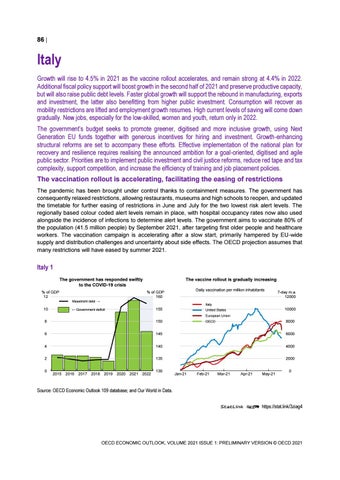
Italy Growth will rise to 4.5% in 2021 as the vaccine rollout accelerates, and remain strong at 4.4% in 2022. Additional fiscal policy support will boost growth in the second half of 2021 and preserve productive capacity, but will also raise public debt levels. Faster global growth will support the rebound in manufacturing, exports and investment, the latter also benefitting from higher public investment. Consumption will recover as mobility restrictions are lifted and employment growth resumes. High current levels of saving will come down gradually. New jobs, especially for the low-skilled, women and youth, return only in 2022. The government’s budget seeks to promote greener, digitised and more inclusive growth, using Next Generation EU funds together with generous incentives for hiring and investment. Growth-enhancing structural reforms are set to accompany these efforts. Effective implementation of the national plan for recovery and resilience requires realising the announced ambition for a goal-oriented, digitised and agile public sector. Priorities are to implement public investment and civil justice reforms, reduce red tape and tax complexity, support competition, and increase the efficiency of training and job placement policies. The vaccination rollout is accelerating, facilitating the easing of restrictions The pandemic has been brought under control thanks to containment measures. The government has consequently relaxed restrictions, allowing restaurants, museums and high schools to reopen, and updated the timetable for further easing of restrictions in June and July for the two lowest risk alert levels. The regionally based colour coded alert levels remain in place, with hospital occupancy rates now also used alongside the incidence of infections to determine alert levels. The government aims to vaccinate 80% of the population (41.5 million people) by September 2021, after targeting first older people and healthcare workers. The vaccination campaign is accelerating after a slow start, primarily hampered by EU-wide supply and distribution challenges and uncertainty about side effects. The OECD projection assumes that many restrictions will have eased by summer 2021.
Italy 1 The government has responded swiftly to the COVID-19 crisis % of GDP 12
The vaccine rollout is gradually increasing Daily vaccination per million inhabitants
% of GDP 160
7-day m.a. 12000
Maastricht debt → Italy
10
155
← Government deficit
10000
United States European Union
8
150
6
145
6000
4
140
4000
2
135
2000
0
2015
2016
2017
2018
2019
2020
2021 2022
130
8000
OECD
0 Jan-21
Feb-21
Mar-21
Apr-21
May-21
0
Source: OECD Economic Outlook 109 database; and Our World in Data. StatLink 2 https://stat.link/3ziag4
OECD ECONOMIC OUTLOOK, VOLUME 2021 ISSUE 1: PRELIMINARY VERSION © OECD 2021
87
Italy: Demand, output and prices 2017
2018
Current prices EUR billion
Italy GDP at market prices Private consumption Government consumption Gross fixed capital formation Final domestic demand Stockbuilding1
1 738.5 1 046.0 327.0 304.2 1 677.2 11.6 1 688.8 536.2 486.4 49.8
Total domestic demand Exports of goods and services Imports of goods and services Net exports1 Memorandum items GDP deflator Harmonised index of consumer prices Harmonised index of core inflation2
_ _ _ _ _ _ _
General government gross debt (% of GDP) General government debt, Maastricht definition (% of GDP) Current account balance (% of GDP)
2020
2021
2022
Percentage changes, volume (2015 prices)
0.8 1.0 0.1 2.9 1.2 0.0 1.1 1.6 2.8 -0.3
0.3 0.3 -0.8 1.1 0.2 -0.7 -0.5 1.9 -0.5 0.7
-8.9 -10.7 1.6 -9.2 -8.1 -0.3 -8.3 -14.5 -13.1 -0.9
4.5 3.1 1.8 10.0 4.1 -0.1 4.0 11.4 10.7 0.6
4.4 5.2 1.1 8.3 4.9 0.1 5.0 7.3 9.7 -0.4
1.1 1.2
0.8 0.6
1.2 -0.1
0.8 1.3
1.1 1.0
_ _
Unemployment rate (% of labour force) Household saving ratio, net (% of disposable income) General government financial balance (% of GDP)
2019
0.6 0.5 0.5 1.2 0.8 10.6 9.9 9.1 9.8 9.7 2.5 2.5 10.3 5.4 0.6 -2.2 -1.6 -9.5 -11.4 -6.4 148.0 156.1 186.1 189.7 187.4 134.4 134.6 155.9 159.6 157.2 2.6 3.3 3.7 3.2 3.0
1. Contributions to changes in real GDP, actual amount in the first column. 2. Harmonised index of consumer prices excluding food, energy, alcohol and tobacco. Source: OECD Economic Outlook 109 database.
StatLink 2 https://stat.link/d3ztv7
Italy 2 Industrial production and exports have rebounded Y-o-y % changes 10
Household confidence is influencing spending
Y-o-y % changes 20
0
0
-10
-20
← Industrial production¹ Exports of goods → Exports of services →
-20
-40
Balance, s.a. -8 -10
20
-12
10
-14
0
-16
-10
-18 -20
-30
2019
2020
-60
Y-o-y % changes 30
-22
-20
← Consumer confidence Retail sales →
-30
Total hours worked →
2019
2020
-40
1. Excluding construction. Source: OECD Economic Outlook 109 database; and OECD Main Economic Indicators database. StatLink 2 https://stat.link/pgjr15
OECD ECONOMIC OUTLOOK, VOLUME 2021 ISSUE 1: PRELIMINARY VERSION © OECD 2021
88
Strong manufacturing production contrasts with weak activity in contactintensive services sectors The contraction in activity in the first quarter of 2021 primarily reflected a slowdown in contact-intensive services sectors. Retail sales declined by 0.3% in the first quarter compared to the previous three months, whilst industrial production rose by 0.9%. Growth in the manufacturing sector has been supported by export demand, primarily from European partner countries and for intermediate goods. Business confidence in manufacturing and construction is now above 2019 levels. Confidence has also risen in business services, but by less, remaining below 2019 levels. Tourism, which in 2019 accounted for 6.4% of GDP, continued to contract, in particular with regards to air flights and overnight stays. Household spending has been heavily influenced by confidence and activity restrictions. Household saving remain elevated, even though employment numbers have stabilised. Surveys suggest that as restrictions ease and employment recovers, saving rates will fall, but at a gradual pace, reflecting high uncertainty and the share of savings held by wealthier households.
Comprehensive fiscal support will continue well into 2021 In April, ongoing confinement measures prompted the government to announce additional fiscal support, bringing the total in 2021 to EUR 72 billion (4.1% of GDP). Income support for households has been expanded, including cash allowances for seasonal workers, emergency income support for working parents, access to unemployment benefits and support for first-time home buyers. Support to firms included an extension of selected tax credits, tax exemptions, payment deferrals and grants based on the size of revenue losses, as well as some sector-specific assistance. The firing ban for large companies will be in effect until 30 June. However, large companies as well as small and medium sized firms can apply for access to part-time work programmes at no cost if they do not lay off workers by the end of the year. For small companies using the wage guarantee funds, the firing ban will be in effect until 31 October. Incentives to encourage hiring include the introduction of a new type of contract that waives social security contributions. Fixed-term contracts can be renewed, waiving the usual requirements until the end of 2021. The moratorium on debt and applications for new loan guarantees for small and medium-sized businesses have been extended to the end of the year. Supportive monetary policy in the euro area, high deposits, counter-cyclical financial regulations and government guarantees should continue to ensure positive credit growth to firms. Guarantees and debt moratoria cover EUR 168 billion and EUR 146 billion in new and existing loans, respectively. The government intends to keep policy supportive for some time, with the budget deficit rising from 2020 to 2021, before gradually falling to below 3% of GDP in 2025. The government has budgeted an increase in investment spending to complement the Next Generation EU funds. Generous incentives to encourage hiring and investment by the private sector have also been budgeted. The OECD projects a rise in public investment to 3.1% of GDP in 2022 and in the debt-to-GDP ratio to nearly 160% in 2021. To reduce public debt levels over the medium term, the government will primarily rely on higher growth, in part thanks to the rapid deployment of Next Generation EU funds. Effective implementation is critical to realise the government’s recovery plan.
Supporting an emergence from the crisis The large government stimulus, increased vaccination rates and the easing of restrictions will drive the economic recovery. The manufacturing sector and exports will lead the recovery, as global growth rebounds, supporting private sector investment. Higher public investments, including those based on the Next Generation EU funds, will further help to crowd in private investment. The services sector will recover
OECD ECONOMIC OUTLOOK, VOLUME 2021 ISSUE 1: PRELIMINARY VERSION © OECD 2021
89 as restrictions ease and the most-at-risk population is vaccinated. Bankruptcies will rise in 2022 as debt moratoria unwind with the normalisation of activity. The support provided by the government should help to mitigate the loss of productive capacity. Unemployment will rise modestly as more people actively look for a job. Employment growth will be subdued, given high levels of job preservation. Consumption is expected to recover as mobility restrictions are lifted, jobs return and lower uncertainty encourages households to reduce precautionary saving and use part of their accumulated savings to finance current spending. GDP is expected to reach its 2019 levels in the second half of 2022. The largest upside risk to the projection is the speed at which the Next Generation EU funds are spent, particularly in 2022. Faster and deeper structural reform implementation represents a further upside risk. Inflation risks are low. Whilst financial market tensions could have a substantial impact on the cost of borrowing, this has been mitigated by supportive EU fiscal and ECB monetary policies to date. A sharp spike in non-performing loans could delay already lengthy procedures and increase deadweight losses associated with bankruptcy.
Reforms to the public administration are needed to sustain higher growth Policy support should be gradually reduced as the recovery becomes more durable. In the near term, the early warning system for bankruptcy and civil court case administration will need additional resources and to automate some processes to handle the rise in caseloads that will follow the removal of support measures. Implementing reforms for a more effective, digitised public service and civil justice system will increase growth and help reduce the regional divide. Improving investment planning, maintenance and spending would raise the Next Generation EU funds’ impact. A simpler, streamlined regulatory environment that supports competition, particularly in the services sectors, would encourage higher employment and investment. Over the medium term, growth-enhancing public spending must rise and tax complexity fall. A more coordinated approach to taxes and the use of these funds could support an accelerated transition to a low-carbon economy. Improving the content and quality of training for workers and the unemployed would reduce unemployment and facilitate a move to higher paying jobs over time, especially for the vulnerable – women and youth in particular.
OECD ECONOMIC OUTLOOK, VOLUME 2021 ISSUE 1: PRELIMINARY VERSION © OECD 2021