153
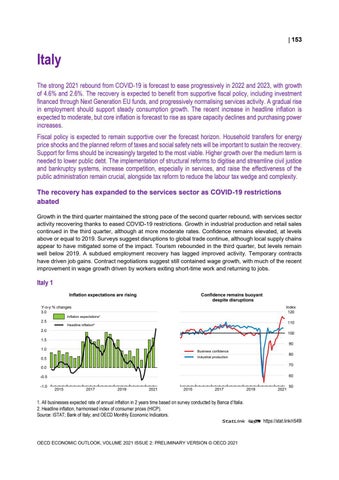
Italy The strong 2021 rebound from COVID-19 is forecast to ease progressively in 2022 and 2023, with growth of 4.6% and 2.6%. The recovery is expected to benefit from supportive fiscal policy, including investment financed through Next Generation EU funds, and progressively normalising services activity. A gradual rise in employment should support steady consumption growth. The recent increase in headline inflation is expected to moderate, but core inflation is forecast to rise as spare capacity declines and purchasing power increases. Fiscal policy is expected to remain supportive over the forecast horizon. Household transfers for energy price shocks and the planned reform of taxes and social safety nets will be important to sustain the recovery. Support for firms should be increasingly targeted to the most viable. Higher growth over the medium term is needed to lower public debt. The implementation of structural reforms to digitise and streamline civil justice and bankruptcy systems, increase competition, especially in services, and raise the effectiveness of the public administration remain crucial, alongside tax reform to reduce the labour tax wedge and complexity. The recovery has expanded to the services sector as COVID-19 restrictions abated Growth in the third quarter maintained the strong pace of the second quarter rebound, with services sector activity recovering thanks to eased COVID-19 restrictions. Growth in industrial production and retail sales continued in the third quarter, although at more moderate rates. Confidence remains elevated, at levels above or equal to 2019. Surveys suggest disruptions to global trade continue, although local supply chains appear to have mitigated some of the impact. Tourism rebounded in the third quarter, but levels remain well below 2019. A subdued employment recovery has lagged improved activity. Temporary contracts have driven job gains. Contract negotiations suggest still contained wage growth, with much of the recent improvement in wage growth driven by workers exiting short-time work and returning to jobs.
Italy 1 Inflation expectations are rising
Confidence remains buoyant despite disruptions
Y-o-y % changes 3.0
Index 120
Inflation expectations¹
2.5
110
Headline inflation²
2.0
100
1.5
90
1.0
Business confidence
80
Industrial production
0.5
70
0.0
60
-0.5 -1.0
2015
2017
2019
2021
0
0
2015
2017
2019
2021
50
1. All businesses expected rate of annual inflation in 2 years time based on survey conducted by Banca d’Italia. 2. Headline inflation, harmonised index of consumer prices (HICP). Source: ISTAT; Bank of Italy; and OECD Monthly Economic Indicators. StatLink 2 https://stat.link/ri549l
OECD ECONOMIC OUTLOOK, VOLUME 2021 ISSUE 2: PRELIMINARY VERSION © OECD 2021
154
Italy: Demand, output and prices 2018
2019
GDP at market prices Private consumption Government consumption Gross fixed capital formation Final domestic demand Stockbuilding¹ Total domestic demand Exports of goods and services Imports of goods and services Net exports¹ Memorandum items GDP deflator Harmonised index of consumer prices Harmonised index of core inflation² Unemployment rate (% of labour force)
2021
2022
2023
Percentage changes, volume (2015 prices)
Current prices EUR billion
Italy
2020
1 771.2 1 066.3 334.5 316.2
0.4 0.2 -0.5 0.7
-9.0 -10.8 1.9 -9.4
6.3 5.5 1.1 16.5
4.6 4.7 1.0 7.6
2.6 1.9 1.2 5.2
1 716.9 11.7
0.2 -0.5
-8.1 -0.4
6.5 -0.2
4.5 -0.1
2.4 0.0
1 728.6 555.0 512.4 42.6
-0.3 1.8 -0.5 0.7
-8.4 -14.7 -13.4 -0.9
6.4 12.7 13.9 0.1
4.4 6.9 6.4 0.4
2.4 4.1 3.8 0.2
_ _ _ _ _ _ _ _ _
0.9 0.6 0.5 10.0
1.2 -0.1 0.5 9.3
1.5 1.8 0.7 9.6
1.9 2.2 1.2 8.9
1.6 1.6 1.6 8.4
Household saving ratio, net (% of disposable income) General government financial balance (% of GDP) General government gross debt (% of GDP) General government debt, Maastricht definition³ (% of GDP) Current account balance (% of GDP)
2.5 10.3 4.7 1.0 -0.1 -1.5 -9.6 -9.4 -5.9 -4.3 155.7 183.9 182.7 178.6 176.8 134.3 155.7 154.6 150.4 148.6 3.2 3.5 3.1 3.0 3.1
1. Contributions to changes in real GDP, actual amount in the first column. 2. Harmonised index of consumer prices excluding food, energy, alcohol and tobacco. 3. The Maastricht definition of general government debt includes only loans, debt securities, and currency and deposits, with debt at face value rather than market value. Source: OECD Economic Outlook 110 database.
StatLink 2 https://stat.link/5u230y
Italy 2 Credit has begun to normalise following the introduction of guarantees Y-o-y % changes 15
Job growth is key for household confidence % of GDP 125
Y-o-y % changes 4
Index 130
← Loans to non-financial corporations Private debt →
10
120
2
120
5
115
0
110
0
110
-2
100 ← All jobs
-5
-10
2015
2017
2019
105
-4
100 2021
-6
Consumer confidence →
2015
2017
90
2019
2021
80
Source: Bank of Italy; and ISTAT. StatLink 2 https://stat.link/35rp2s
OECD ECONOMIC OUTLOOK, VOLUME 2021 ISSUE 2: PRELIMINARY VERSION © OECD 2021
155 The rise in inflation has been driven by energy price developments, although prices for activities heavily affected by COVID-19 restrictions, such as restaurants and leisure, have rebounded alongside activity. Price expectations have risen across firms in both the short and long term, but remain below 2%. Health policies continue to facilitate low levels of COVID-19-related restrictions, with all regions bar one subject to the least restrictive regime. Although infection rates have risen substantially with the spread of the delta variant, hospitalisation rates remain low in most regions. Vaccination rates continue to rise, with over 90% of those 50 and older now fully vaccinated, and more than a quarter of those over 70 having received their booster shots. All workers are now required to provide proof of vaccination, immunity or a negative COVID-19 test.
Fiscal policy remains supportive Fiscal policy remains supportive, as confirmed by the interim budget, with the government targeting a steady reduction in the primary deficit to 1.2% of GDP in 2023. This is a slightly faster improvement than the OECD forecast of 1.8% of GDP, with the difference driven primarily by the government assuming stronger revenue outcomes. Reduced COVID-19 income support to households in 2022 will be offset by revised social safety nets, including the universal child allowance, and higher health care spending. Tax payment deferrals have been extended. Targeted support to firms will be extended beyond 2021 through the SME guarantee fund. Reforms to the tax system will be focused on reducing the labour tax wedge to support employment and improving equity. The government has set aside EUR 8 billion to support tax reform. In response to the current energy price spike, the government reduced system charges for renewable energy subsidies, lowered the VAT rate on gas to 5% and increased existing energy subsidies for poorer households. Over EUR 5.5 billion has been allocated for 2021 and 2022. The National Recovery and Resilience Plan commits over EUR 100 billion in spending to the green transition, including infrastructure to support greener transport options such as rail and electric vehicles, increased renewable energy supply as well as incentives to support energy efficiency for households. The interim budget reaffirmed the government’s commitment to reaching the New Green Deal and the objective of gradually removing harmful environmental subsidies and rationalising energy prices.
The growth turnaround is set to continue GDP growth is expected to remain robust over the forecast horizon, albeit slowing as activity normalises and fiscal stimulus is gradually withdrawn. Private investment is forecast to remain robust as demand, reform implementation and investment incentives sustain confidence. The National Recovery and Resilience Plan supports higher public investment. Tourism and global supply chain constraints are forecast to ease steadily, sustaining export growth. Household consumption is expected to rise as employment gradually increases, fiscal policy is supportive, confidence rises and COVID-19-related restrictions ease on services activities. Corporate failures are expected to rise. Adequate loan loss provisioning will help mitigate the impact on larger banks and their lending. Although energy price impacts will gradually fade, core inflation is expected to increase over the forecast horizon. The steadily closing output gap and higher employment will allow some pass-through of higher producer prices to consumers. Stronger-than-expected 2021 growth has helped to lower the debt-to-GDP ratio.
OECD ECONOMIC OUTLOOK, VOLUME 2021 ISSUE 2: PRELIMINARY VERSION © OECD 2021
156 Risks to the forecast are balanced, given the heightened uncertainty about the recovery trajectory. The recovery in household spending could be weakened by inflation eroding purchasing power, particularly from energy prices, faltering employment or confidence. By contrast, a stronger recovery in permanent jobs and higher wages present upside risks. The pace of implementation of the National Recovery and Resilience Plan presents up and downside risks to confidence and growth. Much will depend on the success of the recently legislated deadlock breaking mechanisms. A sharp spike in non-performing loans could lower credit growth, delay already lengthy court procedures and increase the associated losses. High levels of public debt remain a source of potential vulnerability, alongside COVID-related risks.
Policy must be implemented to ensure that it supports growth Fiscal policy support should be gradually reduced as the recovery becomes firmly established, as planned. Ongoing household support for energy price shocks and the planned reform of taxes and social safety nets are important to sustain the recovery. Support for firms should be increasingly targeted to the most viable, to mitigate potential risks to the banking sector and long-term productivity. Digitalising and streamlining civil justice and bankruptcy processes will limit downside risks to the recovery, as will increased competition and use of certification in regulation, particularly in the services sector. Over the medium term, reforms should support higher public administration effectiveness and more growth-enhancing public spending. Tax reform, combined with a redesign of family and other benefits, could lower complexity and the labour tax wedge, raising employment. The revenue from the welcome decision to reduce environmentally harmful taxes should be used explicitly to support those most affected by the green transition. A long-term plan to harmonise and gradually raise carbon prices across the different sectors, with supporting policies and time to ease transition costs, would raise certainty and support investment. It would take early advantage of Italy’s already high levels of energy efficiency to support competitiveness and avoid higher transition costs in the future. A more digitised and well-staffed public sector would facilitate these reforms.
OECD ECONOMIC OUTLOOK, VOLUME 2021 ISSUE 2: PRELIMINARY VERSION © OECD 2021