150
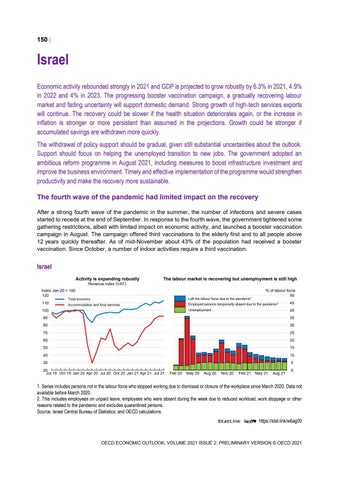
Israel Economic activity rebounded strongly in 2021 and GDP is projected to grow robustly by 6.3% in 2021, 4.9% in 2022 and 4% in 2023. The progressing booster vaccination campaign, a gradually recovering labour market and fading uncertainty will support domestic demand. Strong growth of high-tech services exports will continue. The recovery could be slower if the health situation deteriorates again, or the increase in inflation is stronger or more persistent than assumed in the projections. Growth could be stronger if accumulated savings are withdrawn more quickly. The withdrawal of policy support should be gradual, given still substantial uncertainties about the outlook. Support should focus on helping the unemployed transition to new jobs. The government adopted an ambitious reform programme in August 2021, including measures to boost infrastructure investment and improve the business environment. Timely and effective implementation of the programme would strengthen productivity and make the recovery more sustainable. The fourth wave of the pandemic had limited impact on the recovery After a strong fourth wave of the pandemic in the summer, the number of infections and severe cases started to recede at the end of September. In response to the fourth wave, the government tightened some gathering restrictions, albeit with limited impact on economic activity, and launched a booster vaccination campaign in August. The campaign offered third vaccinations to the elderly first and to all people above 12 years quickly thereafter. As of mid-November about 43% of the population had received a booster vaccination. Since October, a number of indoor activities require a third vaccination.
Israel Activity is expanding robustly
The labour market is recovering but unemployment is still high
Revenue index (VAT) Index Jan-20 = 100 120 110
% of labour force 50
Total economy
Left the labour force due to the pandemic¹
Accommodation and food services
Employed persons temporarily absent due to the pandemic²
45
Unemployment
40
100 90
35
80
30
70
25
60
20
50
15
40
10
30
5
20 Jul 19 Oct 19 Jan 20 Apr 20 Jul 20 Oct 20 Jan 21 Apr 21 Jul 21
Feb 20
May 20
Aug 20
Nov 20
Feb 21
May 21
Aug 21
0
1. Series includes persons not in the labour force who stopped working due to dismissal or closure of the workplace since March 2020. Data not available before March 2020. 2. This includes employees on unpaid leave, employees who were absent during the week due to reduced workload, work stoppage or other reasons related to the pandemic and excludes quarantined persons. Source: Israel Central Bureau of Statistics; and OECD calculations. StatLink 2 https://stat.link/w6ag09
OECD ECONOMIC OUTLOOK, VOLUME 2021 ISSUE 2: PRELIMINARY VERSION © OECD 2021
151
Israel: Demand, output and prices 2018
Israel
2019
Final domestic demand Stockbuilding¹ Total domestic demand Exports of goods and services Imports of goods and services Net exports¹ Memorandum items GDP deflator Consumer price index Core inflation index² Unemployment rate (% of labour force) Household saving ratio, gross (% of disposable income) General government financial balance (% of GDP) General government gross debt (% of GDP) Current account balance (% of GDP)
2021
2022
2023
Percentage changes, volume (2015 prices)
Current prices NIS billion
GDP at market prices Private consumption Government consumption Gross fixed capital formation
2020
1 341.6 731.2 305.3 286.1
3.7 4.0 2.7 3.0
-2.1 -9.2 2.5 -4.0
6.3 10.2 1.0 9.1
4.9 6.6 1.0 6.2
4.0 4.6 0.4 5.3
1 322.6 7.8
3.5 0.2
-5.3 1.1
7.7 -0.3
5.2 -0.2
3.8 0.0
1 330.4 402.4 391.3 11.2
3.7 3.7 3.3 0.1
-4.2 -1.9 -9.4 2.0
7.3 11.4 15.4 -0.4
5.0 6.5 5.2 0.6
3.8 4.9 4.4 0.4
_ _ _ _ _ _ _ _
1.9 0.8 0.7 3.8
0.9 -0.6 -0.1 4.3
2.4 1.5 1.3 5.2
2.1 2.1 2.1 5.0
1.3 1.4 1.4 4.3
2.8 -3.9 59.5 3.4
11.0 -10.8 71.5 5.4
6.7 -5.6 71.5 5.7
3.6 -3.9 70.8 5.6
3.1 -3.2 70.5 5.7
1. Contributions to changes in real GDP, actual amount in the first column. 2. Consumer price index excluding food and energy. Source: OECD Economic Outlook 110 database.
StatLink 2 https://stat.link/lc3dy2
Economic activity has rebounded strongly and GDP already surpassed its pre-pandemic level by mid-2021. GDP growth moderated to around 0.6% in the third quarter of 2021 relative to the second quarter, partly driven by volatile car purchases. The labour market is recovering on the back of the return of furloughed workers, but the number of unemployed workers remains significantly above pre-pandemic levels. At the same time, the job vacancy rate has increased strongly this year, exceeding pre-crisis levels. Consumer price inflation accelerated to 2.3% in October 2021, mainly on the back of rising energy, food and housing expenditure prices. Survey-based medium-term inflation expectations remain anchored close to the midpoint of the central bank’s target range (1%-3%).
Policy support is being withdrawn The government significantly tightened eligibility to unemployment benefits for workers on unpaid leave in June and phased out grants to hard-hit businesses. The authorities target a central government budget deficit of 3.9% in 2022, down from around 11.6% in 2020. This is largely on account of strong revenue growth, driven by buoyant activity in the high-tech and real estate sectors, the phasing out of most COVID-19 emergency support measures, and some additional consolidation efforts. The central bank ended its credit facility for SMEs via banks and announced the end of its government bond-buying programme by the end of the year, conditional on the recovery staying on track.
OECD ECONOMIC OUTLOOK, VOLUME 2021 ISSUE 2: PRELIMINARY VERSION © OECD 2021
152
The economy will continue to recover robustly Private consumption is projected to grow robustly as the booster vaccination campaign progresses, remaining restrictions are removed, and the labour market gradually improves. Fading uncertainty will boost investment growth while exports will be supported by the continued strength of high-tech services. Growth is projected to converge towards its potential rate in 2023. Unemployment will remain above the pre-crisis levels until the end of 2023, which will moderate wage growth. The projections take into account the government’s fiscal target for 2022, and assume continuing fiscal consolidation in 2023, as well as increases in the policy rate in 2023. Consumer price inflation is projected to fall below the mid-point of the central bank’s target range in 2023 as energy price increases abate and supply shortages ease over the projection period. The recovery could be slower if the health situation deteriorates again. A stronger or more persistent increase in inflation could force the central bank to tighten the monetary stance earlier and more strongly with adverse consequences for growth. On the upside, consumption growth could be stronger if accumulated savings are withdrawn more quickly.
Implementing structural reform plans would strengthen productivity The withdrawal of policy support should be gradual, given still substantial uncertainties about the outlook and high unemployment. Stepping up retraining and job-search support can help the unemployed transition to new jobs and avoid unemployment becoming structural. The government’s plans to boost infrastructure investment, streamline licencing requirements, lower tariffs and reform the vocational system have the potential to foster competition, business dynamism and productivity growth. More investment in pre-school education would improve skills and make growth more inclusive. The planned introduction of carbon pricing in the medium term will help reach the new and more ambitious greenhouse gas emissions reduction targets more cost-effectively and should be complemented by removing barriers to the expansion of renewable energy and improving energy efficiency.
OECD ECONOMIC OUTLOOK, VOLUME 2021 ISSUE 2: PRELIMINARY VERSION © OECD 2021