80
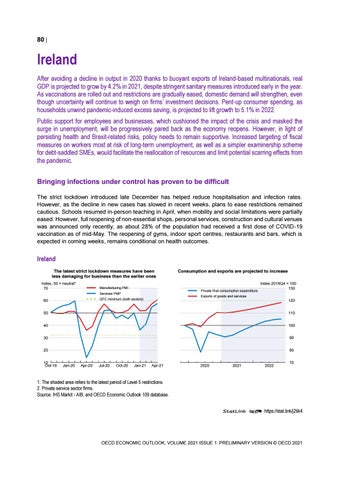
Ireland After avoiding a decline in output in 2020 thanks to buoyant exports of Ireland-based multinationals, real GDP is projected to grow by 4.2% in 2021, despite stringent sanitary measures introduced early in the year. As vaccinations are rolled out and restrictions are gradually eased, domestic demand will strengthen, even though uncertainty will continue to weigh on firms’ investment decisions. Pent-up consumer spending, as households unwind pandemic-induced excess saving, is projected to lift growth to 5.1% in 2022. Public support for employees and businesses, which cushioned the impact of the crisis and masked the surge in unemployment, will be progressively pared back as the economy reopens. However, in light of persisting health and Brexit-related risks, policy needs to remain supportive. Increased targeting of fiscal measures on workers most at risk of long-term unemployment, as well as a simpler examinership scheme for debt-saddled SMEs, would facilitate the reallocation of resources and limit potential scarring effects from the pandemic. Bringing infections under control has proven to be difficult The strict lockdown introduced late December has helped reduce hospitalisation and infection rates. However, as the decline in new cases has slowed in recent weeks, plans to ease restrictions remained cautious. Schools resumed in-person teaching in April, when mobility and social limitations were partially eased. However, full reopening of non-essential shops, personal services, construction and cultural venues was announced only recently, as about 28% of the population had received a first dose of COVID-19 vaccination as of mid-May. The reopening of gyms, indoor sport centres, restaurants and bars, which is expected in coming weeks, remains conditional on health outcomes.
Ireland The latest strict lockdown measures have been less damaging for business than the earlier ones Index, 50 = neutral¹ 70
Consumption and exports are projected to increase
Manufacturing PMI
Private final consumption expenditure
Services PMI²
Exports of goods and services
GFC minimum (both sectors)
60
Index 2019Q4 = 100 130 120
50
110
40
100
30
90
20
80
10 Oct-19
Jan-20
Apr-20
Jul-20
Oct-20
Jan-21
0 Apr-21
0
2020
2021
2022
70
1. The shaded area refers to the latest period of Level 5 restrictions. 2. Private service sector firms. Source: IHS Markit - AIB; and OECD Economic Outlook 109 database. StatLink 2 https://stat.link/j2tik4
OECD ECONOMIC OUTLOOK, VOLUME 2021 ISSUE 1: PRELIMINARY VERSION © OECD 2021
81
Ireland: Demand, output and prices 2017
Ireland GDP at market prices Private consumption Government consumption Gross fixed capital formation Final domestic demand Stockbuilding1 Total domestic demand Exports of goods and services2 Imports of goods and services Net exports1
2018
2020
2021
2022
Percentage changes, volume (2018 prices)
Current prices EUR billion
298.9 94.0 36.6 96.9 227.6 5.4 233.0 359.1 293.2 65.9
2019
8.9 2.6 5.7 -5.5 -0.2 -0.9 0.1 11.2 3.5 10.1
5.9 3.2 5.8 75.0 35.7 0.5 36.8 10.6 32.0 -16.8
2.5 -9.1 6.5 -32.4 -18.0 0.8 -17.0 6.2 -10.0 19.0
4.2 3.9 4.4 -13.5 -3.5 0.7 -3.0 6.9 3.3 5.5
5.1 9.9 0.4 8.8 7.5 0.0 7.4 4.5 5.8 0.4
4.7 0.5 0.7 0.3 5.7 6.9 0.1 75.0 62.9 6.0
4.5 2.6 0.9 0.9 4.9 7.5 0.5 69.4 57.4 -11.4
-9.4 0.6 -0.5 -0.1 5.6 19.8 -5.0 72.5 59.5 4.6
2.8 1.9 0.8 0.8 7.7 16.7 -4.8 75.1 62.1 12.5
7.2 1.0 1.6 1.5 8.1 7.1 -2.8 74.1 61.0 12.2
Memorandum items GVA3, excluding sectors dominated by foreign-owned multinational enterprises GDP deflator Harmonised index of consumer prices Harmonised index of core inflation4 Unemployment rate (% of labour force) Household saving ratio, net (% of disposable income) General government financial balance5 (% of GDP) General government gross debt (% of GDP) General government debt, Maastricht definition (% of GDP) Current account balance (% of GDP)
_ _ _ _ _ _ _ _ _ _
1. Contributions to changes in real GDP, actual amount in the first column. 2. So called "contract manufacturing" (exports of goods produced abroad under contract from an Irish-based entity) by multinational enterprises is assumed to remain at the 2020 level in 2021 and 2022. 3. Gross value added. Data for 2018-2022 are OECD 's estimates. 4. Harmonised index of consumer prices excluding food, energy, alcohol and tobacco. 5. Includes the one-off impact of recapitalisations in the banking sector. Source: OECD Economic Outlook 109 database.
StatL https://stat.link/t7nc5i
A new confinement had less impact on activity The reintroduction of highest-level restrictions weighed mainly on construction and contact-intensive services, which had begun to recover after December’s short-lived reopening. However, retail sales and business confidence indicators suggest businesses have held up significantly better than in previous lockdowns, even in some service sectors. Investment has increased steadily (even if on an annual basis it is affected by significant quarterly volatility before the pandemic). Enterprises and consumers, indeed, made an increasingly effective use of technology and innovation to adapt to the new circumstances. As for the external sector, multinational-dominated exports of pharmaceuticals, medical goods and ICT goods and services have continued to enjoy solid growth like in 2020. The agreement between the European Union and the United Kingdom on trading relations avoided a no-deal outcome, but there are increased frictions to trade, and working out all implementation modalities will take time. Trade flows with the United Kingdom dropped dramatically in early 2021, although this partly reflected precautionary stock building leading up to the agreement.
OECD ECONOMIC OUTLOOK, VOLUME 2021 ISSUE 1: PRELIMINARY VERSION © OECD 2021
82
Policy support has remained substantial The government has extended its support for households and firms with the new lockdown, such as the Pandemic Unemployment Payments and the Employment Wage Subsidy Scheme. By some measures, over 20% of the labour force are out of work and receiving benefits of some sort from the government even if the official unemployment rate remains close to 6%. Additional funding has also been provided to the health service for its COVID-19 response. On the revenue side, income tax receipts have held up rather well, reflecting that job losses are concentrated amongst the low paid who pay very low income taxes. The projections assume that exceptional support programmes will continue for much of 2021 and be scaled back gradually as the economy reopens.
The economy is poised for a strong recovery As shops reopen and vaccination progresses, rising consumer sentiment is expected to pave the way for a marked rebound of spending, driven by the unwinding of the elevated level of largely involuntary household saving in 2020. The easing of Brexit-related uncertainties has improved the business investment outlook, but short-term frictions in the agreement’s implementation could still damp momentum. Similarly, upward-trending house prices, against the backdrop of rigid supply and pandemic-driven increase in demand, should support residential investment. Though recovering over the projection horizon, as uncertainties gradually subside, total investment is set to remain below its historically high levels in 2019. Bankruptcy risks, which have been quiescent until now, might crystallise with the removal of policy support, which may eventually push up unemployment. Similarly, significant concentration of increased saving among higher-income households, whose marginal propensity to consume is lower, could slow down the projected consumption recovery. The recent moves in negotiations on international taxation may have implications for the Irish economy and the location of multinationals. On the upside, faster progress in bringing infections under control and opening of European economies and spillovers from the US fiscal boost could benefit exporters even more than currently projected.
Policy support should be withdrawn gradually As containment measures and vaccination bring infections under control, the economy can be reopened further. Exceptional support for households and firms can begin to be withdrawn when the recovery is underway, avoiding abrupt ending of support programmes that could induce a macroeconomic shock and derail the recovery. Support to firms should be tapered to prevent an abrupt large-scale liquidation of (predominantly small) firms while payments to households should become better targeted to support the vulnerable groups facing greater difficulties re-entering employment.
OECD ECONOMIC OUTLOOK, VOLUME 2021 ISSUE 1: PRELIMINARY VERSION © OECD 2021