ď ź 189
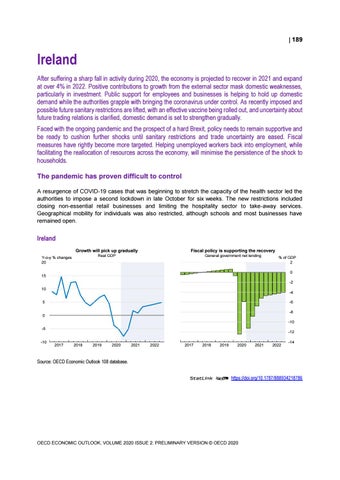
Ireland After suffering a sharp fall in activity during 2020, the economy is projected to recover in 2021 and expand at over 4% in 2022. Positive contributions to growth from the external sector mask domestic weaknesses, particularly in investment. Public support for employees and businesses is helping to hold up domestic demand while the authorities grapple with bringing the coronavirus under control. As recently imposed and possible future sanitary restrictions are lifted, with an effective vaccine being rolled out, and uncertainty about future trading relations is clarified, domestic demand is set to strengthen gradually. Faced with the ongoing pandemic and the prospect of a hard Brexit, policy needs to remain supportive and be ready to cushion further shocks until sanitary restrictions and trade uncertainty are eased. Fiscal measures have rightly become more targeted. Helping unemployed workers back into employment, while facilitating the reallocation of resources across the economy, will minimise the persistence of the shock to households. The pandemic has proven difficult to control A resurgence of COVID-19 cases that was beginning to stretch the capacity of the health sector led the authorities to impose a second lockdown in late October for six weeks. The new restrictions included closing non-essential retail businesses and limiting the hospitality sector to take-away services. Geographical mobility for individuals was also restricted, although schools and most businesses have remained open.
Ireland Growth will pick up gradually
Fiscal policy is supporting the recovery
Real GDP
General government net lending
Y-o-y % changes 20
% of GDP 2 0
15
-2 10
-4
5
-6 -8
0
-10 -5 -10
-12 2017
2018
2019
2020
2021
2022
0
2017
2018
2019
2020
2021
2022
-14
Source: OECD Economic Outlook 108 database. StatLink 2 https://doi.org/10.1787/888934218786
OECD ECONOMIC OUTLOOK, VOLUME 2020 ISSUE 2: PRELIMINARY VERSION Š OECD 2020
190
Ireland: Demand, output and prices 2017
2018
GDP at market prices Private consumption Government consumption Gross fixed capital formation Final domestic demand Stockbuilding1 Total domestic demand Exports of goods and services2 Imports of goods and services Net exports1
298.6 94.0 36.6 97.0 227.6 5.6 233.2 359.1 293.8 65.3
2020
2021
2022
Percentage changes, volume (2018 prices)
Current prices EUR billion
Ireland
2019
9.3 2.6 5.7 -5.6 0.0 -0.9 1.2 11.2 3.1 10.4
5.9 3.2 5.8 75.2 30.0 0.5 31.6 10.6 32.1 -16.9
-3.2 -13.2 12.3 -35.8 -22.1 1.4 -20.2 1.8 -10.4 13.9
0.1 1.5 0.1 -24.0 -9.3 -0.2 -9.1 4.2 -1.7 7.1
4.3 4.3 -4.7 5.3 2.7 0.0 2.6 3.8 2.6 2.5
4.7 0.3 0.7 0.3 5.7 6.9 0.1 75.0 62.9 6.0
4.5 2.7 0.9 0.9 4.9 7.5 0.5 69.4 57.3 -11.4
-11.5 2.3 -0.4 -0.1 5.3 22.8 -7.4 78.3 66.2 4.0
0.0 -0.1 0.4 0.3 8.0 16.5 -6.4 85.1 73.0 8.1
4.6 0.8 1.0 1.0 7.8 13.1 -4.3 86.6 74.5 10.2
Memorandum items GVA3, excluding sectors dominated by foreign-owned multinational enterprises GDP deflator Harmonised index of consumer prices Harmonised index of core inflation4 Unemployment rate (% of labour force) Household saving ratio, net (% of disposable income) General government financial balance5 (% of GDP) General government gross debt (% of GDP) General government debt, Maastricht definition (% of GDP) Current account balance (% of GDP)
_ _ _ _ _ _ _ _ _ _
1. Contributions to changes in real GDP, actual amount in the first column. 2. So called "contract manufacturing" (exports of goods produced abroad under contract from an Irish-based entity) by multinational enterprises is assumed to remain at the 2020 level in 2021 and 2022. 3. Gross value added. Data for 2018-2022 are OECD 's estimates. 4. Harmonised index of consumer prices excluding food, energy, alcohol and tobacco. 5. Includes the one-off impact of recapitalisations in the banking sector. Source: OECD Economic Outlook 108 database.
StatLink 2 https://doi.org/10.1787/888934218805
Export strength masks a weaker domestic economy The initial lockdown hit the domestic economy hard, but multinational companies largely weathered the storm. In particular, exports of pharmaceutical products and medical technology surged. Ireland’s important position in trade of COVID-19-related medical goods provided a bulwark against the precipitous drop in international trade experienced elsewhere. The domestic economy fared less well. While the official unemployment rate has been creeping up only gradually, this has masked substantial numbers who are not working and not classified as unemployed, accounting for around another 10% of the labour force. In addition, heightened uncertainty about Brexit damped business investment. Nonetheless, there were some signs that the economy was faring better before sanitary restrictions were reintroduced, notably retail sales were rebounding strongly.
OECD ECONOMIC OUTLOOK, VOLUME 2020 ISSUE 2: PRELIMINARY VERSION © OECD 2020
191
Fiscal policy has reacted robustly Fiscal policy has reacted promptly and robustly, with temporary wage subsidies and income support measures for workers laid off due to COVID-19. For the business sector, tax deferrals, loan schemes and other measures supporting firms’ cash-flows aimed to prevent mass insolvencies, especially among smaller enterprises. The authorities introduced an additional stimulus package worth EUR 5.2 billion in July, largely based on additional spending to get businesses back on their feet, following the easing of containment measures. The package enhanced the flexibility of the wage subsidy scheme (opening it to seasonal workers), temporarily reduced the standard VAT rate by two percentage points, provided support to the accommodation and food sector and extended income tax relief to self-employed workers. As a result, the general government deficit for 2020 is estimated to have ballooned dramatically. The 2021 budget also envisages a substantial deficit, continuing support for those affected by COVID-19, increasing spending on healthcare, boosting government investment and setting aside funds to mitigate Brexit-related shocks.
The outlook is beset by uncertainty While short-term prospects are particularly uncertain, the Irish economy is set to recover gradually as sanitary restrictions are lifted, an effective vaccine is rolled out and clarity about future trading relations emerges. The economy will be supported by fiscal measures, which will be progressively pared back as employment recovers. Export strength is likely to continue while imports will remain relatively subdued given low rates of business investment. Inflationary pressures are quiescent. The OECD projections assume that trade talks between the European Union and the United Kingdom reach an agreement. A hard Brexit would create a significant shock to the Irish economy. This represents the main downside risk to the outlook, in addition to further surges in coronavirus infections until immunisation is attained. Substantial increases in unemployment, particularly if accompanied by widespread business failure, could lead to scarring effects that would weigh on future growth.
Avoiding long-lasting scars Policy over the next year, as the 2021 budget signals, needs to remain ready to cushion Brexit-related shocks and further surges in coronavirus infections. Once the economy is again recovering, helping workers back into employment quickly or to acquire new skills to improve employment possibilities and continuing to help viable businesses and new businesses emerge as reallocation occurs will be important. Progress on these fronts will avoid long-lasting negative legacies from the current shocks, pushing up unemployment and causing people to drop out of the labour force.
OECD ECONOMIC OUTLOOK, VOLUME 2020 ISSUE 2: PRELIMINARY VERSION © OECD 2020