147
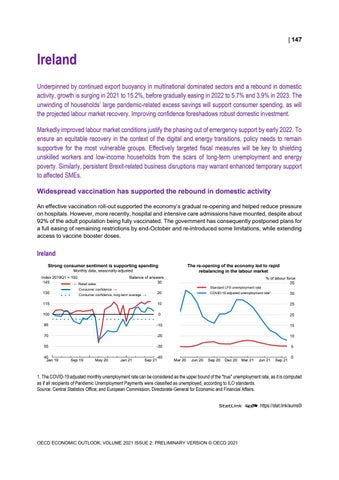
Ireland Underpinned by continued export buoyancy in multinational dominated sectors and a rebound in domestic activity, growth is surging in 2021 to 15.2%, before gradually easing in 2022 to 5.7% and 3.9% in 2023. The unwinding of households’ large pandemic-related excess savings will support consumer spending, as will the projected labour market recovery. Improving confidence foreshadows robust domestic investment. Markedly improved labour market conditions justify the phasing out of emergency support by early 2022. To ensure an equitable recovery in the context of the digital and energy transitions, policy needs to remain supportive for the most vulnerable groups. Effectively targeted fiscal measures will be key to shielding unskilled workers and low-income households from the scars of long-term unemployment and energy poverty. Similarly, persistent Brexit-related business disruptions may warrant enhanced temporary support to affected SMEs. Widespread vaccination has supported the rebound in domestic activity An effective vaccination roll-out supported the economy’s gradual re-opening and helped reduce pressure on hospitals. However, more recently, hospital and intensive care admissions have mounted, despite about 92% of the adult population being fully vaccinated. The government has consequently postponed plans for a full easing of remaining restrictions by end-October and re-introduced some limitations, while extending access to vaccine booster doses.
Ireland Strong consumer sentiment is supporting spending
The re-opening of the economy led to rapid rebalancing in the labour market
Monthly data, seasonally-adjusted Index 2019Q1 = 100 145 ← Retail sales 130
Balance of answers 30
% of labour force 35 Standard LFS unemployment rate
Consumer confidence → Consumer confidence, long-term average →
20
COVID-19 adjusted unemployment rate¹
30
115
10
25
100
0
20
85
-10
15
70
-20
10
55
-30
5
40 Jan 19
Sep 19
May 20
Jan 21
-40 Sep 21
0 Mar 20
Jun 20
Sep 20
Dec 20
Mar 21
Jun 21
Sep 21
0
1. The COVID-19 adjusted monthly unemployment rate can be considered as the upper bound of the "true" unemployment rate, as it is computed as if all recipients of Pandemic Unemployment Payments were classified as unemployed, according to ILO standards. Source: Central Statistics Office; and European Commission, Directorate-General for Economic and Financial Affairs. StatLink 2 https://stat.link/aums0l
OECD ECONOMIC OUTLOOK, VOLUME 2021 ISSUE 2: PRELIMINARY VERSION © OECD 2021
148
Ireland: Demand, output and prices 2018
2019
GDP at market prices Private consumption Government consumption Gross fixed capital formation Final domestic demand Stockbuilding¹ Total domestic demand Exports of goods and services Imports of goods and services Net exports¹ Memorandum items GVA², excluding sectors dominated by foreign-owned multinational enterprises GDP deflator Harmonised index of consumer prices Harmonised index of core inflation³ Unemployment rate (% of labour force) Household saving ratio, net (% of disposable income) General government financial balance⁴ (% of GDP) General government gross debt (% of GDP) General government debt, Maastricht definition⁵ (% of GDP) Current account balance (% of GDP)
2021
2022
2023
Percentage changes, volume (2019 prices)
Current prices EUR billion
Ireland
2020
325.6 99.2 38.8 91.9
5.1 3.2 6.8 100.5
5.8 -11.1 9.4 -22.9
15.2 6.3 2.5 -45.7
5.7 9.9 -1.5 11.7
3.9 3.9 1.5 6.0
229.9 3.0
43.2 1.5
-14.8 0.0
-21.1 0.3
8.1 0.1
4.2 0.0
232.9 399.7 307.0 92.7
46.8 10.5 42.5 -27.2
-13.7 9.5 -7.5 21.4
-20.6 17.2 -10.3 33.7
8.3 5.5 6.5 1.7
4.1 4.2 4.6 1.5
_
3.7
-8.6
4.1
8.0
4.1
_ _ _ _ _ _ _ _ _
4.1 0.9 0.9 5.0 5.3 0.5 69.5 57.3 -19.9
-1.3 -0.5 -0.1 5.8 21.6 -4.9 72.3 58.5 -2.7
-0.6 2.1 1.4 6.3 15.3 -3.2 69.6 55.8 16.3
2.1 2.7 1.9 5.7 6.5 -1.7 68.0 54.2 18.2
1.4 1.7 1.7 5.1 5.1 -0.6 66.5 52.7 19.2
1. Contributions to changes in real GDP, actual amount in the first column. 2. Gross value added. 3. Harmonised index of consumer prices excluding food, energy, alcohol and tobacco. 4. Includes the one-off impact of recapitalisations in the banking sector. 5. The Maastricht definition of general government debt includes only loans, debt securities, and currency and deposits, with debt at face value rather than market value. Source: OECD Economic Outlook 110 database.
StatLink 2 https://stat.link/v8tog7
Real GDP is growing very strongly in 2021, underpinned by persistently buoyant exports in multinational-dominated sectors and a strong rebound in domestic-oriented ones, following the gradual lifting of restrictions. A successful vaccination rollout strengthened household confidence, which, combined with large pandemic-related excess savings, supported strong consumption growth. Business conditions remain sound, as firms continue to hire on the back of expanding orders and investment prospects have improved. However, the recovery remains uneven, with output in many contact-intensive sectors still below pre-pandemic levels. Moreover, increased supply chain delays, triggered by rapidly growing demand, have resulted in markedly higher input prices. Were firms to pass such cost pressures fully on to consumers, upside inflationary risks, already relatively high with annual inflation rising to 5.1% in October, would be further intensified.
Fiscal support needs to be increasingly targeted The strength of the recovery and the resilience of the labour market, since the re-opening of the economy, warrant the government’s decision to phase out the Pandemic Unemployment Payments and Employment Wage Subsidy schemes by the end of April 2022. The fiscal stance, though, is set to remain supportive. Targeted social measures will be required to sustain displaced workers and ailing, but viable, firms in the most affected sectors. At the same time, revenues from the newly increased carbon tax will be largely OECD ECONOMIC OUTLOOK, VOLUME 2021 ISSUE 2: PRELIMINARY VERSION © OECD 2021
149 earmarked to offset its regressive impact on poorer households. The adoption of a spending rule and much larger than expected tax receipts, as of late, have significantly improved public finances. The budget deficit is expected to almost vanish by 2023. Still, further expansions in current expenditure will have to be kept in check in the medium term. Ensuring an adequate build-up of fiscal reserves to tackle the long-term consequences of population ageing, while meeting growing housing needs and funding the climate and digital transitions, will remain the country’s main fiscal challenge.
The economy is poised for a strong recovery High household excess savings and confidence levels have paved the way for a rebound in consumer spending. This will gain further momentum in 2022, as sanitary restrictions are lifted. Because of still impaired global supply chains, strong growth of domestic demand will see inflationary pressures rise in the near term. These, however, will start to subside from mid-2022. Strong economic activity will support employment and wage growth. The phasing out of public support schemes in early 2022, though, will slow the standard unemployment rate’s return to 2019 pre-pandemic levels, which will be reached only by the end of 2023. In the near term, the re-imposition of tighter restrictions, driven by an acceleration of infections with the Delta variant and mounting pressure on hospital capacity, could limit the rebound in consumption and weigh on labour market outcomes. In the medium term, to the extent that higher corporate tax rates may influence the localisation of multinationals, the recent agreement on international taxation could have implications for Ireland’s economy and public finances. In addition, heightened tensions around the implementation of the agreement between the European Union and the United Kingdom could further aggravate business constraints, risking a reorientation of trade flows. On the upside, a faster-than-expected recovery in tourism could bring a needed boost to the lagging hospitality industry.
Sustaining growth will require structural measures While the short-term outlook is favourable, Ireland faces important challenges in the medium to long term in sustaining growth and improving well-being. The government has recently launched a programme to boost housing supply and has committed to ambitious climate change objectives. These will require substantial investment. Therefore, maintaining budgetary discipline and boosting participation and productivity in the domestic-oriented economy, in particular by enhancing access to finance for innovative SMEs, will be important. COVID-19 stretched the medical system’s capacity, suggesting attention to ensuring effectiveness in health spending is warranted.
OECD ECONOMIC OUTLOOK, VOLUME 2021 ISSUE 2: PRELIMINARY VERSION © OECD 2021