153
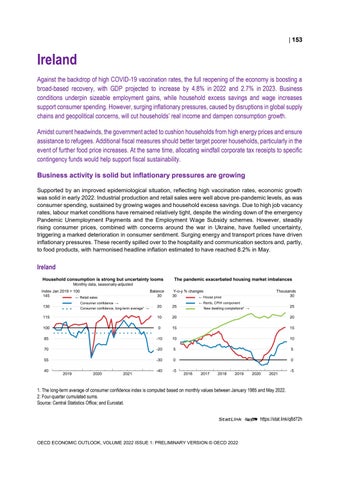
Ireland Against the backdrop of high COVID-19 vaccination rates, the full reopening of the economy is boosting a broad-based recovery, with GDP projected to increase by 4.8% in 2022 and 2.7% in 2023. Business conditions underpin sizeable employment gains, while household excess savings and wage increases support consumer spending. However, surging inflationary pressures, caused by disruptions in global supply chains and geopolitical concerns, will cut households’ real income and dampen consumption growth. Amidst current headwinds, the government acted to cushion households from high energy prices and ensure assistance to refugees. Additional fiscal measures should better target poorer households, particularly in the event of further food price increases. At the same time, allocating windfall corporate tax receipts to specific contingency funds would help support fiscal sustainability. Business activity is solid but inflationary pressures are growing Supported by an improved epidemiological situation, reflecting high vaccination rates, economic growth was solid in early 2022. Industrial production and retail sales were well above pre-pandemic levels, as was consumer spending, sustained by growing wages and household excess savings. Due to high job vacancy rates, labour market conditions have remained relatively tight, despite the winding down of the emergency Pandemic Unemployment Payments and the Employment Wage Subsidy schemes. However, steadily rising consumer prices, combined with concerns around the war in Ukraine, have fuelled uncertainty, triggering a marked deterioration in consumer sentiment. Surging energy and transport prices have driven inflationary pressures. These recently spilled over to the hospitality and communication sectors and, partly, to food products, with harmonised headline inflation estimated to have reached 8.2% in May.
Ireland Household consumption is strong but uncertainty looms
The pandemic exacerbated housing market imbalances
Monthly data, seasonally-adjusted Index Jan 2019 = 100 145 ← Retail sales
Balance 30
Consumer confidence →
130
Y-o-y % changes 30 ← House price
Thousands 30
← Rents, CPIH component
20
25
115
10
20
20
100
0
15
15
85
-10
10
10
70
-20
5
5
55
-30
0
0
-40
-5
40
Consumer confidence, long-term average¹ →
2019
2020
2021
25
New dwelling completions² →
2016
2017
2018
2019
2020
2021
-5
1. The long-term average of consumer confidence index is computed based on monthly values between January 1985 and May 2022. 2. Four-quarter cumulated sums. Source: Central Statistics Office; and Eurostat. StatLink 2 https://stat.link/q8d72h
OECD ECONOMIC OUTLOOK, VOLUME 2022 ISSUE 1: PRELIMINARY VERSION © OECD 2022
154
Ireland: Demand, output and prices 2018
2019
GDP at market prices Private consumption Government consumption Gross fixed capital formation
2021
2022
2023
Percentage changes, volume (2019 prices)
Current prices EUR billion
Ireland
2020
325.5 99.2 38.8 91.9
5.1 3.2 6.8 100.5
5.9 -11.1 9.4 -22.9
13.4 5.6 5.4 -37.7
4.8 5.8 -0.3 27.9
2.7 3.0 2.1 3.3
Final domestic demand Stockbuilding¹
229.9 3.1
42.8 1.6
-14.9 0.0
-16.8 -0.1
13.0 -1.5
3.0 0.0
Total domestic demand Exports of goods and services Imports of goods and services Net exports¹
233.0 399.6 307.1 92.5
42.5 10.5 42.5 -27.2
-14.5 9.5 -7.5 21.4
-17.0 16.6 -3.6 25.7
10.1 5.1 11.0 -3.6
2.9 3.5 4.0 0.8
_
3.7
-8.6
4.9
4.6
3.0
_ _ _ _ _ _ _ _ _
4.1 0.9 0.9 5.0 5.2 0.5 69.5 57.3 -19.9
-1.3 -0.5 -0.1 5.8 21.4 -5.1 72.3 58.6 -2.7
-0.3 2.4 1.7 6.2 17.9 -1.9 65.0 56.1 14.0
4.5 6.6 3.7 4.8 12.5 -0.5 62.0 53.1 11.2
2.9 5.0 3.7 5.0 8.3 -0.1 60.1 51.2 11.3
Memorandum items GVA², excluding sectors dominated by foreign-owned multinational enterprises GDP deflator Harmonised index of consumer prices Harmonised index of core inflation³ Unemployment rate (% of labour force) Household saving ratio, net (% of disposable income) General government financial balance⁴ (% of GDP) General government gross debt (% of GDP) General government debt, Maastricht definition⁵ (% of GDP) Current account balance (% of GDP)
1. Contributions to changes in real GDP, actual amount in the first column. 2. Gross value added. 3. Harmonised index of consumer prices excluding food, energy, alcohol and tobacco. 4. Includes the one-off impact of recapitalisations in the banking sector. 5. The Maastricht definition of general government debt includes only loans, debt securities, and currency and deposits, with debt at face value rather than market value. Source: OECD Economic Outlook 111 database.
StatLink 2 https://stat.link/7z4ais
Direct macroeconomic risks from the war in Ukraine are limited, as Ireland’s goods trade with Russia, Ukraine and Belarus is modest. However, specific shocks could hit agriculture and some industries dependent on specialised energy inputs, particularly as the oil embargo takes effect. As for trade in services, the aircraft leasing industry could be affected, although the impact on the domestic economy would be negligible. Following the Government’s commitment not to cap their number, Ireland has so far welcomed more than 33 000 Ukrainian refugees, with state accommodation provided to about two thirds of them. A new Cabinet subcommittee was recently established to oversee the all-government response to the crisis.
Targeted fiscal support should be prioritised To mitigate the adverse impact of rapidly rising energy bills on household income, the government took support measures worth about 0.5% of 2021 GDP. Largely made up of untargeted electricity credits and reductions in energy-related indirect taxes and levies, such measures have provided only limited protection to poorer households. Any new initiatives should focus on temporary assistance to the most vulnerable and productivity-enhancing public investment. In addition, the costs of the refugee crisis, so far financed via unspent COVID-19 contingency funds, will weigh on public spending in 2023. The recently introduced
OECD ECONOMIC OUTLOOK, VOLUME 2022 ISSUE 1: PRELIMINARY VERSION © OECD 2022
155 fiscal rule, limiting annual permanent expenditure increases to around 5%, should keep spending in check, while buoyant tax receipts will continue to improve public finances.
Growing uncertainties will dent the pace of the recovery The full reopening of the economy and the prospects of a relatively normal summer tourist season, combined with high household excess savings, will support consumer spending in 2022. However, mounting uncertainties, fuelled by geopolitical tensions and still impaired global supply chains, will work in the opposite direction. Due to a tight labour market, wages will grow strongly in 2022, but moderate somewhat thereafter, as growth subsides. Even so, high inflation will cut real household disposable income and weigh on firms’ investment decisions, especially in 2023, as the embargo on Russian oil takes effect. If funding costs were to rise faster than assumed, more domestic firms might downsize or ditch their investment plans. Similarly, higher interest rates could make housing less affordable. Additionally, protracted uncertainties around the full implementation of Brexit agreements may further weaken firms’ competitiveness. Persistently high input price inflation, while weighing on firms’ profitability, could also hamper the fiscal sustainability of the ambitious government agenda to subsidise residential construction and retrofitting, in a bid to boost housing supply and ease pressure from high house prices and rents. On the upside, GDP growth may turn out stronger, as multinational-dominated exports of pharmaceutical and medical goods, as well as ICT services, could again surprise on the upside.
Sustaining growth will require structural reforms Ireland faces important challenges in order to sustain growth and improve wellbeing in the medium to long term. These include ambitious and investment-intensive objectives to ensure affordable housing, to overhaul the health system to improve quality of care and value for money, and to achieve a just carbon transition by 2050. Regarding the latter, the government recently committed to maintain the schedule of carbon price increases as planned, whilst vowing to protect those more at risk of fuel poverty. This would preserve the carbon tax price signal and help strengthen energy saving incentives. In addition, measures fostering the acquisition of digital and green construction skills, particularly among displaced workers, and improving access to finance for innovative SMEs, would boost participation and productivity in the domestic-oriented economy.
OECD ECONOMIC OUTLOOK, VOLUME 2022 ISSUE 1: PRELIMINARY VERSION © OECD 2022