143
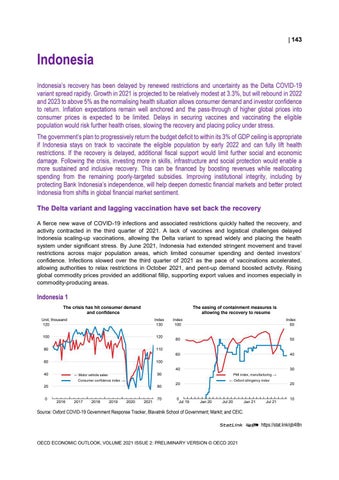
Indonesia Indonesia’s recovery has been delayed by renewed restrictions and uncertainty as the Delta COVID-19 variant spread rapidly. Growth in 2021 is projected to be relatively modest at 3.3%, but will rebound in 2022 and 2023 to above 5% as the normalising health situation allows consumer demand and investor confidence to return. Inflation expectations remain well anchored and the pass-through of higher global prices into consumer prices is expected to be limited. Delays in securing vaccines and vaccinating the eligible population would risk further health crises, slowing the recovery and placing policy under stress. The government’s plan to progressively return the budget deficit to within its 3% of GDP ceiling is appropriate if Indonesia stays on track to vaccinate the eligible population by early 2022 and can fully lift health restrictions. If the recovery is delayed, additional fiscal support would limit further social and economic damage. Following the crisis, investing more in skills, infrastructure and social protection would enable a more sustained and inclusive recovery. This can be financed by boosting revenues while reallocating spending from the remaining poorly-targeted subsidies. Improving institutional integrity, including by protecting Bank Indonesia’s independence, will help deepen domestic financial markets and better protect Indonesia from shifts in global financial market sentiment. The Delta variant and lagging vaccination have set back the recovery A fierce new wave of COVID-19 infections and associated restrictions quickly halted the recovery, and activity contracted in the third quarter of 2021. A lack of vaccines and logistical challenges delayed Indonesia scaling-up vaccinations, allowing the Delta variant to spread widely and placing the health system under significant stress. By June 2021, Indonesia had extended stringent movement and travel restrictions across major population areas, which limited consumer spending and dented investors’ confidence. Infections slowed over the third quarter of 2021 as the pace of vaccinations accelerated, allowing authorities to relax restrictions in October 2021, and pent-up demand boosted activity. Rising global commodity prices provided an additional fillip, supporting export values and incomes especially in commodity-producing areas.
Indonesia 1 The crisis has hit consumer demand and confidence
The easing of containment measures is allowing the recovery to resume
Unit, thousand 120
Index 130
100
120
80
110
60
100
Index 100
Index 60
80
50
60
40
40 40
Consumer confidence index →
20 0
80
2016
2017
2018
30
90
← Motor vehicle sales
2019
2020
2021
70
PMI index, manufacturing → ← Oxford stringency index
20
0 Jul 19
Jan 20
Jul 20
Jan 21
Jul 21
20
10
Source: Oxford COVID-19 Government Response Tracker, Blavatnik School of Government; Markit; and CEIC. StatLink 2 https://stat.link/qb4l8n OECD ECONOMIC OUTLOOK, VOLUME 2021 ISSUE 2: PRELIMINARY VERSION © OECD 2021
144
Indonesia: Demand, output and prices 2018
2019
GDP at market prices Private consumption Government consumption Gross fixed capital formation Final domestic demand Stockbuilding¹ Total domestic demand Exports of goods and services Imports of goods and services Net exports¹ Memorandum items GDP deflator Consumer price index Private consumption deflator General government financial balance (% of GDP)
2021
2022
2023
Percentage changes, volume (2010 prices)
Current prices IDR trillion
Indonesia
2020
14 838.8 8 455.1 1 338.6 4 791.2 14 585.0 412.4 14 997.4 3 116.5 3 275.1 - 158.6
5.0 5.2 3.3 4.5 4.8 -0.9 3.7 -0.9 -7.4 1.4
-2.1 -2.7 1.9 -4.9 -3.1 -0.3 -3.3 -7.7 -14.7 1.1
3.3 1.6 4.2 3.4 2.4 -0.1 2.2 21.7 19.1 1.1
5.2 5.0 1.4 5.4 4.8 0.5 5.2 8.8 9.9 0.2
5.1 5.6 1.3 7.2 5.8 0.0 5.7 4.5 7.2 -0.3
_ _ _ _ _
1.6 3.0 3.2 -2.2 -2.7
-0.5 1.9 1.9 -6.2 -0.4
5.4 1.7 1.8 -5.7 0.4
4.1 2.8 3.5 -4.8 1.2
3.1 3.1 3.6 -2.9 0.5
Current account balance (% of GDP) 1. Contributions to changes in real GDP, actual amount in the first column. Source: OECD Economic Outlook 110 database.
StatLink 2 https://stat.link/sly5xk
Indonesia 2
% of GDP 0
Unwinding fiscal support will help return the budget deficit to target
The COVID crisis has set back Indonesia's convergence
General government financial balance¹
Percentage gap in GDP per capita²
% -50
-1
-52
-2
-54
-3
-56
-4
-58
-5
-60
-6
-62
-7
2012
2014
2016
2018
2020
2022
0
0
2010
2012
2014
2016
2018
2020
2022
-64
1. The data for 2019 and 2020 are OECD estimates. 2. Relative to the population weighted average of 18 OECD member countries that have the lowest real GDP per capita in 2019 (in constant 2015 PPPs). Source: OECD Economic Outlook 110 database. StatLink 2 https://stat.link/l4oz27
OECD ECONOMIC OUTLOOK, VOLUME 2021 ISSUE 2: PRELIMINARY VERSION © OECD 2021
145 Nonetheless, activity and employment remain below potential. Along with regulated prices and well-anchored inflation expectations, this has limited the pass-through of higher global prices into consumer prices. The headline inflation rate has been broadly stable through 2021, reaching 1.7% in the year to October 2021, while core inflation has slowed to 1.3%.
Economic support measures are being unwound Fiscal and monetary policies have supported activity through the crisis and are expected to normalise with the recovery. After a historically wide budget deficit of 6.2% of GDP in 2020, the government plans to modestly narrow the deficit in 2021 and 2022. In 2023, the government plans a sharper fiscal consolidation as it reinstates its Constitutional budget deficit ceiling of 3% of GDP, which implies the primary budget will be near balance. Expenditure measures have contributed less than revenues to Indonesia’s fiscal support during the crisis and expected consolidation in coming years. Additional spending in 2021 has been mostly for health measures, including vaccinations, and support to firms, while much of the vital social support provided in 2020 was not extended. Revenues, which fell sharply with activity and commodity prices in 2020, are expected to rise from late 2021 with higher commodity prices and the economic recovery. The government also plans to raise revenues by increasing some tax rates, including VAT rates, and by improving collection. A carbon tax, to be introduced in April 2022, will be among the new revenue measures. The rate of USD 2.10 per tonne of CO2 equivalent is lower than originally planned and most other countries’ carbon taxes, but it is an important step to pricing carbon. Indonesia plans to develop a carbon market to help substantially reduce its greenhouse gas emissions, which are currently the highest relative to GDP among G20 countries after accounting for land use. Meanwhile, Indonesia continues to subsidise energy, notably electricity, which is largely generated with coal. Subsidies of USD 4.3 billion (0.4% of GDP) in 2021 mostly benefit small household and business users. The government is working to cut subsidy costs by improving energy efficiency and the efficiency of electricity generation and distribution. Monetary policy is expected to remain supportive as fiscal policy consolidates. Bank Indonesia (BI) has maintained its policy interest rate at the historic low of 3.5%, and it is expected to maintain rates at this level into 2022 before gradually raising rates as inflationary pressures emerge. The desynchronisation between monetary policy in Indonesia and other economies creates risks of portfolio capital outflows, which would place pressure on the Rupiah exchange rate and interest rates. However, the rise in global commodity prices is providing some offsetting support to the Rupiah. Maintaining the credibility of BI’s inflation targeting framework, and exchange rate flexibility, will help monetary policy to support the recovery.
Completing the vaccination campaign will allow the economy to rebound Improvements in the health situation and the progressive lifting of restrictions are projected to enable a demand-driven rebound in activity late in 2021 and into 2022. Higher commodity prices, the recovery in global travel and tourism, and Indonesia’s spare capacity compared with other manufacturing exporters are expected to support exports, employment and incomes. Private investment is likely to be additionally supported by the relatively low cost and ready access to financing following a period of depressed borrowing. These factors should more than offset the withdrawal of fiscal support. Inflation is projected to gradually rising to the centre of Bank Indonesia’s target band. Factors moderating inflation pressures include the spare capacity created by the crisis, price subsidies that limit the pass-through of higher energy prices, the stable Rupiah, and well-anchored inflation expectations.
OECD ECONOMIC OUTLOOK, VOLUME 2021 ISSUE 2: PRELIMINARY VERSION © OECD 2021
146 Realising the projected rebound and return to growth will require the recent pace of vaccination to continue, so as that the population is broadly vaccinated by the second quarter of 2022. New supply shortages or logistical challenges that delayed the ramping-up of vaccinations, or the growth of vaccination hesitancy, could expose the country to future waves of infections and further delay the recovery. If the normalisation of the health and economic situations is delayed, the planned return of the budget deficit to within the 3% of GDP ceiling would weaken the recovery and increase the risk of scarring from the crisis. In this case, the limited resources for social protection could amplify the humanitarian impact of the crisis, for example by allowing past progress in reducing poverty and inequality to unwind.
Higher quality investment in infrastructure and skills can accelerate Indonesia’s convergence The COVID-19 crisis has set back Indonesia’s convergence with high-income countries, underscoring the importance of continuing progress on reforms and investments in infrastructure and skills. Ensuring infrastructure becomes a driver rather than a drag on rapid growth in activity and living standards is an ongoing challenge in Indonesia, amplified by the growing priority of cutting greenhouse gas emissions. Better co-ordination across levels of government, a more robust public procurement system that awards contracts to the highest economic quality bid, and strengthening transparency and integrity in public resource management can improve the quality and effectiveness of public investment. The introduction of a carbon price and planned development of a carbon market will encourage private investments that support the green economy transition. Developing institutional integrity and effectiveness, including by supporting Bank Indonesia’s integrity, can help deepen domestic financial markets and support financing for innovative businesses and investments. Boosting educational outcomes and skills is vital for sustained growth in productivity and well-being, especially following the disruption to schooling during the COVID shutdowns. For example, solid analytical and problem-solving capabilities across the population provide the best foundations for the government’s digital and high technology goals. Achieving this will require reforms such as making early childhood education compulsory, improving teaching quality through better contracts and performance support for teachers, and developing transparent and robust certification of tertiary and vocational education quality.
OECD ECONOMIC OUTLOOK, VOLUME 2021 ISSUE 2: PRELIMINARY VERSION © OECD 2021