136
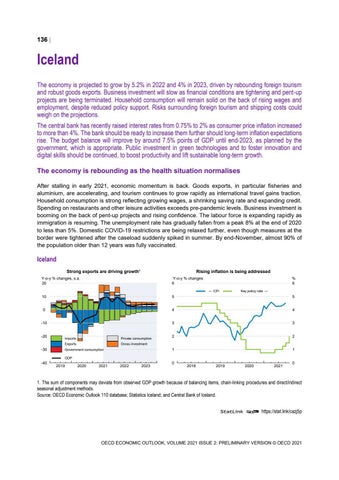
Iceland The economy is projected to grow by 5.2% in 2022 and 4% in 2023, driven by rebounding foreign tourism and robust goods exports. Business investment will slow as financial conditions are tightening and pent-up projects are being terminated. Household consumption will remain solid on the back of rising wages and employment, despite reduced policy support. Risks surrounding foreign tourism and shipping costs could weigh on the projections. The central bank has recently raised interest rates from 0.75% to 2% as consumer price inflation increased to more than 4%. The bank should be ready to increase them further should long-term inflation expectations rise. The budget balance will improve by around 7.5% points of GDP until end-2023, as planned by the government, which is appropriate. Public investment in green technologies and to foster innovation and digital skills should be continued, to boost productivity and lift sustainable long-term growth. The economy is rebounding as the health situation normalises After stalling in early 2021, economic momentum is back. Goods exports, in particular fisheries and aluminium, are accelerating, and tourism continues to grow rapidly as international travel gains traction. Household consumption is strong reflecting growing wages, a shrinking saving rate and expanding credit. Spending on restaurants and other leisure activities exceeds pre-pandemic levels. Business investment is booming on the back of pent-up projects and rising confidence. The labour force is expanding rapidly as immigration is resuming. The unemployment rate has gradually fallen from a peak 8% at the end of 2020 to less than 5%. Domestic COVID-19 restrictions are being relaxed further, even though measures at the border were tightened after the caseload suddenly spiked in summer. By end-November, almost 90% of the population older than 12 years was fully vaccinated.
Iceland Strong exports are driving growth¹
Rising inflation is being addressed
Y-o-y % changes, s.a. 20
Y-o-y % changes 6
% 6
10
5
5
0
4
4
-10
3
3
2
2
1
1
Key policy rate →
← CPI
-20 -30
Imports
Private consumption
Exports
Gross investment
Government consumption GDP
-40
2019
2020
2021
2022
2023
0
0
2018
2019
2020
2021
0
1. The sum of components may deviate from observed GDP growth because of balancing items, chain-linking procedures and direct/indirect seasonal adjustment methods. Source: OECD Economic Outlook 110 database; Statistics Iceland; and Central Bank of Iceland. StatLink 2 https://stat.link/cazj5p
OECD ECONOMIC OUTLOOK, VOLUME 2021 ISSUE 2: PRELIMINARY VERSION © OECD 2021
137
Iceland: Demand, output and prices 2018
Iceland
2019
Final domestic demand Stockbuilding¹ Total domestic demand Exports of goods and services Imports of goods and services Net exports¹ Memorandum items GDP deflator Consumer price index Core inflation index² Unemployment rate (% of labour force) General government financial balance (% of GDP) General government gross debt³ Current account balance (% of GDP)
2021
2022
2023
Percentage changes, volume (2015 prices)
Current prices ISK billion
GDP at market prices Private consumption Government consumption Gross fixed capital formation
2020
2 844.7 1 429.9 686.6 625.8
2.4 1.9 3.9 -2.1
-6.5 -3.0 4.5 -8.7
5.0 4.0 2.2 14.1
5.2 3.7 0.7 7.1
4.0 2.4 1.2 8.6
2 742.4 7.7
1.5 -0.6
-2.4 0.9
5.6 0.1
3.6 0.0
3.5 0.0
2 750.2 1 326.7 1 232.2 94.6
0.8 -4.7 -8.4 1.5
-1.6 -30.2 -22.5 -4.4
5.8 12.7 14.6 -0.8
3.6 16.8 12.4 1.5
3.5 5.3 4.0 0.6
_ _ _ _ _ _ _
4.6 3.0 2.9 3.9
3.2 2.8 2.9 6.4
4.3 4.3 4.3 5.9
3.1 3.5 3.5 4.0
2.5 2.5 2.5 3.6
-1.5 61.5
-8.6 70.4
-11.6 80.7
-7.9 86.6
-4.2 88.7
5.8
0.9
-0.5
1.2
1.7
1. Contributions to changes in real GDP, actual amount in the first column. 2. Consumer price index excluding food and energy. 3. Includes unfunded liabilities of government employee pension plans. Source: OECD Economic Outlook 110 database.
StatLink 2 https://stat.link/by38q1
Policy is tightening Monetary policy is tightening. Between May and November, the central bank has raised the interest rate in four steps from 0.75% to 2%. Headline consumer price inflation has reached more than 4%, fuelled by rising house prices and shipping costs. The króna has slightly depreciated since the summer of 2021. The policy interest rate is projected to rise further to 2.8% by the end of 2023 to anchor inflation expectations. Fiscal tightening has also started as the short-term work scheme − the flagship support programme during the crisis − has ended. The budget is expected to tighten further by around 5% points of GDP until 2023, as planned by the government, which is appropriate.
The recovery will continue GDP is projected to grow by 5.2% in 2022 and 4% in 2023, driven by strong foreign tourism upon further relaxation of COVID-19 restrictions and sustained demand for aluminium and seafood. Business investment will slow following the 2021 boom as financial conditions are tightening and pent-up projects are worked off. Household consumption growth will remain solid thanks to continuously growing wages and dissaving. Inflation will gradually decline as house prices slow and shipping costs normalise. Public debt will rise to around 89% of GDP despite fiscal tightening. The projections are subject to considerable uncertainty and risks. Foreign tourism could stall if economic and health conditions worsen again. Further supply chain disruptions and persistently high shipping costs would affect exports and imports disproportionally. A stronger than usual volcanic eruption could sever air transport links.
OECD ECONOMIC OUTLOOK, VOLUME 2021 ISSUE 2: PRELIMINARY VERSION © OECD 2021
138
Strengthening digitalisation could underpin long-term growth Digital innovation could help accelerate the reallocation of labour and underpin the post-pandemic recovery. A more competition-friendly regulatory framework would sharpen firms’ incentives to adopt advanced technologies. The public sector should become more digitised. More effective public support for business R&D and a higher take-up rate of generous tax incentives would spur innovation by small firms. Business and universities need to collaborate more to maximise knowledge flows. Strengthening digital skills could reduce labour market mismatch and facilitate the transition to more productive jobs. Investment in green and digital technologies and higher carbon taxation could help achieve the country’s climate targets.
OECD ECONOMIC OUTLOOK, VOLUME 2021 ISSUE 2: PRELIMINARY VERSION © OECD 2021