66
Hungary The economy is projected to grow by about 5% per annum in 2021 and 2022. Economic activity is expected to rebound from mid-2021 onwards, as a swift vaccination rollout supports the recovery of private consumption. External demand will strengthen with the recovery in major European trading partners. The labour market will continue to improve, while high wage growth and a recent currency depreciation will further add to inflationary pressures. Fiscal policy will remain supportive as long as COVID-19-related restrictions are in place. The central bank has limited room for further easing given the elevated inflation rate. As the recovery gathers pace, the phasing out of temporary measures to preserve jobs and businesses is needed to enable an effective reallocation of resources. In the medium term, changing the tax mix is key: labour taxes should continue to be lowered to raise labour force participation and environmental taxes increased to promote more environmentally sustainable growth. The vaccine rollout is progressing swiftly In early 2021, the country experienced a severe third wave of the pandemic, with high infection and mortality rates. The government extended measures taken during the second wave, including restrictions on hospitality facilities. Since then, one of the fastest vaccine rollouts in Europe has helped to improve the health situation, allowing the authorities to start gradually lifting restrictions in April 2021.
Hungary Industrial production and exports have recovered
Business confidence continues to strengthen
Index 2019Q4 = 100¹ 110
Balance, s.a. 75
100
50
90
25
80
0
70
-25 Manufacturing
60
Retail trade
Consumer confidence index
Exports of goods and services
Business confidence index - Services
-50
Purchasing Managers' index - Manufacturing²
50
2018
2019
2020
0
0
2018
2019
2020
-75
1. Manufacturing refers to the production index s.a., retail trade refers to sales in real terms s.a., and exports of goods and services are expressed in real terms. 2. The headline PMI is a number from 0 to 100. A PMI above 50 represents an expansion when compared with the previous month. A PMI reading under 50 represents a contraction, and a reading at 50 indicates no change. Source: OECD Economic Outlook 109 database; OECD Main Economic Indicators database; GKI; and Refinitiv. StatLink 2 https://stat.link/uhj70m
OECD ECONOMIC OUTLOOK, VOLUME 2021 ISSUE 1: PRELIMINARY VERSION © OECD 2021
67
Hungary: Demand, output and prices 2017
Hungary GDP at market prices Private consumption Government consumption Gross fixed capital formation Final domestic demand Stockbuilding1 Total domestic demand Exports of goods and services Imports of goods and services Net exports1 Memorandum items GDP deflator Consumer price index Core inflation index2 Unemployment rate (% of labour force) Household saving ratio, net (% of disposable income) General government financial balance (% of GDP) General government gross debt (% of GDP) General government debt, Maastricht definition (% of GDP) Current account balance (% of GDP)
2018
2019
2020
2021
2022
Percentage changes, volume (2015 prices)
Current prices HUF billion
39 233.4 19 696.0 7 912.9 8 698.6 36 307.5 248.3 36 555.8 33 744.7 31 067.0 2 677.7
5.4 5.1 1.7 16.4 7.1 0.1 7.1 5.0 7.0 -1.2
4.6 5.1 4.0 12.8 6.9 -0.2 6.6 5.8 8.2 -1.7
-5.1 -2.3 -1.0 -7.3 -3.5 0.4 -2.9 -6.8 -4.4 -2.1
4.6 -0.1 1.6 8.3 2.6 0.0 2.8 9.9 7.5 2.1
5.0 5.7 2.5 5.7 5.0 0.0 4.9 5.7 5.7 0.2
_ _ _ _ _ _ _ _ _
4.8 2.9 2.1 3.7 8.1 -2.1 86.6 69.1 0.3
4.8 3.3 3.2 3.4 6.3 -2.1 83.5 65.5 -0.5
5.9 3.3 3.0 4.2 8.7 -8.1 97.6 80.4 0.1
5.6 3.9 3.4 4.0 8.8 -7.5 99.4 81.9 0.8
3.8 3.9 3.9 3.4 6.6 -5.9 99.4 81.9 0.8
1. Contributions to changes in real GDP, actual amount in the first column. 2. Consumer price index excluding food and energy. Source: OECD Economic Outlook 109 database.
StatLink 2 https://stat.link/5twy4e
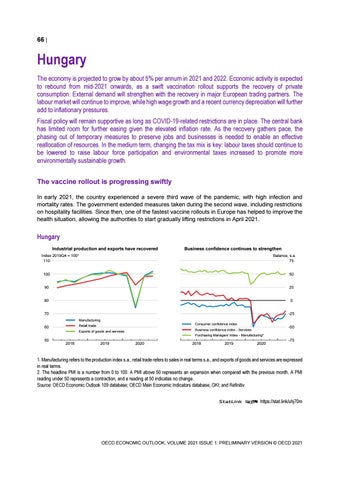
Industry continues to recover while service activity remains subdued Industrial production and exports rebounded strongly in late 2020, and are now exceeding their pre-pandemic levels. Business confidence has continued to strengthen. Service sectors are held back by containment measures. The labour market improved, as reflected in a fall in the unemployment rate by 0.4 percentage point in early 2021, while the employment rate rose by 0.7 percentage point. Gross earnings of full-time employees in the private sector continued to register strong growth, at around 8.9% in early 2021, as the tripartite wage agreement raised minimum wages by 8% in 2020 and 4% in 2021. Partly reflecting the continued weakening of the currency, headline inflation has been above the central bank’s target of 3% since February 2021.
Policy continues to provide relief A comprehensive fiscal stimulus package, including wage support and home-building subsidies, is supporting economic activity. In 2021-27, additional investment of 3.4% of GDP will be financed by EU funds. The central bank’s accommodative monetary policy is further supporting aggregate demand and liquidity. Furthermore, to help bridge the temporary payment difficulties of borrowers, the government extended the loan repayment moratorium until mid-2021, and the central bank raised the amount of its SME financing programme “Funding for Growth Scheme Go!” to 6% of GDP. A major factor in avoiding a stronger rise in unemployment was the extension of the short-time work scheme in heavily-affected sectors for the duration of the pandemic. These measures amount to about 5% of GDP in discretionary one-offs and will contribute to an expected budget deficit of 7.5% of GDP in 2021. OECD ECONOMIC OUTLOOK, VOLUME 2021 ISSUE 1: PRELIMINARY VERSION © OECD 2021
68
The recovery is set to strengthen Economic activity is projected to recover strongly in the second half of 2021, reflecting the lifting of restrictions as vaccine programmes are rolled out. Private consumption will be driven by the release of pent-up demand and the normalisation of saving after the increase in 2020. External demand will strengthen with the recovery in major European trading partners. Investment is expected to rebound on the back of stronger inflows of foreign direct investment and EU Recovery and Resilience Facility funds. The ongoing labour market recovery will allow unemployment to reach pre-pandemic levels in 2022. Nonetheless, wage growth is projected to remain high, and inflation will stay elevated. Downside risks include prolonged supply-chain problems, which could disrupt the production of export goods. Faster-thanexpected wage growth and a further currency depreciation would increase cost pressures on firms and fuel inflation expectations, which could require an abrupt tightening of monetary policy. On the upside, a faster recovery of major European trading partners would benefit growth, given the economy’s dependence on exports.
Maintaining policy support should depend on the strength of the recovery Fiscal policy should remain supportive until the recovery is firmly underway. Once restrictions are lifted, the recovery will have ample support from the release of pent-up demand, suggesting that additional fiscal stimulus may not be needed to support demand. The withdrawal of state-backed emergency loans would help the efficient reallocation of resources to expanding sectors. Nonetheless, the government should maintain supportive fiscal policies in 2022 if supply-chain disruptions continue to restrain production or the recovery remains weak for other reasons. High labour taxes could be reduced further, financed by broadening the base for consumption taxes, further reducing tax evasion and raising environmental taxes. A strategy to decarbonise the economy is needed to secure environmental objectives. To boost growth potential and maintain fiscal sustainability, structural reforms to raise labour force participation and improve productivity should be accelerated.
OECD ECONOMIC OUTLOOK, VOLUME 2021 ISSUE 1: PRELIMINARY VERSION © OECD 2021