139
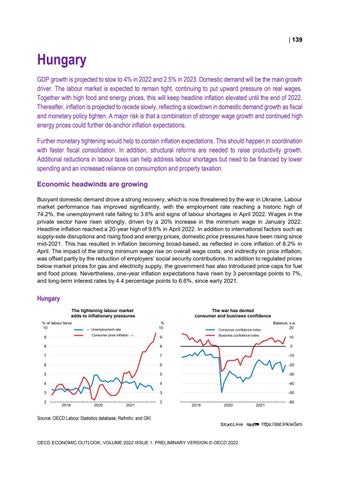
Hungary GDP growth is projected to slow to 4% in 2022 and 2.5% in 2023. Domestic demand will be the main growth driver. The labour market is expected to remain tight, continuing to put upward pressure on real wages. Together with high food and energy prices, this will keep headline inflation elevated until the end of 2022. Thereafter, inflation is projected to recede slowly, reflecting a slowdown in domestic demand growth as fiscal and monetary policy tighten. A major risk is that a combination of stronger wage growth and continued high energy prices could further de-anchor inflation expectations. Further monetary tightening would help to contain inflation expectations. This should happen in coordination with faster fiscal consolidation. In addition, structural reforms are needed to raise productivity growth. Additional reductions in labour taxes can help address labour shortages but need to be financed by lower spending and an increased reliance on consumption and property taxation. Economic headwinds are growing Buoyant domestic demand drove a strong recovery, which is now threatened by the war in Ukraine. Labour market performance has improved significantly, with the employment rate reaching a historic high of 74.2%, the unemployment rate falling to 3.6% and signs of labour shortages in April 2022. Wages in the private sector have risen strongly, driven by a 20% increase in the minimum wage in January 2022. Headline inflation reached a 20-year high of 9.6% in April 2022. In addition to international factors such as supply-side disruptions and rising food and energy prices, domestic price pressures have been rising since mid-2021. This has resulted in inflation becoming broad-based, as reflected in core inflation of 8.2% in April. The impact of the strong minimum wage rise on overall wage costs, and indirectly on price inflation, was offset partly by the reduction of employers’ social security contributions. In addition to regulated prices below market prices for gas and electricity supply, the government has also introduced price caps for fuel and food prices. Nevertheless, one-year inflation expectations have risen by 3 percentage points to 7%, and long-term interest rates by 4.4 percentage points to 6.6%, since early 2021.
Hungary The tightening labour market adds to inflationary pressures % of labour force 10
% 10
← Unemployment rate Consumer price inflation →
9
The war has dented consumer and business confidence Consumer confidence index Business confidence index
9
Balance, s.a. 20 10
8
8
0
7
7
-10
6
6
-20
5
5
-30
4
4
-40
3
3
-50
2
2019
2020
2021
2
0
2019
2020
2021
-60
Source: OECD Labour Statistics database; Refinitiv; and GKI. StatLink 2 https://stat.link/wi3aro
OECD ECONOMIC OUTLOOK, VOLUME 2022 ISSUE 1: PRELIMINARY VERSION © OECD 2022
140
Hungary: Demand, output and prices 2018
2019
GDP at market prices Private consumption Government consumption Gross fixed capital formation
2021
2022
2023
Percentage changes, volume (2015 prices)
Current prices HUF billion
Hungary
2020
43 392.4 21 373.1 8 543.1 10 729.9
4.6 5.0 4.3 12.8
-4.7 -1.2 -0.9 -7.0
7.1 4.6 3.7 5.9
4.0 3.9 2.1 4.1
2.5 1.5 1.0 2.8
Final domestic demand Stockbuilding¹
40 646.2 902.3
6.9 0.1
-2.7 0.0
4.7 1.1
3.6 0.0
1.8 0.0
Total domestic demand Exports of goods and services Imports of goods and services Net exports¹
41 548.4 36 338.7 34 494.7 1 844.0
6.8 5.4 8.2 -2.0
-2.7 -6.1 -4.0 -1.8
5.8 10.3 8.7 1.4
3.4 3.0 2.3 0.5
1.7 3.1 2.1 0.8
_ _ _ _ _ _ _ _ _
4.8 3.3 3.4 3.3
6.6 3.3 3.3 4.1
6.9 5.1 4.5 4.0
7.9 10.3 9.3 3.8
7.0 7.0 6.1 3.7
9.2 -2.1 84.1 65.5 -0.7
10.5 -7.8 97.5 79.6 -1.6
9.6 -6.8 88.7 76.8 -3.1
7.1 -5.5 88.1 76.3 -5.0
8.3 -5.4 86.7 75.1 -3.8
Memorandum items GDP deflator Consumer price index Core inflation index² Unemployment rate (% of labour force) Household saving ratio, net (% of disposable income) General government financial balance (% of GDP) General government gross debt (% of GDP) General government debt, Maastricht definition³ (% of GDP) Current account balance (% of GDP)
1. Contributions to changes in real GDP, actual amount in the first column. 2. Consumer price index excluding food and energy. 3. The Maastricht definition of general government debt includes only loans, debt securities, and currency and deposits, with debt at face value rather than market value. Source: OECD Economic Outlook 111 database.
StatLink 2 https://stat.link/yegpk0
The war in Ukraine is a major headwind to economic growth. Direct trade with Russia and Ukraine is low (accounting for only 3% of all exports) but the war has caused heavy disruptions to global supply-chains, prolonging supply-side bottlenecks in the automotive sector. The forint has depreciated by 10% against the euro since the start of the war. Moreover, Hungary is highly reliant on energy imports from Russia, including about 95% of its gas and 45% of its oil and petroleum. Consumer and business confidence fell at the onset of the war, but recovered partly in April. The conflict has also led to the arrival of over half a million refugees from Ukraine (about 5% of the population) by the end of April. In addition to propping up the hospitality sector, this will have an impact on the labour market as about one tenth of the new arrivals (or 50 000 people) are expected to take up jobs in sectors with labour shortages, notably agriculture and health.
Fiscal policy has been supportive Fiscal policy remained expansionary in early 2022 with another four percentage point reduction in employers’ social security contributions. In addition, families with dependent children received a personal income tax refund and pensioners a 13th-month pension in early 2022. The announced fiscal measures will contribute to an expected budget deficit of 5.5% of GDP in 2022, implying a fiscal expansion of 0.5% of GDP. The fiscal stance is adding to the pressures on the central bank to contain inflation expectations. Since June 2021, the central bank has raised its base policy rate by 5.3 percentage points to 5.9%. It announced it would continue with monthly base rate increases as long as the headline inflation forecast
OECD ECONOMIC OUTLOOK, VOLUME 2022 ISSUE 1: PRELIMINARY VERSION © OECD 2022
141 remains above the target of 3% with a tolerance band of +/- 1%. The projections assume further increases in the interest rate over the projection horizon as announced by the central bank.
Domestic demand will be the main growth driver The strong post-pandemic recovery is set to slow due to the impact of the war in Ukraine. In the near term, the conflict will add to already high inflation through higher fuel and food prices, putting pressure on private consumption and investment. Nonetheless, private consumption will benefit from further increases in real incomes due to the tight labour market. Private and public investment will grow, helped by generous home building subsidies, domestic and foreign direct investment and stronger inflows of EU funds. Higher food and energy prices together with strong wage growth are expected to feed into headline inflation in 2022 and 2023. Nonetheless, inflation is projected to fall in 2023 as tighter fiscal and monetary policies slow domestic demand growth. Downside risks include even stronger wage growth, which could raise demand pressures and, along with high food and energy prices, fuel rising inflation expectations. Another important risk is an embargo on Russian gas imports. On the upside, a shorter-than-expected war in Ukraine could ease price pressures and accelerate growth.
Policy needs to contain inflation expectations Further monetary tightening is needed to contain inflation expectations. This should be implemented alongside faster fiscal consolidation. Price caps on energy prices could boost contingent liabilities of the state by around 1% of GDP in 2022. A better-targeted measure would be direct income support to households most exposed to high energy costs. Such support should be financed by cutting government spending elsewhere.
OECD ECONOMIC OUTLOOK, VOLUME 2022 ISSUE 1: PRELIMINARY VERSION © OECD 2022