172
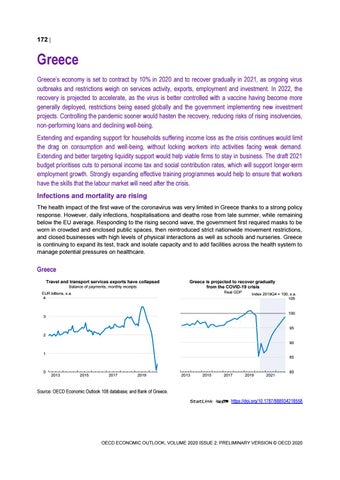
Greece Greece’s economy is set to contract by 10% in 2020 and to recover gradually in 2021, as ongoing virus outbreaks and restrictions weigh on services activity, exports, employment and investment. In 2022, the recovery is projected to accelerate, as the virus is better controlled with a vaccine having become more generally deployed, restrictions being eased globally and the government implementing new investment projects. Controlling the pandemic sooner would hasten the recovery, reducing risks of rising insolvencies, non-performing loans and declining well-being. Extending and expanding support for households suffering income loss as the crisis continues would limit the drag on consumption and well-being, without locking workers into activities facing weak demand. Extending and better targeting liquidity support would help viable firms to stay in business. The draft 2021 budget prioritises cuts to personal income tax and social contribution rates, which will support longer -term employment growth. Strongly expanding effective training programmes would help to ensure that workers have the skills that the labour market will need after the crisis. Infections and mortality are rising The health impact of the first wave of the coronavirus was very limited in Greece thanks to a strong policy response. However, daily infections, hospitalisations and deaths rose from late summer, while remaining below the EU average. Responding to the rising second wave, the government first required masks to be worn in crowded and enclosed public spaces, then reintroduced strict nationwide movement restrictions, and closed businesses with high levels of physical interactions as well as schools and nurseries. Greece is continuing to expand its test, track and isolate capacity and to add facilities across the health system to manage potential pressures on healthcare.
Greece Travel and transport services exports have collapsed
Greece is projected to recover gradually from the COVID-19 crisis
Balance of payments, monthly receipts
Real GDP
EUR billions, s.a. 4
Index 2019Q4 = 100, s.a. 105
100
3
95 2 90 1
0
85
2013
2015
2017
2019
0
0
2013
2015
2017
2019
2021
80
Source: OECD Economic Outlook 108 database; and Bank of Greece. StatLink 2 https://doi.org/10.1787/888934218558
OECD ECONOMIC OUTLOOK, VOLUME 2020 ISSUE 2: PRELIMINARY VERSION © OECD 2020
173
Greece: Demand, output and prices 2017
Greece GDP at market prices Private consumption Government consumption Gross fixed capital formation Final domestic demand Stockbuilding1,2 Total domestic demand Exports of goods and services Imports of goods and services Net exports1 Memorandum items GDP deflator Harmonised index of consumer prices Harmonised index of core inflation3 Unemployment rate (% of labour force) Household saving ratio, net (% of disposable income) General government financial balance4 (% of GDP) General government gross debt (% of GDP) General government debt, Maastricht definition (% of GDP) Current account balance5 (% of GDP)
2018
Current prices EUR billion
177.2 121.7 36.2 20.8 178.6 1.2 179.8 62.0 64.6 - 2.7 _ _ _ _ _ _ _ _ _
2019
2020
2021
2022
Percentage changes, volume (2010 prices)
1.6 2.3 -4.2 -6.6 0.1 1.4 1.4 9.1 8.0 0.3
1.9 1.9 1.2 -4.6 1.0 0.1 1.1 4.8 3.0 0.7
-10.1 -7.0 1.3 -11.5 -5.7 0.0 -5.6 -23.8 -12.1 -4.5
0.9 1.3 0.5 4.6 1.5 0.0 1.4 -5.2 -3.1 -0.5
6.6 3.6 -0.7 13.5 3.7 0.0 3.6 19.1 8.2 2.8
-0.1 0.2 -0.4 1.2 0.8 0.8 0.5 -1.2 -0.2 0.8 0.3 0.8 -1.2 -0.6 0.8 19.3 17.3 16.9 17.8 17.2 -15.0 -11.9 -7.8 -10.7 -15.0 1.0 1.5 -9.4 -7.0 -2.6 201.2 205.1 238.3 232.2 219.2 186.2 180.5 213.7 207.6 194.6 -2.9 -1.5 -5.2 -5.7 -2.7
1. 2. 3. 4.
Contributions to changes in real GDP, actual amount in the first column. Including statistical discrepancy. Harmonised index of consumer prices excluding food, energy, alcohol and tobacco. National Accounts basis. Data also include Eurosystem profits on Greek government bonds remitted back to Greece, and the estimated government support to financial institutions and privatisation proceeds. 5. On settlement basis. Source: OECD Economic Outlook 108 database.
StatLink 2 https://doi.org/10.1787/888934218577
Very weak tourism activity is undermining the recovery Greece’s domestic consumer and services activity rebounded after restrictions were lifted in May and June. However, tourist arrivals were exceptionally weak through the peak summer season, due to uncertainty over the health situation and containment policies, and as governments in major markets required arrivals from Greece to quarantine. This has weighed heavily on demand, turnover, employment and exports. In the third quarter of 2020, accommodation and food service firms’ turnover was 50% lower than a year earlier. This has reduced domestic demand, contributing to notable drops in turnover in industry and wholesale and retail trade. Weak demand has also weighed heavily on job creation, although support measures have limited job losses. Job seekers have been dropping out of the labour market, mitigating the rise in the unemployment rate.
OECD ECONOMIC OUTLOOK, VOLUME 2020 ISSUE 2: PRELIMINARY VERSION © OECD 2020
174
Policy is shifting from income and liquidity support to tax cuts and investment spending The government has budgeted spending of EUR 21.5 billion (11% of 2019 GDP) in 2020 to support workers and firms in the most affected sectors, the self-employed, the unemployed and borrowers, and to buttress firms’ liquidity through deferred tax and contribution payments and subsidised lending. A one-off retroactive pension payment of EUR 1.4 billion in late 2020 also bolsters household incomes. In 2021, the government is budgeting EUR 2.7 billion to support incomes of furloughed workers and to cut the income tax wedge, and to subsidise social contributions for new hires. It will help first homebuyers and cut selected VAT rates. The government plans to supplement the public investment budget of EUR 6.75 billion with EUR 2.6 billion of Next Generation EU grants in 2021, which would more than double its 2019 investment spending. Its investment priorities are labour and social inclusion policies in education and health, green and digital projects, infrastructure and improvements to the business environment.
The continuing health crisis will curtail the recovery The renewed strict containment measures and shutdowns are set to weaken consumer demand and services exports in the final quarter of 2020 and the first quarter of 2021. The recovery in activity later in 2021 is projected to be gradual, as the ongoing health crisis drags on consumer confidence and amplifies uncertainty in Greece and its major export markets. Weak incomes and activity are projected to damp government revenues. The health situation is assumed to improve from early 2022, as a vaccination against the virus will have become widely deployed, hastening the projected recovery in services, lifting incomes and employment, and allowing exports and government revenues to rise towards pre-crisis levels. The budget will continue to support activity and public debt is projected to decline from a peak of 214% of GDP in 2020. The ambitious public investment plans and access to low-cost financing for private investment will support domestic demand from late 2021. Investment may be stronger than projected if execution rates improve substantially and if take-up of loans from the EU Recovery and Resilience Facility is strong. Greece’s services exports particularly expose its economy to a protracted health crisis, which would exacerbate business failures and non-performing loans, and reverse part of recent improvements in banks’ health and ability to finance new private investment.
More targeted income support, upgrading skills and improving the investment climate would strengthen the recovery The COVID-19 crisis underscores the need for Greece to address long-standing challenges. Weak employment adds urgency to strengthening targeted income support. Delays in tax and contribution payments to reduce liquidity pressures should come with stronger efforts to improve tax and payment compliance. The severe liquidity constraints that many firms are facing are likely to increase non-performing loans again, despite the government’s extension of credit and loan guarantees and progress in implementing the ‘Hercules’ disposal programme. Further actions should be prepared now to strengthen banks’ capital and ability to finance investment for the recovery. Measures to help activity move towards tradable and higher-innovation sectors will strengthen productivity growth. Recent progress in digitalising public services demonstrates how this can help reduce the burden of red tape. Better active labour market programmes, education and professional training would ensure that job seekers have the skills for opportunities emerging from the COVID-19 crisis.
OECD ECONOMIC OUTLOOK, VOLUME 2020 ISSUE 2: PRELIMINARY VERSION © OECD 2020